Meta said this week that its Muse Spark model helped mathematicians crack six open research problems, then followed the announcement with an open-source hardware push called Muse Gadgets. The one-two punch, disclosed between October 2 and October 4, 2026, puts Meta’s AI assistant in an unusual spot: a consumer-facing chatbot brand now carries a research credential and a hardware ecosystem play on the same week.
The math claim and the hardware release are separate announcements, but they land together, and that timing matters. Meta is trying to prove Muse Spark is more than a social app feature while also giving hobbyists and hardware makers a reason to build around it. Meta’s AI research division, which publishes its work through its own research hub, has been pushing to position itself as more than a consumer-app lab. Below is what’s confirmed, what’s still vague, and why both pieces of news matter for the broader AI model race.
What Meta Actually Announced
Meta said Muse Spark helped mathematicians work through six major research problems. The subject matter spans probability, differential equations, group theory, optimization, arithmetic physics, and non-associative algebra, according to the announcement. Five of the six papers reportedly tackled questions that were previously open in their respective fields, meaning no prior published proof or solution existed before this round of work.
Two model versions did the work: Muse Spark 1.1 and Muse Spark 1.2. The research was written up across six separate papers. Meta has been iterating on Spark versions quickly this year, and this is the most research-heavy use case the model has been tied to so far, a step beyond the agentic coding improvements Meta shipped in Muse Spark 1.3.
It’s worth being precise about the wording here, because the distinction matters to anyone who actually works in math research. Meta’s own phrasing says Muse Spark “helped” mathematicians solve the problems, not that the model solved them independently. That’s a meaningfully different claim than a fully autonomous proof-generation system, and it tracks with how most AI-assisted math research has worked over the past two years: human mathematicians directing the model, checking its output, and formalizing the results themselves.
Muse Gadgets: Meta Opens Up the Hardware Layer
The second piece of news is a bigger strategic signal. Meta Chief AI Officer Alexandr Wang announced Muse Gadgets, an open-source ESP32 firmware and Linux SDK built so outside developers can make hardware that talks to Muse. Wang’s own words framed it plainly: “Today we are announcing Muse Gadgets!” He went on to describe the release as “an open-source ESP32 firmware and Linux SDK that lets anyone build Muse-compatible hardware.”
ESP32 is a cheap, widely used microcontroller family from Espressif that powers everything from smart-home sensors to DIY robotics kits. Choosing it as the base layer is a signal in itself: Meta isn’t asking hardware partners to build on some proprietary chip. It’s going after the maker and tinkerer crowd that already has ESP32 boards on their desks, the same crowd that built an entire hobbyist ecosystem around Espressif’s chip line over the last decade.
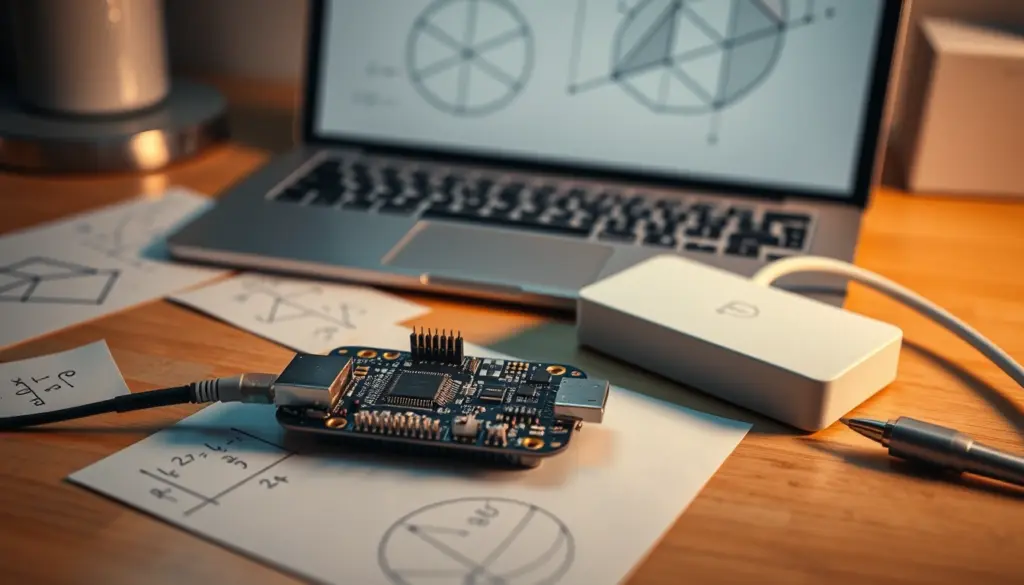
Alongside the firmware and SDK, Meta introduced Muse Home Link, a USB-C device meant to connect Muse to a home network. No pricing has been disclosed for Muse Home Link or any other piece of Muse hardware, and Meta has not published additional technical specs, a release window, or a list of supported third-party devices beyond what’s in the firmware and SDK release itself. Anyone publishing a price or spec sheet right now is guessing. Meta’s corporate newsroom, which typically carries official product detail once a device is closer to launch, has not yet posted a dedicated page for Muse Home Link as of this writing.
Why a Chatbot Company Is Suddenly Doing Math Research
Meta Muse launched as a consumer AI companion, competing for attention against ChatGPT and other assistant apps. It picked up 2.8 million downloads and later added features like video avatars, email access, and Mac control. None of that positions Muse as a research tool. The math announcement changes the framing.
Mathematicians have leaned on large language models for proof assistance, conjecture generation, and computation checking for a couple of years now, but most of the attention has gone to models built or marketed specifically for technical reasoning. Meta tying a consumer-brand model to six research papers, five of them on previously open problems, is a credibility move as much as a research one. It tells enterprise and academic buyers that the same model powering a social AI companion can also sit at a whiteboard with a working mathematician.
That’s also consistent with how Mark Zuckerberg has talked about Meta’s AI roadmap generally. He’s pushed back publicly on the idea that AI development should slow down, breaking from other industry leaders who’ve called for more caution, and rejected calls to pump the brakes on frontier model work. A research credential for Muse Spark fits neatly into that stance: it’s evidence Meta can point to when arguing that fast iteration produces real scientific value, not just chatbot engagement numbers.
The Open-Source Hardware Bet, in Context
Muse Gadgets is Meta trying to do for its AI assistant what Amazon did for Alexa and what Google did for the Assistant SDK years ago: get an ecosystem of cheap, third-party hardware built on top of the platform before a competitor locks in that layer first. The difference is timing. Alexa and Assistant opened their SDKs to hardware makers when voice assistants were still a novelty. Muse is entering an AI assistant market that’s already crowded, with OpenAI’s agent products and Google’s Gemini integrations both chasing the same home and wearable device space.
Using ESP32 as the hardware base is a low-cost, low-friction choice. Development boards run a few dollars each, the chip has built-in Wi-Fi and Bluetooth, and there’s a massive existing library of community firmware and tutorials. A developer who already has an ESP32 project running doesn’t need to buy new silicon to experiment with Muse connectivity, just flash new firmware. That lowers the barrier to entry dramatically compared to a closed hardware certification program.
What Muse Home Link Tells Us About Meta’s Direction
Muse Home Link being a USB-C device that bridges Muse to a home network suggests Meta is thinking about always-on, ambient access points for the assistant, something that sits on a shelf or plugs into a router rather than living only inside a phone app. That lines up with the broader direction Meta has taken with Muse features like Mac control and email access: the company wants Muse present across more surfaces, not just the main app.
Still, without pricing or a shipping date, Muse Home Link reads more like a developer preview than a retail product announcement. Companies that want to build compatible gadgets now have a target to build against, even if ordinary consumers have nothing to buy yet.
Competitive Landscape: How Rivals Stack Up
Meta isn’t the only lab trying to pair a consumer AI product with a research or developer story. OpenAI has pushed GPT-6 Sol and Luna at aggressive pricing to undercut rivals, and cut prices by roughly half at launch to grab developer share. Google’s Gemini line has leaned on tight integration with its own hardware and cloud stack rather than opening a hobbyist SDK. None of the major labs have published an open hardware firmware layer quite like Muse Gadgets.
| Company | Consumer AI Product | Research Credibility Angle | Open Hardware Program |
|---|---|---|---|
| Meta | Muse (Spark models) | Six math papers, five on open problems | Muse Gadgets (ESP32 firmware + Linux SDK) |
| OpenAI | ChatGPT / GPT-6 Sol, Luna | Internal model benchmarks, enterprise agent deployments | No open firmware layer; API-first |
| Gemini assistant line | Internal research publications, DeepMind papers | Closed hardware, tied to Pixel/Nest devices | |
| Anthropic | Claude (consumer + enterprise) | Interpretability and safety research publications | No consumer hardware program |
The table above is a rough sketch, not an apples-to-apples spec sheet, because each company is pursuing a different mix of consumer reach, research output, and hardware strategy. But it shows Meta carving out a distinct lane: pairing a mass-market chatbot brand with both a research claim and a maker-friendly hardware kit in the same week.
A Brief History of AI-Assisted Math Research
AI-assisted proof work isn’t new. Automated theorem provers have existed in some form for decades, and formal proof assistants like Lean and Coq have been used by mathematicians long before large language models entered the picture. What’s changed in the last two to three years is the use of general-purpose LLMs as research collaborators: tools that can suggest proof strategies, check algebraic manipulations, or flag likely dead ends faster than a human working alone.
Several labs have published papers describing LLMs contributing to mathematical research over the past two years, usually framed carefully as the model assisting a human mathematician rather than operating independently. Meta’s Muse Spark announcement fits that same pattern. The six papers reportedly span probability, differential equations, group theory, optimization, arithmetic physics, and non-associative algebra, a notably broad spread for a single model generation, which suggests the assistance was more about accelerating specific calculation or verification steps than producing full novel proofs unassisted.
Preprint servers like arXiv remain the place where this kind of AI-assisted math work typically gets posted and scrutinized by peers, and that scrutiny matters more than the initial announcement. Until the six papers are reviewed and, where applicable, formally verified, the “open problem solved” framing should be read as preliminary rather than settled.
Market and Developer Impact
For Meta, the immediate payoff isn’t revenue, it’s narrative. A research credential gives sales teams and enterprise partners something concrete to cite beyond download counts and app store rankings. It also gives Meta ammunition in conversations with academic and scientific computing customers who’ve been skeptical that a social-app-first AI assistant has the technical depth for serious work.
For the ESP32 and maker hardware community, Muse Gadgets is a potential new reason to build. Open-source projects hosted on platforms like GitHub have historically been where this kind of SDK adoption plays out first, with hobbyist repos and example projects showing up within days of a firmware release. If Meta’s SDK is genuinely easy to work with, expect early community projects, smart displays, sensor hubs, simple robotics, built on top of it within weeks, long before any official Meta-branded Muse hardware reaches a shelf.
There’s a risk on both fronts, too. The math claim could draw pushback from mathematicians who want more detail on exactly how much of the problem-solving process was human-directed versus model-generated, a tension that’s dogged nearly every “AI solves math problem” headline since the practice started making news. And the open hardware program could struggle to gain traction if Meta doesn’t follow through quickly with clear documentation, pricing, and a real product like Muse Home Link actually shipping.
What Happens Next: Predictions
- The six math papers will draw scrutiny from the broader mathematics community once posted for peer review, and expect debate over how much credit belongs to the model versus the human researchers.
- Meta will likely announce pricing and a ship date for Muse Home Link within the next one to two quarters, following the pattern it’s used for other Muse hardware and feature rollouts this year.
- Expect early community-built ESP32 projects using the Muse Gadgets firmware to surface on GitHub within weeks, mostly simple integrations like smart speakers, desk displays, and sensor hubs.
- Rival labs, particularly OpenAI and Google, will face pressure to publish their own research-assistance case studies to counter Meta’s math announcement, continuing the pattern of competitive one-upmanship already seen in the GPT-6 Sol and Luna pricing war.
- If the open hardware approach gains real traction, other consumer AI assistants may follow with their own open firmware layers rather than closed certification programs, mirroring how smart-home standards eventually converged around shared protocols.
Confirmed vs. Unconfirmed: A Quick Reference
| Claim | Status | Detail |
|---|---|---|
| Muse Spark helped solve six research problems | Confirmed | Meta’s own announcement; model “helped” mathematicians, did not solve independently |
| Five of six papers address previously open questions | Confirmed | Per the announcement and subsequent reporting |
| Muse Spark 1.1 and 1.2 were the versions used | Confirmed | Named explicitly in reporting on the research |
| Muse Gadgets is open-source ESP32 firmware + Linux SDK | Confirmed | Announced by Alexandr Wang |
| Muse Home Link is a USB-C device | Confirmed | Connects Muse to a home network |
| Muse Home Link price | Unconfirmed | No pricing disclosed as of October 4, 2026 |
| Additional specs, release date, supported hardware | Unconfirmed | Not published beyond the firmware/SDK/USB-C description |
How This Fits Meta’s Bigger Muse Strategy
Muse has gone through a fast string of upgrades this year, from the original launch, to custom voice features, to the Mac control and email integration rolled out more recently, to a mascot-driven marketing push that leaned hard into approachable branding. The math research announcement and Muse Gadgets both continue that pattern of rapid, almost weekly expansion, but they pull in a different direction than the mascot campaign: one is playful and consumer-facing, the other is technical and infrastructure-facing.
Running both plays at once, cute mascot on one side, open hardware SDK and math research credibility on the other, is a bet that Muse can be both an approachable companion app and a serious technical platform without the two personas undercutting each other. Whether that holds up depends largely on execution over the next few months: does Muse Home Link actually ship, do the math papers hold up under review, and does the ESP32 developer community actually build anything with the SDK.
Frequently Asked Questions
What is Muse Spark?
Muse Spark is the model family behind Meta’s Muse AI assistant. Meta has released multiple versions this year, including 1.1 and 1.2, which were the versions tied to the recent math research announcement, and 1.3, which focused on agentic coding improvements.
Did Muse Spark solve the math problems on its own?
No. Meta’s own language says the model helped mathematicians solve the problems. That implies human researchers directed the process and verified the results, rather than the model producing fully independent proofs.
What is Muse Gadgets?
Muse Gadgets is an open-source ESP32 firmware and Linux SDK that Meta released so outside developers can build hardware compatible with Muse. It was announced by Meta Chief AI Officer Alexandr Wang.
What is Muse Home Link, and how much does it cost?
Muse Home Link is a USB-C device meant to connect Muse to a home network. Meta has not disclosed a price or release date for it as of this writing.
Why did Meta pick ESP32 for Muse Gadgets?
ESP32 is a low-cost, widely available microcontroller with built-in Wi-Fi and Bluetooth, made by Espressif. It already has a large hobbyist and maker community, which makes it an easy base for third-party developers to build Muse-compatible hardware without new silicon.
How does this compare to OpenAI and Google’s approach?
Neither OpenAI nor Google has released an open hardware firmware layer comparable to Muse Gadgets. OpenAI has focused on aggressive API pricing with products like GPT-6 Sol and Luna, while Google has kept its Gemini assistant tied closely to its own hardware, like Pixel and Nest devices.
Will the six math papers be peer reviewed?
That’s standard practice for mathematical research claims, and it’s reasonable to expect the papers to go through typical scrutiny from the mathematics community, including scrutiny of how much the model contributed versus the human researchers involved.
Is this related to Meta’s broader AI strategy under Zuckerberg?
It fits the pattern. Mark Zuckerberg has publicly pushed back against calls to slow down AI development, and a research credential for Muse Spark gives Meta a concrete example to point to when defending that stance.
Related
- A Clippy Marketing Moment? Meta’s Muse Gets a Mascot [2026]
- Meta Muse Spark 1.3 Cuts Tool Calls 20%, Tokens 25% [2026]
- Meta Muse Downloads Hit 2.8M, Beat ChatGPT’s Pace [2026]
- Meta Muse Gets Video Avatars, Email, Mac Control [2026]
- Zuckerberg Rejects AI Slowdown, Breaks From 3 CEOs [2026]
- GPT-6 Sol, Luna Launch at 50% Off, Undercut Claude [2026]