
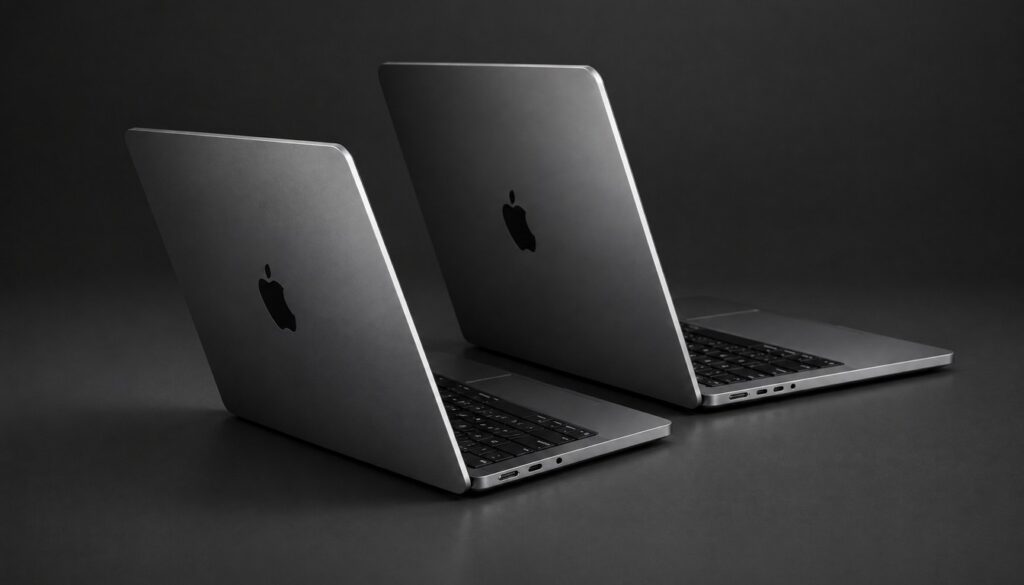
Apple is reportedly getting ready to break a rule it has held onto for more than 15 years: no touchscreens on a Mac. According to Bloomberg’s Mark Gurman, the company is preparing to unveil its first touch-enabled, OLED-screened MacBook Pro models, with an announcement that could land as soon as October 27 or 28, 2026, and store shelves following on November 6. The claim, first laid out on Gurman’s Power On podcast and tracked since in a string of follow-up reports, has set off a scramble among Apple watchers trying to pin down exactly what’s shipping and when.
No Apple keynote has confirmed any of this. There is no press invite, no teaser video, no official date on Apple’s newsroom. Everything circulating right now, including the OLED panel, the touch layer, the model sizes, and the launch window, traces back to reporter sourcing rather than an Apple statement. That distinction matters, and it’s one this article holds onto throughout. Still, the reporting chain is unusually consistent for an unannounced Apple product, and that consistency is why the story is spreading fast across tech outlets this week.
What the MacBook Pro OLED touchscreen leak actually claims
Strip away the speculation and the core claim is fairly narrow. Gurman has repeatedly said Apple is developing 14-inch and 16-inch MacBook Pro models built around OLED panels that also support touch input, which would make them the first touchscreen Macs in the line’s history. He first floated October or November as the launch window on the debut episode of his Power On podcast, then sharpened that estimate in a later episode to point at a specific pair of dates: an announcement around October 27 or 28, with retail availability targeted for November 6.
Sportskeeda Tech picked up and amplified the leaked timing on October 16, framing it as a launch date leak rather than a fresh rumor, which is part of why search interest around “macbook pro oled” has climbed through the back half of 2026. The Apple Post and MacRumors have each run their own write-ups tracking the same claims, cross-referencing Gurman’s statements across multiple podcast episodes and newsletter entries rather than treating any single mention as the final word.
What’s missing from all of this is just as telling as what’s present. No one has published a price. No one has confirmed a product name beyond “MacBook Pro,” despite chatter online about a possible “MacBook Ultra” branding. No full spec sheet exists. The leak is a launch window and a display technology, not a product page.
Timeline: how the OLED MacBook Pro story built up
The touchscreen MacBook Pro rumor didn’t appear overnight. It built in layers over several months, with each report adding or walking back a detail. Tracking the sequence helps explain why some outlets are now treating a specific date range as close to settled, even without Apple’s involvement.
| Date | Source | What was reported |
|---|---|---|
| June 11, 2026 | MacRumors, citing leaker Instant Digital | Leaker claims the touchscreen MacBook is “100% confirmed” |
| October 1, 2026 | Bloomberg’s Power On podcast (Mark Gurman) | First public framing of an October-or-November launch for 14-inch and 16-inch OLED touch MacBook Pro models |
| October 4, 2026 | MacRumors, citing Gurman | New models said to be “significantly lighter” than current MacBook Pro hardware |
| October 8, 2026 | MacRumors, citing Gurman on X | Gurman walks back earlier thinness claims, says the machines likely won’t be significantly thinner |
| October 14-15, 2026 | Bloomberg Power On podcast | Gurman narrows the announcement to on or around October 27 or 28, with a possible November 6 ship date |
| October 16, 2026 | Sportskeeda Tech | Publishes the leaked launch-date story, driving fresh search interest |
Notice how the claims shift over the course of six weeks. Weight comes up before it gets qualified. Thinness gets floated, then explicitly retracted by the same reporter. That back-and-forth is normal for pre-launch Apple coverage, where sourcing improves as a product gets closer to shipping, but it also means treating any single data point in isolation is a mistake. The pattern, not any one headline, is the story.
Who is Mark Gurman, and why his reporting carries weight
Gurman writes Bloomberg’s Power On newsletter and hosts the Power On podcast, and he has built a long track record of pre-announcing Apple hardware and software plans, often months ahead of an official reveal. That track record is the main reason a touchscreen MacBook Pro leak gets this much attention instead of being dismissed as internet noise. His sourcing inside Apple’s supply chain and engineering teams has previously surfaced accurate details on iPhone, iPad, and Mac hardware before Apple’s own announcements.
On the October 1 podcast episode, Gurman put his own framing on the launch window directly, saying: “Apple, I believe, will introduce its first touchscreen MacBook Pro this fall, as early as October.” He added a qualifier in the same discussion: “It could slip to November, but as early as October.” Both lines, reported by MacRumors, set the tone for everything that followed, including his later narrowing of the window to the October 27-28 and November 6 dates.
Gurman isn’t the only name attached to the story. Back in June, a leaker known as Instant Digital told followers the touchscreen panel was already locked in, stating “It’s 100% confirmed that the MacBook screen will be touch-enabled,” a claim MacRumors reported at the time. That claim predates Gurman’s podcast comments by months, and the fact that two separately sourced leaks converge on the same touch-panel detail is a big part of why the broader rumor has held up this long without an official denial from Apple.
OLED and touch: what actually changes inside a MacBook Pro
Apple’s current MacBook Pro lineup uses mini-LED backlit displays under the Liquid Retina XDR branding, a technology built around thousands of individually dimmable LED zones behind an LCD panel. OLED works differently: each pixel generates its own light and can switch off completely, which typically produces deeper black levels and can trim the thickness of the display stack because there’s no separate backlight layer to fit.
Layering touch sensing onto an OLED panel is its own engineering problem, separate from the display technology itself. Reports describing on-cell touch integration point toward a thinner touch layer bonded closer to the display rather than a separate glass sensor sitting on top, which is the approach Apple already uses on iPhone and iPad. Pulling that same approach into a 14-inch or 16-inch laptop panel, at laptop production volumes, is a different manufacturing challenge than scaling it for a phone screen, and it’s one reason this specific MacBook Pro redesign has been rumored for years before any launch date leaked.
Apple has already shipped its own chip transition with the M5 Pro and M5 Max Fusion architecture, so the silicon side of a new MacBook Pro generation is largely a known quantity at this point. The open question is whether Apple pairs a touch-enabled OLED display with the current M5 family or holds the new screen back for a chip refresh. Nothing in the current reporting settles that question either way.
Why a touchscreen Mac is a bigger deal than it sounds
Apple has resisted touchscreen Macs in public for well over a decade. Executives, including the late Steve Jobs, argued for years that mixing touch input with a traditional keyboard-and-trackpad laptop created an ergonomically awkward product, and that the iPad already served the touch-first use case. That stance became something of an industry punchline as rival laptop makers built entire product lines, from Microsoft’s Surface devices to convertible Windows ultrabooks, around touch and pen input that Apple’s MacBook line never offered.
A touchscreen MacBook Pro, if it ships as described, would mark one of the more significant philosophical shifts in the Mac’s recent history, on par with Apple’s move away from Intel chips to its own silicon. It would also validate years of patent filings and supply-chain leaks that pointed toward exactly this outcome, lending retroactive credibility to reports that looked speculative when they first surfaced.
14-inch vs 16-inch: what’s known about model sizes
Every report traced back to Gurman describes two model sizes, 14-inch and 16-inch, mirroring the current MacBook Pro lineup exactly. That continuity suggests Apple isn’t planning to collapse its Pro laptop range into a single size or add a third tier, at least not with this specific redesign. It also means existing MacBook Pro buyers shopping by screen size shouldn’t expect the touchscreen shift to force a different size decision than they’d already be making today.
Weight and thickness: a moving target
Weight has been the most unstable detail in the entire leak cycle. Gurman first described the new models as “significantly lighter” than the current MacBook Pro, a claim covered by The Apple Post among others. Days later, he qualified his own earlier thinness framing, posting on X that he didn’t think the new machines would end up significantly thinner after all, even while weight reduction remained part of the story. Reports describe Apple reworking and miniaturizing internal components to cut weight without necessarily shrinking the chassis depth, which is a more modest engineering target than a dramatic redesign.
Price and naming: separating confirmed facts from rumor
This is the section where the leak thins out fastest. No pricing figure for a touchscreen OLED MacBook Pro has surfaced in any of the current reporting, from Gurman or anyone else. Online chatter about a “MacBook Ultra” name change has circulated for months, but it remains unconfirmed, and none of the named sources tracking this story have attached that branding to an actual product. The table below separates what’s been reported with some consistency from what’s still pure speculation.
| Detail | Status | Source |
|---|---|---|
| 14-inch and 16-inch OLED touch models | Reported consistently across multiple outlets | Bloomberg’s Mark Gurman, via MacRumors |
| Announcement around Oct. 27-28, 2026 | Reported, unconfirmed by Apple | Bloomberg Power On podcast |
| Retail availability Nov. 6, 2026 | Reported, unconfirmed by Apple | Bloomberg Power On podcast, via MacRumors and The Apple Post |
| Tandem OLED with on-cell touch | Reported, unconfirmed | Industry/supply-chain reporting |
| macOS 27.2 used in testing | Reported, unconfirmed | MacRumors, citing Gurman |
| Pricing | No figure reported anywhere | Not available |
| “MacBook Ultra” naming | Unconfirmed online speculation | Not traced to a named source |
macOS 27.2 and the software side of the launch
Software often leaks the timing of hardware before the hardware itself does, and that pattern shows up here too. Reports describe Apple testing the new MacBook Pro hardware against macOS 27.2, which was circulating in beta at the time Gurman discussed the timeline. If macOS 27.2 is indeed built to support touch input at the operating system level, that’s a meaningful tell: Apple doesn’t typically wire touch handling into a point release of macOS unless it’s shipping hardware that needs it in the near term.
That doesn’t mean macOS as a whole gets rebuilt around touch the way iPadOS was. A more likely scenario, based on how Apple has handled other transitions, is a narrower set of touch-specific interactions layered onto existing macOS behavior, with the trackpad and keyboard remaining the primary input method for most tasks. Apple has had years to study how iPad users actually use touch alongside a keyboard, through products like the iPad Pro with Magic Keyboard, and that research almost certainly informs whatever touch model macOS 27.2 ships with.
Competitive landscape: touchscreen laptops aren’t new, except for Apple
It’s worth putting Apple’s reluctance into context, because touchscreen laptops have existed in the Windows world for well over a decade. Microsoft’s Surface line, along with convertible and 2-in-1 designs from Dell, HP, and Lenovo, has normalized touch and pen input on laptop-class hardware for a huge slice of the PC market. Apple has, until now, treated that entire category as something the iPad covers instead, keeping a hard line between touch devices and trackpad devices.
That line has started blurring in other ways over the past year regardless of the touchscreen question. Apple’s own M5 generation chips pushed Mac hardware further into workloads once reserved for discrete GPUs and specialized AI silicon, a shift visible in products like the dual Mac Studio setup Apple has positioned against Nvidia-based AI workstations. A touchscreen MacBook Pro would be a parallel move: closing a feature gap with Windows laptops rather than chasing a brand-new use case, and doing it on Apple’s own, delayed timeline rather than the PC industry’s.
Apple’s chip roadmap context matters here too. The company has already shipped the 36-core M5 Ultra with 1.2TB/s of memory bandwidth for its highest-end desktop hardware, and separate reporting has suggested Apple may skip certain tiers of its M6 generation entirely in favor of a later refresh. None of that reporting ties directly to the touchscreen MacBook Pro leak, but it shows Apple juggling multiple hardware transitions across the Mac lineup at once this cycle, which raises the stakes for getting the OLED touch rollout right on the first try.
Market impact: what this means for Apple’s laptop business
Apple’s MacBook Pro line sits at the premium end of its Mac business, and a genuine display and input redesign gives Apple a reason for existing Pro owners to upgrade outside the normal chip-driven refresh cycle. Chip upgrades alone have produced diminishing upgrade urgency in recent generations, since year-over-year CPU and GPU gains on Apple Silicon have narrowed compared to the dramatic jump Apple made when it first left Intel behind. A new display technology and a new input method are the kind of changes that show up immediately to a buyer in a store, rather than requiring a spec-sheet comparison to notice.
There’s also a supply-chain angle. OLED panels at MacBook Pro screen sizes, with touch layers bonded on, require display suppliers capable of producing large-format OLED at volume, a smaller list of vendors than the one Apple already relies on for mini-LED panels. Any production bottleneck at that stage would show up first as limited initial stock rather than a delayed announcement, which is a pattern Apple has followed before with constrained components.
Historical context: Apple’s touch resistance, revisited
Apple didn’t arrive at a no-touch-Mac stance by accident. The original iPad launched in 2010 specifically to give Apple a touch-first device that didn’t need to compromise around a keyboard and trackpad, and that product-line separation held for well over a decade. Apple leadership publicly defended the split multiple times over the years, arguing that touch and trackpad input serve genuinely different postures and use cases rather than one being a strictly better version of the other.
What changed is less about the ergonomic argument and more about engineering capability. On-cell touch integration, the kind reportedly planned for this MacBook Pro, wasn’t mature or cost-effective at laptop panel sizes a decade ago. Apple’s own iPad Pro line proved out touch-plus-keyboard workflows at scale first, effectively using the iPad as a years-long field test for exactly the interaction model a touchscreen MacBook Pro would need to support. AppleInsider has tracked this same OLED and touchscreen shift across multiple MacBook Pro rumor cycles, underscoring how long the engineering groundwork has been in motion.
What could still go wrong before the launch
Pre-launch Apple leaks carry real uncertainty, and this one has already shown its own contradictions. The thinness claim went from “significantly lighter” to a direct walk-back within roughly a week, a reminder that even Gurman’s own reporting evolves as his sourcing firms up closer to launch. A date slip from October into November, or further, remains entirely possible given that Apple hasn’t confirmed any date publicly.
Manufacturing yield on a new touch-OLED panel at laptop scale is another open risk. Apple has dealt with display supply constraints on new panel technologies before, and a yield problem discovered late in production could push the November 6 target without necessarily delaying the October announcement, resulting in a longer-than-usual gap between unveiling and actual shipping.
Predictions: what happens next
- Apple holds some form of announcement in the back half of October 2026, most likely close to the October 27-28 window Gurman has pointed to, even if it arrives as a press release rather than a live keynote.
- Pricing, when it appears, lands at a premium over the current MacBook Pro lineup rather than at parity, consistent with how Apple has priced past display and input upgrades.
- Early stock is constrained in the first weeks after the November 6 target, driven by the newer touch-OLED panel supply chain rather than chip availability.
- Apple frames the touch layer as an addition to, not a replacement for, the trackpad and keyboard workflow, keeping messaging closer to “more ways to work” than a full interface overhaul.
- Reviewers and buyers spend the following weeks debating whether touch meaningfully changes how a MacBook Pro gets used day to day, echoing the early debate that followed Microsoft’s Surface line years ago.
How this fits into Apple’s broader 2026 hardware cycle
This isn’t the only hardware transition Apple is managing this year. The company already retired its long-running 12-inch MacBook service policy after Apple’s own seven-year retirement rule caught up with several older products, and competitors like Nvidia have been pushing hard into the same high-end creator and AI workstation space that Apple’s Mac lineup increasingly targets, as seen in the RTX Spark launch aimed squarely at Apple Silicon’s memory advantage. A touchscreen MacBook Pro lands in the middle of that competitive pressure, giving Apple a visible, consumer-facing differentiator at a moment when raw chip benchmarks alone aren’t enough to drive upgrade cycles.
None of that context confirms the leak. It does explain why Apple has incentive to ship something distinctive on the Mac side this fall, and why a touch-enabled OLED display, rather than another modest chip bump, fits the moment Apple finds itself in.
Frequently asked questions
Has Apple confirmed a touchscreen MacBook Pro?
No. Everything reported so far traces back to Bloomberg’s Mark Gurman and other sourced leaks. Apple has not issued any statement, teaser, or press invite confirming the product, its display technology, or its launch date.
When could the OLED MacBook Pro launch?
Gurman has pointed to an announcement around October 27 or 28, 2026, with retail availability possibly landing on November 6, 2026. Both dates remain unconfirmed by Apple and could shift.
What screen sizes are expected?
Reporting consistently points to 14-inch and 16-inch models, matching the sizes Apple already offers in the current MacBook Pro lineup.
Will the new MacBook Pro be thinner or lighter?
Gurman initially said the new models would be “significantly lighter,” then later walked back claims that they would be significantly thinner. Reports describe internal component rearranging aimed at cutting weight without necessarily reducing chassis thickness.
How much will it cost?
No pricing figure has been reported by any named source. Any number circulating online ahead of an Apple announcement should be treated as unverified speculation.
Is the product called “MacBook Ultra”?
That name has circulated in online speculation, but no named source covering this leak has confirmed it. The product is currently referred to as a MacBook Pro in all sourced reporting.
What display technology is expected?
Reports describe a tandem OLED panel with on-cell touch integration, a different approach from the mini-LED Liquid Retina XDR displays used in the current MacBook Pro lineup.
Does macOS already support touch input?
Reports indicate Apple has been testing the new hardware with macOS 27.2, suggesting touch support is being built at the operating system level ahead of a hardware launch, though Apple hasn’t detailed what that support looks like.