
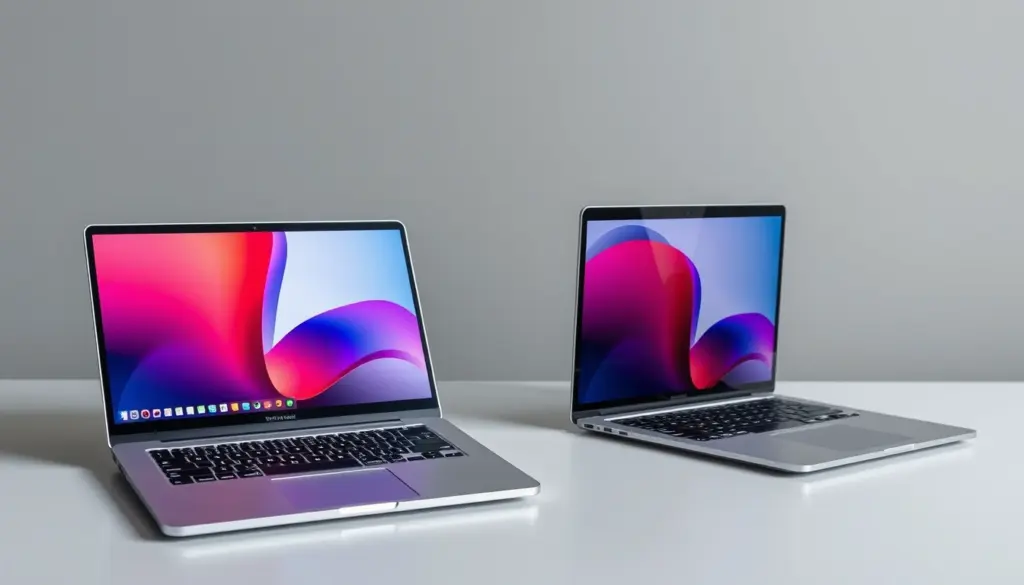
A Chinese laptop maker best known for budget gaming rigs just released a 14-inch ultrabook it is openly pitching against Apple’s MacBook Pro M5. The Machenike 14 Ultra went on sale in China on October 1, 2026, built around Intel’s new Core Ultra X7 358H chip, the first wave of silicon from Intel’s Panther Lake platform. Notebookcheck and TechNave both picked up the launch within hours, and the pitch is blunt: a 120Hz, 2,880 x 1,800 display, a fresh Arc B390 integrated GPU, and a price of 8,499 CNY, or roughly $1,267 at the reported exchange rate.
That is a price tag that undercuts Apple’s entry-level 14-inch MacBook Pro by a wide margin, especially after Apple’s own price increases earlier this year. Whether a Windows laptop with that spec sheet can actually function as a MacBook Pro substitute is a separate question, and it is the one worth digging into. Machenike is not the first Chinese OEM to frame a new laptop this way, but it is among the first to do it with Panther Lake hardware, which makes the launch a useful early data point for how Intel’s newest mobile chips perform in the real market rather than in slide decks.
What Machenike Actually Launched
The Machenike 14 Ultra is not a brand-new concept. Machenike first introduced the design back in July 2026, showing off the Panther Lake chip months before Intel’s broader mobile rollout reached most shelves. What changed on October 1 is availability: the laptop is now officially for sale in China, with pricing and final specs locked in. Notebookcheck, TechNave, and tech-insider.org all covered the China launch, repeating the same core numbers Machenike put out: a 14-inch panel at 2,880 x 1,800 resolution, a 120Hz refresh rate, and 400 nits of brightness.
Machenike has built its brand on gaming laptops with aggressive pricing, not thin-and-light productivity machines, so the 14 Ultra marks a shift in ambition. Pairing that history with a chassis aimed at creative and office users, rather than gamers, is the clearest signal that the company sees an opening in the premium ultrabook segment, a segment Apple has dominated in China’s higher price tiers for years.
What the coverage does not confirm is just as important. None of the reports list RAM configurations, storage options, battery capacity, port selection, chassis weight, or operating system details. Machenike has not issued an on-record statement beyond the product listing itself, and no executive quote has surfaced in the outlets covering the story. Readers should treat anything beyond the confirmed figures above as unverified until Machenike publishes a full spec sheet or outlets get hands-on units to test.
Inside the Chip: What the Core Ultra X7 358H Brings to a $1,267 Laptop
The headline component is the processor. The Intel Core Ultra X7 358H sits inside Intel’s Panther Lake family, the generation Intel has pitched as a genuine architectural reset after years of playing catch-up to Apple Silicon and AMD’s mobile chips. Panther Lake combines Intel’s newest process node with a redesigned tile layout that splits compute, graphics, and platform controller functions across separate dies, stitched together with Intel’s Foveros packaging.
For a company like Machenike, putting a brand-new Panther Lake chip into a sub-$1,300 laptop is a statement in itself. Early Panther Lake designs from bigger brands have mostly shown up in premium configurations priced well above $1,500. Machenike shipping a Panther Lake machine at 8,499 CNY suggests Intel is making the chip available to OEMs further down the price ladder faster than it did with the previous Meteor Lake and Lunar Lake generations, both of which launched first in flagship-tier laptops before trickling down to mainstream pricing a year or more later.
Why the X7 Tier Matters
Intel’s Core Ultra naming splits Panther Lake into multiple tiers, and the X7 designation sits in the upper-middle of that stack, below the top-end parts Intel reserves for workstation-class laptops. Putting an X7 chip, rather than a cut-down entry part, into a 14-inch productivity laptop signals Machenike wants the 14 Ultra taken seriously as a performance machine, not just a budget alternative with a nice screen bolted on. None of the outlets covering the launch published independent benchmark results, so performance claims against the MacBook Pro’s M5 chip remain, for now, a marketing position rather than a measured one.
Arc B390 Graphics: Intel’s Bet on Laptop Gaming and Creative Work
The second major spec is graphics. The Machenike 14 Ultra uses Intel’s integrated Arc B390 GPU rather than a discrete chip from Nvidia or AMD, which keeps the laptop thinner and the price down but puts real weight on how far Intel has pushed its integrated graphics architecture. Intel has spent the last two Panther Lake-adjacent launches trying to convince buyers that its integrated Arc silicon can handle real creative workloads and light gaming, not just desktop rendering and video playback.
That matters for the MacBook Pro comparison specifically, because Apple’s M5 chip ships with a 10-core GPU that includes hardware-accelerated ray tracing and dedicated neural accelerators on every core, features Apple has leaned on heavily in its own marketing. If Machenike wants the 14 Ultra to be taken seriously as a creative tool and not just an office laptop, the Arc B390’s real-world performance against Apple’s GPU, in apps like video editors and 3D tools, is going to be the detail reviewers hunt for first. No third-party benchmark of the Arc B390 inside the 14 Ultra has been published yet.
The Screen: 2,880 x 1,800 Resolution at 120Hz, 400 Nits
Display specs are where the Machenike 14 Ultra makes its most direct case. A 120Hz refresh rate on a 14-inch productivity laptop was a premium feature only a couple of years ago, and pairing it with a 2,880 x 1,800 resolution puts pixel density in a comparable range to competing high-end ultrabooks. The reported 400-nit brightness ceiling is the one figure that clearly trails Apple’s display, where the MacBook Pro M5’s Liquid Retina XDR panel hits 1,000 nits of sustained full-screen brightness in SDR content and 1,600 nits at its HDR peak.
None of the launch coverage specifies panel technology (IPS, OLED, or otherwise), color gamut coverage, or HDR certification for the Machenike display, so direct image-quality comparisons against Apple’s Mini LED XDR panel are not yet possible. Brightness alone, though, is a meaningful gap for anyone planning to use the laptop outdoors or under strong office lighting.
Price Check: 8,499 Yuan, and What That Actually Buys
The China launch price of 8,499 CNY converts to roughly $1,267 at the exchange rate cited in the original coverage. That number alone explains most of the “MacBook Pro rival” framing: it lands hundreds of dollars below Apple’s cheapest 14-inch MacBook Pro configuration in markets where Apple sells directly. Currency conversions move daily, and the figure here reflects the rate reported at launch rather than a fixed dollar price Machenike has committed to for a US or European release, since no release outside China has been confirmed.
It is also worth separating China pricing from what a Western retail price would likely look like. Chinese domestic laptop pricing routinely runs lower than what the same specs would fetch after import duties, localization costs, and regional margins are added for a US or EU launch, if one ever happens. Buyers hoping to import a unit directly should also factor in the near-total absence of confirmed warranty, software, and regional certification details.
Machenike 14 Ultra vs MacBook Pro M5: The Spec Sheet
Putting the two laptops side by side shows exactly where Machenike is making its case, and exactly where the comparison breaks down for lack of confirmed data. The MacBook Pro figures below come from Apple’s own published specifications and Apple’s October 2025 launch materials for the 14-inch M5 model.
| Spec | Machenike 14 Ultra | MacBook Pro M5 (14-inch) |
|---|---|---|
| Chip | Intel Core Ultra X7 358H (Panther Lake) | Apple M5, 10-core CPU / 10-core GPU |
| Graphics | Intel Arc B390 (integrated) | Apple M5 GPU with hardware ray tracing and per-core Neural Accelerators |
| Display size | 14 inches | 14.2 inches |
| Resolution | 2,880 x 1,800 | 3,024 x 1,964 |
| Refresh rate | 120Hz | Up to 120Hz, adaptive ProMotion (10Hz-120Hz) |
| Peak brightness | 400 nits | 1,000 nits sustained (SDR), 1,600 nits peak (HDR) |
| Unified/system memory | Not disclosed | Up to 32GB unified memory |
| Starting price | 8,499 CNY (~$1,267) in China | $1,599 at October 2025 launch; raised to $1,999 after Apple’s June 2026 price increase |
| Confirmed availability | China only, as of this report | Global |
Even with the gaps, two things stand out. Machenike wins on refresh-rate parity and undercuts Apple sharply on price, even against the MacBook Pro’s original 2025 launch price before the 2026 hike. Apple still holds a clear lead on display brightness and resolution density, and Apple’s confirmed 32GB unified memory ceiling versus Machenike’s undisclosed memory configuration leaves one of the most important productivity specs unresolved on the Machenike side.
How Machenike Stacks Up Against Other Panther Lake Laptops
Machenike is not launching into an empty field. Panther Lake has been rolling out across multiple Chinese and global OEMs through the back half of 2026, with price points spread across the market rather than clustered at one tier. The table below places the 14 Ultra against two other Panther Lake-class machines that have already reached shelves, based on each brand’s own published launch pricing.
| Laptop | Platform | Display | Launch price (reported) |
|---|---|---|---|
| Machenike 14 Ultra | Intel Core Ultra X7 358H, Arc B390 | 14-inch, 2,880 x 1,800, 120Hz, 400 nits | 8,499 CNY (~$1,267), China |
| Lenovo Xiaoxin 14 SE | Intel Wildcat Lake platform | 14-inch panel | Reported at roughly $834 |
| Apple MacBook Pro M5 (14-inch) | Apple M5, 10-core CPU/GPU | 14.2-inch Liquid Retina XDR, 120Hz ProMotion | $1,599 at 2025 launch, $1,999 after June 2026 hike |
The spread shown here says a lot about where Intel’s new chips are landing in 2026. Panther Lake and adjacent Intel platforms are showing up from budget-focused brands at under $900 all the way up to Machenike’s more performance-leaning $1,267 configuration, while Apple’s silicon stays locked to a single, higher price band it has occupied for years. That spread gives Intel something it has lacked in recent generations: OEM partners willing to build genuinely cheap machines around the newest chip immediately, rather than months later once yields improve and costs drop.
Why China Is Ground Zero for This Launch
China-first launches are not unusual for mid-tier laptop brands, and Machenike’s history reinforces why it is happening here first. The company built its name selling gaming laptops directly to Chinese buyers at prices Western OEMs rarely match, and it has the domestic supply chain relationships to move a new chip design to market fast once Intel makes it available.
China is also one of the most price-competitive laptop markets in the world, with dozens of domestic brands fighting for the same mid-to-premium buyers that Apple has historically owned at the top. A Panther Lake machine priced under 8,500 CNY gives Machenike a direct shot at buyers who want MacBook-like screen quality and build without paying Apple’s markup, especially after Apple’s own June 2026 price increase pushed the US MacBook Pro M5 further out of reach for budget-conscious shoppers.
Whether Machenike brings the 14 Ultra to other markets is an open question. The company has not announced international availability, pricing, or a timeline for expansion beyond China, and nothing in the current coverage suggests that is imminent.
From Meteor Lake to Panther Lake: Intel’s Long Climb Back
Context helps explain why a single mid-range Chinese laptop is getting this much attention. Intel spent the early 2020s losing ground on two fronts at once: Apple’s move to its own M-series silicon cut Intel out of the Mac lineup entirely starting in 2020, and AMD’s Ryzen mobile chips ate into Intel’s share of the Windows laptop market through efficiency gains Intel struggled to match for several generations.
Meteor Lake, launched in late 2023, was Intel’s first real attempt at a tiled, chiplet-style mobile architecture and the debut of a dedicated NPU for AI workloads. Lunar Lake followed in 2024 with a sharper focus on battery life and integrated graphics, closing some of the efficiency gap with Apple Silicon. Panther Lake, the platform underpinning the Machenike 14 Ultra, is Intel’s next full step in that progression, built on a newer process node and carrying a redesigned graphics architecture in the Arc B-series. Each generation has chipped away at the gap Apple opened with the original M1 back in 2020, without fully closing it. A $1,267 Panther Lake laptop that OEMs are willing to market directly against a MacBook Pro is, at minimum, evidence that Intel’s partners believe the gap has narrowed enough to make the comparison worth attempting in public.
What’s at Stake for Intel, AMD, and Apple
For Intel, every OEM willing to build an aggressively priced Panther Lake laptop is a win independent of how the 14 Ultra actually performs. Intel needs design wins at every price tier to rebuild the market share it lost over the past five years, and a sub-$1,300 machine from a brand like Machenike reaches buyers that premium-tier Panther Lake laptops from bigger names never will.
AMD, meanwhile, has spent recent generations positioning its Ryzen mobile chips as the value leader against Intel in thin-and-light laptops. A cheap, well-specced Panther Lake machine undercuts part of that pitch directly, forcing AMD’s OEM partners to answer with either lower prices or faster chip refreshes of their own.
Apple has the least to lose in the short term. The MacBook Pro brand carries loyalty, a mature software ecosystem, and resale value that a one-generation-old Chinese challenger cannot replicate overnight. But Apple’s own June 2026 price increase, which pushed the entry 14-inch M5 MacBook Pro from $1,599 to $1,999, widens the price gap that laptops like the 14 Ultra are built to exploit. Every dollar Apple adds to its entry price makes a $1,267 alternative look more attractive to buyers who were already on the fence.
Can a $1,267 Windows Laptop Really Compete With a MacBook Pro?
The honest answer right now is: it’s too early to say. Machenike has matched or beaten Apple on refresh rate and price, and it is using a genuinely new Panther Lake chip rather than a warmed-over previous-generation part. That is a real achievement for a brand operating well below Apple’s price floor.
But the comparison runs into a wall the moment you look past the marketing sheet. Apple’s MacBook Pro M5 has a higher-resolution, dramatically brighter display, a confirmed 32GB unified memory ceiling, a mature macOS software stack, and years of battery-life and build-quality benchmarking behind it. Machenike has not disclosed memory, storage, battery capacity, port selection, or chassis weight for the 14 Ultra, and no independent reviewer has published benchmarks comparing the Arc B390 or the Core Ultra X7 358H against Apple’s M5 in real workloads. Until that testing exists, “MacBook Pro rival” is a marketing claim built on four confirmed specs, not a verified performance result.
What We Still Don’t Know About the Machenike 14 Ultra
To be clear about the limits of what has actually been confirmed: Machenike and the outlets covering the launch have not published RAM configurations, storage capacity or type, battery size, charging specs, port layout, webcam quality, speaker setup, chassis material, weight, thickness, or operating system details for the 14 Ultra. There is also no confirmed timeline, pricing, or commitment for sales outside China.
None of that is unusual for a China-first launch covered within hours of going on sale. It does mean that buyers and reviewers outside China are, for now, working from a partial spec sheet, and any claim beyond the confirmed processor, graphics, display, and price figures should be treated as unverified until Machenike or an independent reviewer fills in the gaps.
Five Predictions for the Rest of 2026
- Independent benchmarks arrive within weeks. Given how fast Chinese tech outlets typically get hands-on units, expect Cinebench, Geekbench, and Arc B390 gaming numbers for the 14 Ultra before the end of October 2026.
- More Panther Lake laptops launch at aggressive prices. Machenike’s pricing move will likely push other Chinese OEMs to release their own sub-$1,500 Panther Lake machines rather than reserving the chip for premium tiers.
- A full spec sheet follows, not a redesign. Expect Machenike to disclose RAM, storage, and battery details in the coming weeks rather than treat them as a surprise reveal, since competitive pressure from other OEM launches will force full transparency.
- International availability stays uncertain through 2026. Nothing in the current coverage points to a US or EU launch, and Machenike’s past products have mostly stayed within China or limited export channels.
- Apple holds price and leans on software, not a counter-discount. Apple has shown no pattern of cutting MacBook Pro prices in response to budget competitors, and the more likely response is continued emphasis on battery life, build quality, and the Apple Intelligence software stack rather than a price match.
Frequently Asked Questions
What is the Machenike 14 Ultra?
It is a 14-inch Windows laptop from Chinese laptop maker Machenike, built around Intel’s new Core Ultra X7 358H “Panther Lake” chip. It officially went on sale in China on October 1, 2026, after first being introduced in July 2026.
How much does the Machenike 14 Ultra cost?
Machenike priced the laptop at 8,499 CNY in China, which converts to roughly $1,267 at the exchange rate reported at launch. No pricing has been announced for any market outside China.
What processor and graphics does the Machenike 14 Ultra use?
It uses the Intel Core Ultra X7 358H processor from Intel’s Panther Lake platform, paired with Intel’s integrated Arc B390 graphics.
Is the Machenike 14 Ultra available outside China?
As of this report, no. Machenike has only confirmed sales in China, with no announced timeline for an international release.
How does the Machenike 14 Ultra compare to the MacBook Pro M5?
The Machenike 14 Ultra undercuts the MacBook Pro M5 on price and matches its peak 120Hz refresh rate, but trails on display brightness and resolution based on Apple’s published specs. Machenike has not disclosed memory or storage specs, so a full comparison is not yet possible, and no independent benchmarks exist yet for either chip against the other inside these specific machines.
What is Intel Panther Lake?
Panther Lake is Intel’s current mobile chip platform, following Meteor Lake and Lunar Lake, built on a newer manufacturing process with a redesigned tile architecture and Intel’s Arc B-series integrated graphics.
What display does the Machenike 14 Ultra have?
A 14-inch panel running at 2,880 x 1,800 resolution, a 120Hz refresh rate, and a peak brightness of 400 nits. Panel technology (such as IPS or OLED) has not been confirmed.
Has Machenike released official benchmark numbers?
No independent or official benchmark results have been published for the Core Ultra X7 358H or Arc B390 inside the 14 Ultra. Current coverage is limited to confirmed specs and pricing, not measured performance.