
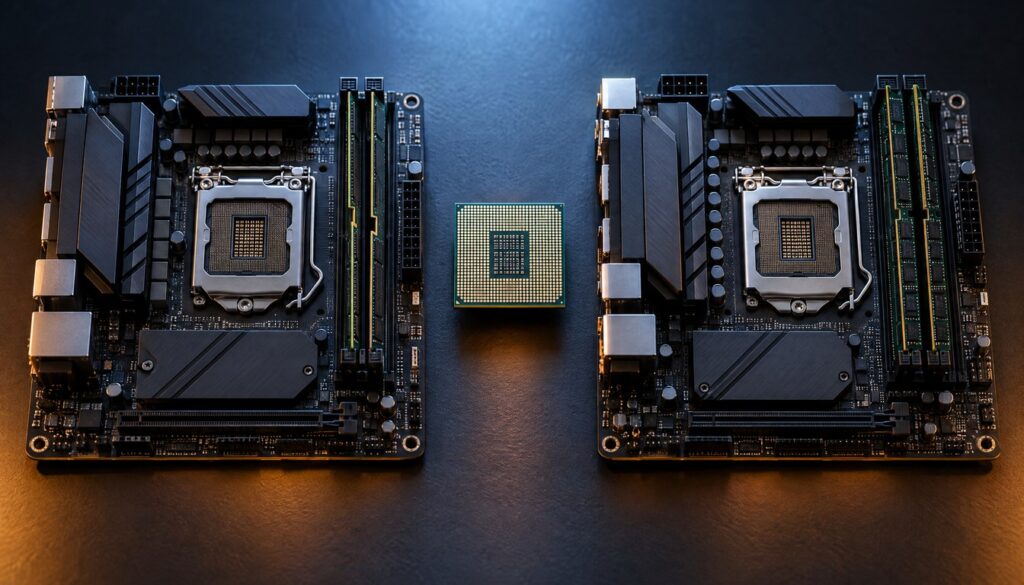
GIGABYTE confirmed on October 9, 2026 that it is rolling out new BIOS support across its entire B760 and H610 motherboard lineups, covering both DDR4 and DDR5 variants, to prepare for upcoming Intel processors built for the Socket LGA1700 platform. The company did not name the chips. It said only that they are “expected to launch in early 2027,” a phrasing that has sent enthusiast outlets scrambling to connect the dots to the long-rumored Raptor Lake Next refresh.
Tom’s Hardware was among the first to flag the BIOS listings, and German outlet Igor’s Lab corroborated the board list shortly after. What makes the story notable isn’t a spec leak. It’s that a major motherboard vendor just told its customers, in writing, to expect a new CPU generation on hardware that’s already five years old. That’s an unusual move in a desktop CPU market that typically retires sockets every two to three years.
What Gigabyte Actually Confirmed
Strip away the speculation and the confirmed facts are narrow but specific. GIGABYTE says its B760 and H610 chipset boards, in both their DDR4 and DDR5 configurations, will receive BIOS updates that add support for upcoming LGA1700 processors. The new firmware is already posted on GIGABYTE’s official support site. GIGABYTE’s own upgrade instructions boil down to three steps: download the BIOS file, flash the motherboard, then swap in the new processor. No new board. No new memory kit, unless a buyer wants one.
Everything past that point is inference. GIGABYTE did not use the term Raptor Lake Next in its own announcement, and it did not publish model numbers, core counts, clock speeds, or pricing. The “early 2027” launch window is GIGABYTE’s language, not a date Intel has put on a roadmap slide. Outlets including Tom’s Hardware, Igor’s Lab, and BigGo Finance have all reported the BIOS update as the strongest signal yet that Intel plans another round of chips for a platform many assumed was winding down. None of them, however, have an on-record spec sheet from Intel itself.
One Detail Everyone Is Getting Slightly Wrong
A lot of the social chatter around this story describes the upcoming chips as supporting “both DDR4 and DDR5.” That’s not quite what GIGABYTE said. DDR4 and DDR5 are physically and electrically incompatible, so no single motherboard accepts both. What GIGABYTE actually confirmed is that its DDR4-equipped boards and its separate DDR5-equipped boards, across the B760 and H610 families, are both getting BIOS support for the new chips. The processor family spans both memory ecosystems because it will be sold into two different board categories, not because any individual chip talks to both memory types at once.
It’s a subtle distinction, but it matters for anyone deciding whether to upgrade. A buyer with a DDR4 B760 board gets a CPU upgrade path without touching memory. A buyer with a DDR5 board gets the same CPU upgrade path with no memory downgrade. Both groups benefit, but neither gets a free lunch of using the other’s RAM.
Why “Raptor Lake Next” Is Still an Unofficial Label
Shattered.io previously covered pieces of this rumor thread in our report on alleged Raptor Lake Next leaks pointing to a Core 2000HX branding scheme, and the GIGABYTE BIOS update is the first corroboration from an actual hardware partner rather than a leaker account. Even so, “Raptor Lake Next” remains a reporting shorthand, not an Intel product name. The chips could ship under a Core 3, Core 5, or Core 7 label consistent with Intel’s current Core Ultra-era naming, or under something else entirely. Until Intel or a tier-one OEM confirms a name, treat any branding you see online as a placeholder.
The safer assumption, grounded only in what GIGABYTE actually said, is this: Intel has a new LGA1700 processor family coming, GIGABYTE expects it in early 2027, and it will run on existing B760 and H610 boards after a firmware update. Specs, pricing, and core counts are all still open questions.
Intel’s LGA1700 Timeline, From Alder Lake to a Possible 2027 Chip
To understand why this is unusual, it helps to look at how long Intel typically keeps a socket alive. Intel introduced LGA1700 with 12th Gen Core “Alder Lake” in November 2021. The 13th Gen “Raptor Lake” generation followed in October 2022, and the 14th Gen “Raptor Lake Refresh” arrived in October 2023. Intel then moved its mainstream desktop platform to the new LGA1851 socket for Core Ultra 200S “Arrow Lake” chips in 2024, which was widely read at the time as the end of the road for LGA1700 on the high end.
| Generation | Codename | Launch | Socket | Status |
|---|---|---|---|---|
| 12th Gen Core | Alder Lake | November 2021 | LGA1700 | Shipped |
| 13th Gen Core | Raptor Lake | October 2022 | LGA1700 | Shipped |
| 14th Gen Core | Raptor Lake Refresh | October 2023 | LGA1700 | Shipped |
| Core Ultra 200S | Arrow Lake | 2024 | LGA1851 | Shipped |
| Unnamed LGA1700 chip | Reported as “Raptor Lake Next” | “Early 2027” per GIGABYTE | LGA1700 | Unconfirmed by Intel |
If the rumored 2027 chip ships on LGA1700 as GIGABYTE’s BIOS listings suggest, the socket will have stayed commercially relevant for roughly five years, spanning four processor generations, even after Intel’s flagship desktop line had already moved on to a newer socket. That’s an unusual second act for a platform Intel appeared to have closed the book on in 2024.
Why DDR4 Support Still Makes Sense in Late 2026
Keeping DDR4 alive on a chip expected in 2027 might sound like a step backward, but the economics line up. B760 and H610 are Intel’s value-tier chipsets, and a large share of those boards shipped in DDR4 configurations because DDR4 kits have remained cheaper than DDR5 throughout the memory market’s recent price swings. Shattered.io recently detailed how DRAM pricing has climbed sharply enough to outpace even leading-edge logic chips on a per-gigabyte basis, a dynamic that makes a DDR4 upgrade path genuinely attractive for budget builders rather than a legacy afterthought.
For system builders and OEMs selling pre-built budget desktops, the calculus is simple: a CPU-only upgrade keeps bill-of-materials costs down and lets a retailer sell a “new” machine without re-qualifying a motherboard design or sourcing a fresh memory SKU. For the millions of existing B760 and H610 owners, it means a potential performance bump without opening the wallet for a full platform swap. Intel gets to extend revenue from a mature, already-amortized chipset design rather than funding a new one from scratch.
The Trade-Off Nobody Is Advertising
DDR4 tops out at lower bandwidth and higher latency characteristics than DDR5, and a chip’s memory controller still has to be designed to talk to the older standard. That’s a real engineering cost for Intel, not a free option. The fact that GIGABYTE is bothering to prepare DDR4 boards at all suggests Intel sees enough remaining DDR4 install base, likely concentrated in budget and emerging-market desktops, to justify keeping that controller logic alive for one more generation rather than forcing every LGA1700 holdout onto DDR5 or a new socket.
How This Stacks Up Against AMD’s AM5 Platform
The timing invites an obvious comparison. AMD launched Socket AM5 alongside the Ryzen 7000 series in September 2022, roughly a year after LGA1700 debuted, and committed the platform to DDR5 exclusively from day one. Where Intel’s LGA1700 extension looks improvised, a reaction to a healthy installed base and pricier DDR5, AMD’s socket longevity has been a stated plan since the start. AMD has since reaffirmed that commitment multiple times, most recently confirming AM5 support continuing through 2029, which would give the socket roughly seven years of relevance by the time it winds down.
| Metric | Intel LGA1700 | AMD AM5 |
|---|---|---|
| Introduced | November 2021 | September 2022 |
| Memory support | DDR4 or DDR5, depending on board | DDR5 only |
| Generations supported | 12th, 13th, 14th Gen, plus a possible 2027 chip | Ryzen 7000, 8000, 9000, with Zen 6/Zen 7 planned |
| Stated longevity plan | Not publicly committed; extension appears reactive | Publicly reaffirmed through 2029 |
| Flagship desktop status | Superseded by LGA1851 in 2024 | Still current flagship socket |
The contrast says something about each company’s current market position. Shattered.io reported that AMD’s desktop and server CPU share has climbed to a record high while Intel’s has fallen to its lowest point in roughly three decades, and a confident market leader can afford to plan a socket’s life years in advance. Intel, by contrast, appears to be squeezing additional value out of an older platform rather than unveiling a confident new roadmap milestone. That’s not necessarily a bad strategy for Intel’s budget segment, but it reads differently than AMD’s public multi-year pledge.
Where Intel’s Real Future Platform Sits
It’s worth separating this LGA1700 story from Intel’s actual next-generation desktop push. Intel’s forward-looking architecture work, including the cache strategy shattered.io examined in our look at Intel’s Nova Lake cache bet aimed at AMD’s X3D lead, is happening on a different track entirely. A 2027 LGA1700 chip, if it ships as rumored, would most plausibly serve as a budget-tier holdover rather than Intel’s flagship answer to Nova Lake-class silicon. The two stories are related only in that both involve Intel trying to extend value from existing engineering work rather than starting from a blank sheet.
What This Means If You Already Own a B760 or H610 Board
Practically speaking, nothing changes today for current LGA1700 owners. There is no new CPU to buy yet, and the BIOS update by itself adds no performance or features to an existing system; it simply prepares the board’s firmware to recognize a chip that doesn’t exist on shelves. Anyone running a 12th, 13th, or 14th Gen Core processor on a B760 or H610 board can flash the new firmware whenever GIGABYTE makes it broadly available, but there’s no urgency to do so before an actual CPU ships.
The more useful takeaway is for anyone currently weighing a platform decision. If a budget build is already planned around a B760 or H610 motherboard, this news is a mild argument for sticking with that chipset rather than jumping to a pricier LGA1851 board now, since a CPU upgrade path appears to be coming without a socket change. If a full new-platform build is on the table regardless, nothing here should shift that decision, since specs and pricing for the 2027 chip remain unknown and could land anywhere on the performance spectrum.
Market Impact for Builders, OEMs, and Motherboard Vendors
For the PC building community, the immediate effect is a wait-and-see signal rather than an action item. Nobody should delay a planned build today on the strength of a BIOS changelog with no CPU attached to it. But for owners of B760 or H610 boards who were considering a full platform replacement, the news is a reason to pump the brakes and watch for more concrete details before spending on a new motherboard and memory kit.
For system integrators and budget-PC retailers, the calculation is more immediate. A CPU-only refresh cycle is cheaper to execute than a full platform refresh, and it lets smaller OEMs keep selling existing chassis and board designs for another sales cycle. For GIGABYTE specifically, being first to confirm BIOS readiness is a marketing advantage: competing motherboard vendors on B760 and H610 designs will likely need to publish similar BIOS updates to avoid looking behind on day-one compatibility once Intel actually names the chips.
There’s also a ripple effect on the memory market. If a meaningful share of the new chip’s addressable market sits on DDR4 boards, that could modestly extend demand for DDR4 modules at a moment when the broader memory industry is tilted hard toward DDR5 production. Given how tight memory supply has already run in 2026, any extension of DDR4 relevance is a minor but real variable for system builders pricing out budget machines.
How the Tech Press Is Reading the Announcement
Coverage has been consistent on the core facts and cautious on everything else. Tom’s Hardware framed the BIOS update as a hint at a 2027 Raptor Lake Next launch while stopping short of calling it confirmation of an official product. Igor’s Lab corroborated the board list and matched it against GIGABYTE’s published compatibility pages. BigGo Finance summarized the story for a financial and investor audience, noting that GIGABYTE disclosed no SKUs, specifications, or pricing alongside the BIOS rollout.
None of the outlets that have covered the story claim to have an Intel spokesperson on record confirming the chip’s branding, specifications, or exact launch date. That absence is itself informative. Intel has, at least so far, let a motherboard partner’s BIOS changelog do the talking rather than issuing its own statement, which is consistent with how the company handled earlier stages of unconfirmed product cycles.
Open Questions Intel Hasn’t Answered
- Will the chips carry a new brand name, or extend the existing Core Ultra or Core naming scheme?
- What core counts, cache sizes, and clock speeds will the lineup include?
- Will pricing position the chips as budget replacements or mid-range upgrades?
- Will “early 2027” hold, or slip the way earlier Raptor Lake Refresh timing shifted in past cycles?
- Will other motherboard vendors beyond GIGABYTE confirm matching BIOS support before Intel makes an official statement?
Until Intel addresses any of these directly, every number attached to “Raptor Lake Next” online, including specific core-count or wattage figures some enthusiast sites have floated, should be read as rumor-tier, not verified specification.
Five Predictions for Early 2027
- Other major motherboard vendors on B760 and H610 designs will publish comparable BIOS updates within weeks of GIGABYTE’s, to avoid appearing behind on day-one compatibility.
- Intel will likely position the new chips as entry-level or mid-range parts rather than flagship silicon, given the budget-tier chipsets involved.
- Expect Intel to eventually confirm the chip family under its current Core or Core Ultra naming convention rather than resurrecting the Raptor Lake name commercially.
- “Early 2027” will probably slip toward mid-2027 in practice, consistent with how previous Intel refresh cycles have often landed later than initial informal guidance suggested.
- DDR4 demand in the budget PC segment will get a modest, temporary boost once retailers start marketing CPU-only upgrade kits built around the new chips.
What to Watch Between Now and Launch
The next concrete signal will likely come from one of three places: an official Intel roadmap slide naming the family, a matching BIOS update from a second major motherboard vendor such as ASUS, MSI, or ASRock, or a leaked benchmark tied to an actual engineering sample rather than a firmware changelog. Until one of those appears, this remains a single, credible, but narrow confirmation from one motherboard partner, not a product launch.
For context on how quickly these stories can shift, shattered.io’s earlier look at Intel’s Core Ultra competitive position against Qualcomm’s Snapdragon X2 shows how fast benchmark-driven corrections can follow an initial rumor cycle. The same pattern is likely here: expect clarifying detail, not a contradiction, as more partners weigh in.
Frequently Asked Questions
What did GIGABYTE actually confirm about Raptor Lake Next?
GIGABYTE confirmed BIOS updates across its B760 and H610 motherboard lineups, in both DDR4 and DDR5 configurations, for upcoming LGA1700 processors it says are “expected to launch in early 2027.” It did not confirm the Raptor Lake Next name, specs, or pricing.
Will the new chip support both DDR4 and DDR5 at once?
No. DDR4 and DDR5 are incompatible memory standards, so no single motherboard runs both. GIGABYTE’s DDR4 boards and its separate DDR5 boards are each getting BIOS updates, meaning the chip family will be sold into both board categories rather than one board type bridging both standards.
Do I need to buy a new motherboard for the upcoming chips?
Based on GIGABYTE’s announcement, no, provided you already own a supported B760 or H610 board. The stated upgrade path is to download the BIOS update, flash the motherboard, and install the new processor.
Is Raptor Lake Next an official Intel product name?
No. It is a label used by enthusiast press and leakers to describe the rumored chips. Intel and GIGABYTE have not used that branding in any official communication reviewed for this story.
How old is the LGA1700 socket at this point?
Intel introduced LGA1700 with 12th Gen Alder Lake in November 2021. A 2027 chip on the same socket would mark roughly five years of commercial life, spanning four processor generations.
How does this compare to AMD’s socket strategy?
AMD’s AM5 socket launched in September 2022 and is DDR5-only. AMD has reaffirmed AM5 support continuing through 2029, a multi-year commitment stated well in advance, in contrast with Intel’s LGA1700 extension, which appears to be a reaction to market conditions rather than a long-planned roadmap item.
Why would Intel still support DDR4 in 2027?
A large share of existing B760 and H610 boards shipped with DDR4, which has remained cheaper than DDR5 through recent memory price increases. Supporting DDR4 lets existing owners upgrade their CPU without replacing memory or motherboard, which matters most in budget desktop and system-integrator channels.
When will Intel confirm official specs and pricing?
No date has been confirmed. GIGABYTE’s own language points to early 2027 for the processors themselves, but Intel has not issued an official statement, and past Intel refresh cycles have sometimes slipped past initial informal timing.