AMD is sampling a new chip built for a market with zero margin for error: space. The company confirmed it is now sampling the AMD Versal AI Core XQRVC1902 adaptive SoC in an enhanced space-grade package, a move that pushes its AI-engine silicon out of data centers and into satellites, rovers and deep-space probes. The announcement, detailed in AMD datasheet DS946, marks one of the clearest signs yet that chipmakers see orbit as the next frontier for onboard compute, not just a niche defense contract line.
For an industry used to measuring product cycles in months, AMD is talking in decades. The new package is designed to support missions lasting up to 15 years, a timeline that puts it in the same conversation as the multi-decade spacecraft programs run by NASA and the European Space Agency. Early access customers already have hardware in hand, according to AMD, though the company has not named them.
What AMD Actually Announced
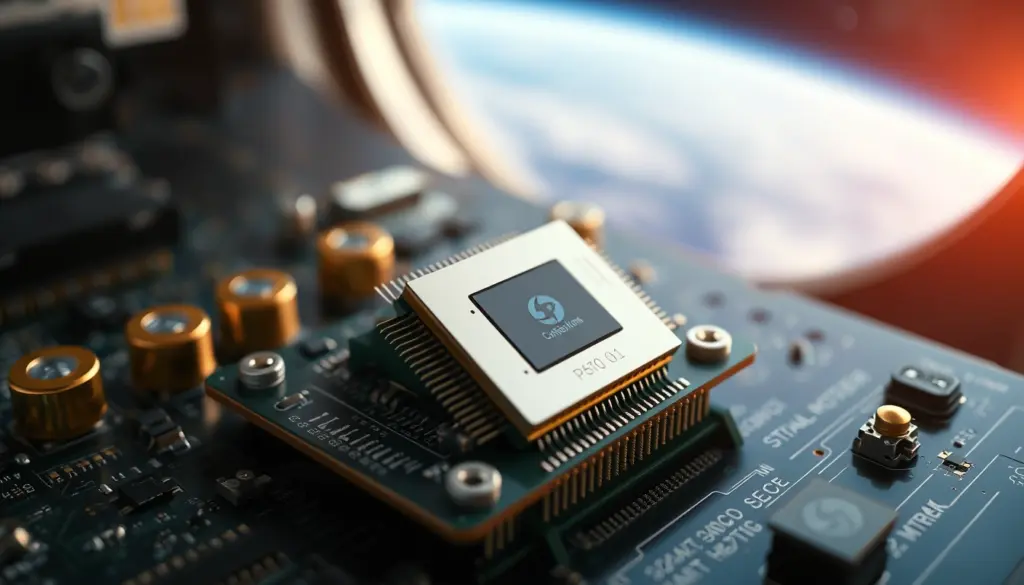
Strip away the framing and the news is specific: AMD is sampling the Versal AI Core XQRVC1902 in what it calls an advanced space-grade organic lidless package. AMD built the package itself, and it leans on an enhanced organic substrate material combined with conservative design rules to handle the thermal cycling and mechanical stress that comes with sitting in orbit for years at a time. “We have developed an enhanced space-grade organic lidless package for the Versal AI Core XQRVC1902 adaptive SoC and are seeking Class Y qualification,” AMD’s aerospace team said in a company blog post.
Class Y is not a marketing label. It is a formal flight-qualification tier, and AMD says fully qualified units should reach customers in the second half of 2027. That gap between sampling now and shipping qualified parts in roughly two years is normal for space-grade hardware, where a single radiation-induced bit flip at 36,000 kilometers up cannot be patched with a firmware update. AMD’s own newsroom statement put it plainly: “AMD today announced sampling with early access customers of the AMD Versal AI Core XQRVC1902 adaptive SoC in an enhanced space-grade package.”
The Versal AI Core line itself is not new. AMD’s Versal family combines programmable logic, dedicated AI engines and Arm processor cores on a single adaptive SoC, a design built for workloads that need to be reconfigured after deployment. In orbit, that reconfigurability matters: a satellite cannot be pulled back to a lab if a sensor-processing algorithm needs a rework after launch. AMD describes the radiation-tolerant Versal lineup as closing a specific gap: “The radiation tolerant, space-grade AMD Versal adaptive SoCs close this gap by integrating programmable logic, AI engines and Arm cores to enable on-board high-performance processing in orbit and directly on the lunar surface,” the company said in a 2026 blog update.
Why 15 Years Matters More Than TFLOPS
In the terrestrial AI chip market, the headline number is almost always throughput. In space, the headline number is survival time. AMD’s pitch for the XQRVC1902 centers on durability, not peak performance, and that is a deliberate contrast with how AMD talks about its data-center silicon. “This new packaging will support missions for up to 15 years, offering a robust foundation for geosynchronous satellites, lunar exploration, and deep-space probes,” AMD’s aerospace team said in the same blog post.
Fifteen years is roughly the operational life of a geostationary communications satellite, and it comfortably covers most planetary science missions. It also means a chip sampled today, if it lands on a 2029 launch, could still be returning data in the early 2040s. That is a planning horizon almost no consumer or enterprise chip vendor has to think about, and it explains why AMD leans so heavily on manufacturing process rather than clock speed when describing the part.
AMD’s published space-grade specifications back up the durability framing. The company lists radiation-tolerance characterization, an AMD class B manufacturing, qualification and burn-in process, and full M-temperature-range support spanning minus 55 degrees Celsius to positive 125 degrees Celsius. That range covers the swing a satellite experiences moving between direct sunlight and Earth’s shadow multiple times per orbit, a cycle that happens roughly every 90 minutes for low Earth orbit hardware and far less often, but with larger swings, for geostationary and lunar payloads.
The Packaging Problem Nobody Talks About
Most chip coverage focuses on the die: the transistor count, the node, the architecture. AMD’s space announcement is almost entirely about the package wrapped around the die, and that distinction matters. A lidless package removes the metal lid that normally caps a chip, which helps with heat dissipation but also removes a layer of physical protection. Compensating for that tradeoff is where AMD says its conservative design rules and enhanced organic substrate come in, reducing the thermal and mechanical stress that would otherwise crack solder joints or delaminate layers during a decade-plus of thermal cycling in vacuum.
This is a quieter kind of innovation than a new transistor architecture, but it is arguably the harder engineering problem for space applications. A chip that performs brilliantly in a lab but delaminates after 400 orbital day-night cycles is useless on a spacecraft nobody can service. AMD positions its space-grade devices for use in satellites, rovers and other spacecraft broadly, rather than tying the XQRVC1902 to a single named mission, which is consistent with how chipmakers typically talk about space silicon before formal qualification completes.
AMD’s Quiet Space Push, in Context
AMD has not made space hardware the center of its public narrative the way it has with data-center GPUs or client CPUs. Compare the volume of coverage AMD gets for its Ryzen desktop chips, or for its $8.2 billion acquisition of World Labs, against the comparatively low profile of its space-grade Versal line. That asymmetry is partly structural: the space and defense silicon market is smaller in unit volume than consumer electronics, and most of its customers do not publicize contracts the way cloud providers do.
But the strategic logic lines up with AMD’s broader push to diversify beyond the data-center AI race it is running against Nvidia. AMD has been stacking up compute partnerships on Earth, including the $1.2 billion AMD Helios deal with HPE and Vultr, while simultaneously extending its adaptive SoC architecture to a market where Nvidia has far less of a foothold. Radiation-tolerant, flight-qualified silicon is a different competitive lane than H100-class accelerators, and it is one where AMD’s Xilinx acquisition, absorbed years ago, gives it a head start that predates the current AI chip boom entirely.
Who Else Is Building for Orbit
AMD is not the only chip or tech company treating space as a serious compute venue in 2026. Google has been running its own orbital AI experiment through the Suncatcher program, which recently sent four TPUs to space as part of a bet on orbital AI infrastructure, following an earlier satellite that rode along on one of SpaceX’s rideshare missions. Those efforts are aimed at a different problem than AMD’s: Google is testing whether AI training and inference can happen in orbit at all, while AMD is focused on hardening chips that already do onboard processing for existing satellite and rover payloads.
Even gaming hardware has found its way off-planet in a smaller, more improvised way. Airbus engineers used a $400 Steam Deck to steer a Mars rover prototype earlier this year, a reminder that the line between consumer and aerospace compute is blurrier than it looks. AMD’s space-grade Versal push sits closer to the serious end of that spectrum: purpose-built, radiation-characterized, qualification-tested silicon meant for missions measured in years, not a repurposed handheld.
| Company | Space Compute Effort | Status as of October 2026 |
|---|---|---|
| AMD | Versal AI Core XQRVC1902 space-grade package | Sampling with early access customers; Class Y units targeted for H2 2027 |
| Suncatcher orbital TPU program | Four TPUs launched to space as part of ongoing orbital AI test | |
| SpaceX | Rideshare launch infrastructure (Transporter missions) | Hosting third-party payloads including satellite compute hardware |
| Airbus | Mars rover prototype control hardware | Demonstrated consumer-hardware (Steam Deck) control interface in prototype testing |
The Technical Specs Worth Knowing
For engineers evaluating the XQRVC1902 or tracking the broader AMD Versal XQR Series, the publicly listed specifications are narrower than AMD’s data-center chip sheets but more rigorously tested in specific ways. AMD’s space-grade feature list includes radiation-tolerance characterization data, a dedicated class B manufacturing and burn-in qualification flow, and operation across the full M-temperature range. None of this shows up in a typical Ryzen or EPYC spec sheet, because none of it needs to.
| Specification | Detail |
|---|---|
| Device | AMD Versal AI Core XQRVC1902 adaptive SoC |
| Package type | Advanced space-grade organic lidless package |
| Target mission duration | Up to 15 years |
| Operating temperature range | -55°C to +125°C (full M-temperature range) |
| Manufacturing process | AMD class B manufacturing, qualification, and burn-in process |
| Flight qualification target | Class Y units, second half of 2027 |
| Reference documentation | AMD datasheet DS946 |
| Target applications | Satellites, rovers, other spacecraft |
The architecture underneath, Versal’s mix of programmable logic, AI engines and Arm cores, is what lets a single chip handle sensor fusion, image processing and onboard AI inference without needing a separate accelerator die. That matters on a spacecraft where every additional component is more mass, more power draw and one more potential point of failure. It is a very different design philosophy from a 6,144-core desktop accelerator, where raw parallel throughput is the whole point.
Historical Context: Chips Have Been Going to Space for Decades
Space-grade silicon is not a new category AMD invented. Radiation-hardened and radiation-tolerant chips have flown on missions since the earliest communications satellites, and the field has always lagged consumer silicon by one or more process generations because qualification testing takes years and foundries will not requalify a line for small-volume orders. What makes 2026 notable is the application: AMD is extending AI-engine capable silicon, not just general-purpose logic, into that qualification pipeline.
AMD’s position here traces back to its 2020 acquisition of Xilinx, which brought the Versal adaptive SoC architecture and decades of FPGA space-qualification experience into AMD’s portfolio. That history is why AMD can credibly talk about class B manufacturing processes and Class Y flight qualification today rather than starting from zero. It is also why this announcement reads less like a new business line and more like AMD extending an existing aerospace franchise to its newest architecture generation.
Market Impact: A Small Line Item With Strategic Weight
Space-grade chip sales will not move AMD’s quarterly revenue in any material way. The entire radiation-hardened and radiation-tolerant silicon market is a sliver of what AMD earns from gaming GPUs or server CPUs. The strategic value is elsewhere: it diversifies AMD’s addressable market at a moment when its data-center AI business is almost entirely defined by its rivalry with Nvidia, and it gives AMD a toehold in a government and defense-adjacent procurement channel that tends to run on long contracts and sticky customer relationships once a part is qualified.
It also reinforces AMD’s pitch to institutional and government buyers that its adaptive SoC architecture is a platform, not a single product. A customer that qualifies the XQRVC1902 for a satellite payload today becomes a candidate for AMD’s next-generation Versal parts tomorrow, the same way cloud customers who standardize on EPYC server CPUs tend to stay on AMD’s roadmap for successive generations rather than re-qualifying an entirely new vendor.
What AMD Has Not Confirmed
It is worth being precise about what this announcement does and does not include. AMD has not named the early access customers sampling the XQRVC1902. It has not disclosed pricing, a specific launch mission, or a completed Class Y qualification, since that milestone is not expected until the second half of 2027. No AMD executive or named engineer has been quoted beyond company-attributed blog and newsroom statements. Readers should treat any claim beyond AMD’s own published statements, including specific mission assignments or customer names circulating elsewhere, as unverified until AMD or a launch customer confirms it directly.
Competitive Comparison: AMD vs the Rest of the Space Silicon Field
AMD’s closest direct comparison point is itself: the broader AMD Versal XQR Series, of which the XQRVC1902 is the newest entrant to get this specific enhanced package. Outside AMD, the radiation-tolerant adaptive computing space has historically been a narrow field, with FPGA and SoC vendors competing on qualification pedigree more than raw specifications. AMD’s advantage, inherited through Xilinx, is that it already has a running XQR product line and an established class B manufacturing process, rather than needing to build a space qualification program from scratch.
Where AMD differs from the broader AI chip market, including its own data-center lineup, is the metric that matters. A customer buying an MI300-class accelerator cares about tokens per second and memory bandwidth. A customer buying the XQRVC1902 cares about documented behavior under total ionizing dose, single-event upset rates, and a 15-year reliability target. Those are not benchmarks that show up on a leaderboard, but they are the only benchmarks that matter once a chip is bolted to a spacecraft bus.
Predictions: Where This Goes From Here
- Expect AMD to publish additional space-grade Versal variants before the Class Y qualification milestone lands in the second half of 2027, following the same sampling-then-qualification pattern it used for the XQRVC1902.
- Government and defense-linked satellite programs will likely be the first disclosed customers, since those contracts are more often made public than commercial satellite operator deals.
- AMD will probably continue framing this work through blog posts and datasheets rather than splashy launch events, consistent with how it has handled its XQR Series to date.
- Competition in space-grade AI silicon will intensify as more terrestrial AI chip vendors look at defense and aerospace budgets as a hedge against the cyclical nature of commercial AI infrastructure spending.
- Expect scrutiny to grow around unverified claims that circulate online about specific missions or researchers tied to space chip announcements, since qualification-stage chip news tends to attract speculation that outruns what vendors have actually confirmed.
Why This Matters for Engineers and Buyers, Not Just Space Agencies
For most readers, a space-grade SoC sampling announcement will not change a purchasing decision this quarter. But it is a useful signal for anyone tracking where adaptive SoC architecture is headed. The same programmable-logic-plus-AI-engine design that AMD is hardening for orbit also underpins its commercial Versal lineup used in telecom, industrial automation and defense ground systems. Improvements AMD makes to packaging durability and thermal tolerance for space applications tend to filter back into ruggedized commercial parts over subsequent product generations, the same way automotive-grade chip requirements have shaped consumer silicon reliability standards over the past decade.
It is also a data point for anyone assessing AMD’s overall strategy against Nvidia. Nvidia’s public narrative is overwhelmingly about data-center AI scale. AMD’s space-grade push, by contrast, is a reminder that AMD’s adaptive SoC portfolio, built on the Xilinx FPGA foundation, gives it market exposure that does not directly overlap with Nvidia’s GPU-centric roadmap at all. That is a narrower lane, but it is one AMD has occupied for years with comparatively little direct competition.
Frequently Asked Questions
What chip did AMD announce for space use?
AMD confirmed it is sampling the AMD Versal AI Core XQRVC1902 adaptive SoC in an enhanced space-grade package, detailed in AMD datasheet DS946.
How long is this chip designed to last in space?
AMD says the enhanced package is designed to support space missions lasting up to 15 years.
When will fully qualified units be available?
AMD expects Class Y flight-qualified units in the second half of 2027. The chip is currently sampling with early access customers, not shipping qualified hardware yet.
What temperature range does the chip support?
AMD lists full M-temperature-range support, from -55°C to +125°C, as part of the space-grade feature set.
What is a space-grade organic lidless package?
It is a chip packaging approach, developed by AMD, that removes the standard protective lid and uses an enhanced organic substrate material with conservative design rules to withstand thermal and mechanical stress in orbit.
Is this related to AMD’s Xilinx acquisition?
The Versal adaptive SoC architecture and the broader AMD Versal XQR Series trace back to technology and manufacturing expertise AMD gained through its acquisition of Xilinx, which had an established space and aerospace FPGA business before the deal closed.
Has AMD named any customers or missions for this chip?
No. AMD has said the chip is sampling with early access customers but has not publicly named any of them, nor confirmed a specific satellite, rover or spacecraft mission.
How does this compare to AMD’s data-center AI chips?
Data-center chips like AMD’s MI-series accelerators are optimized for raw AI compute throughput. The space-grade Versal line is optimized for radiation tolerance, thermal durability and multi-year reliability rather than peak performance.
Related
- AMD Gorgon Halo Benchmarks Hit Back at RTX Spark
- AMD Buys Fei-Fei Li’s World Labs for $8.2B
- HPE’s $1.2B AMD Helios Deal Matches Nvidia’s 72 GPUs
- Google’s Suncatcher: 4 TPUs Head to Space Oct. 1
- Airbus Steers Mars Rover Prototype With a $400 Steam Deck