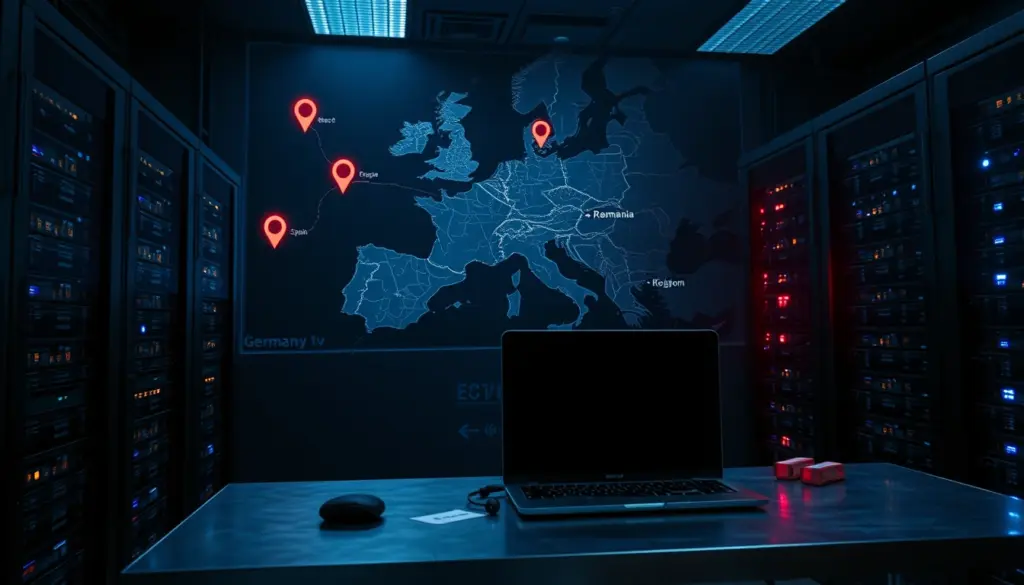
Operation KillSwitch, the law-enforcement action that took down the KillSec ransomware group on September 30, 2026, turns out to be bigger than the first headlines suggested. Three suspects are in custody, eight properties were searched across Greece, Romania, Spain, and the United Kingdom, and investigators seized more than 110 terabytes of leak-site data. But the detail that reframes the whole case is the one buried deeper in the official announcement: the investigation was led by German authorities and drew support from ten countries, not the four where raids actually took place.
That gap between where police knocked on doors and how many nations actually worked the case is the real story here. KillSec has been sold on underground forums as a cheap, teen-friendly ransomware-as-a-service (RaaS) kit for roughly two years, and a suspected 16-year-old administrator allegedly ran much of it. Taking that operation apart required a coordination machine that spans Europol, Eurojust, national police forces, and private cybersecurity firms, operating across borders where a RaaS gang can spin up a new server faster than a single national police force can get a warrant. This piece looks at what that coordination machine actually looks like, how it stacks up against the law enforcement playbooks used against LockBit, Hive, and ALPHV/BlackCat, and what it signals for a ransomware economy that increasingly runs on teenagers, cheap infrastructure, and global reach.
What Europol Actually Confirmed About Operation KillSwitch
Europol’s own announcement is the most reliable record of what happened. According to the agency, authorities took control of KillSec’s leak site and infrastructure on September 30, 2026, arresting three suspects on a provisional basis and searching eight properties in Greece, Romania, Spain, and the United Kingdom. Europol said investigators had identified a 16-year-old as the group’s suspected main operator and administrator, and framed the case as touching “around 1,000 suspected ransomware attacks worldwide,” according to the Europol press release.
The agency’s statement explicitly described the action as “part of Operation KillSwitch, an international investigation led by German authorities into around 1,000 suspected attacks worldwide,” per the same release. That single line does a lot of work. It tells us Germany, not Europol itself or a single national force, held the pen on this case, and it tells us the probe’s scope (roughly 1,000 attacks) dwarfs the visible footprint of three arrests and eight searches. The Register reported that “authorities announced on Thursday that an international operation had seized the group’s infrastructure and made three provisional arrests,” while CyberScoop went further, describing the arrests as part of “Operation KillSwitch, a globally coordinated operation aided by 10 countries and private cybersecurity companies.”
Several details remain unconfirmed in the public record as of this writing. The identities of the two suspects beyond the alleged 16-year-old operator have not been released. No ransom totals, victim counts, or named corporate targets have been attached to the roughly 1,000 attacks figure. Separately, one suspect identified in UK proceedings, Fouad Eltibrizi, also known online as “Archduke,” has been named by the US Department of Justice as a Dutch national facing cybercrime charges, a case covered in detail in our earlier report on that arrest. Whether he is one of the three provisional arrests tied to the September 30 action, or a related but separate proceeding, has not been spelled out clearly in the sources reviewed for this piece. Readers should treat that linkage as unresolved rather than confirmed.
Ten Countries, Four Raid Sites: Why the Numbers Don’t Match
A case spanning ten countries but producing physical raids in only four is not unusual in cybercrime enforcement, and it’s worth explaining why. Modern ransomware groups rent infrastructure, bounce traffic through bulletproof hosting, and often have affiliates, developers, and money-laundering contacts scattered across jurisdictions that have little to do with where any single operator physically lives. A German-led task force investigating roughly 1,000 attacks plausibly pulled data, subpoenas, and server images from hosting providers and telecoms in countries well beyond the four raid sites. Those contributing nations get credited as part of the operation even when no doors get kicked in on their soil.
This is the structural reality of ransomware-as-a-service: the “crime scene” is distributed by design. KillSec’s leak site, like most RaaS dashboards, likely ran through a chain of proxies, bulletproof hosts, and cryptocurrency mixers that never touch the country where an alleged administrator sleeps at night. Germany taking the lead role, rather than Greece, Romania, Spain, or the UK where the physical searches happened, suggests German investigators either developed the initial lead, held jurisdiction over a key piece of infrastructure, or built the evidentiary case that justified the warrants executed elsewhere. None of the sources reviewed specify which, so that remains an informed inference rather than a confirmed fact.
What is confirmed is the scale mismatch itself, and it matters for anyone trying to gauge how seriously to take takedown announcements generally. A headline count of three arrests understates the investigative footprint by an order of magnitude once the ten-country support network is counted. For defenders and incident responders, that’s a useful corrective: the number of named suspects in a press release rarely reflects how big the actual law enforcement effort behind a ransomware disruption really was.
Operation KillSwitch by the Numbers
| Metric | Figure | Source |
|---|---|---|
| Date action taken | September 30, 2026 | Europol |
| Lead investigator | German authorities | Europol |
| Countries supporting the operation | 10 | CyberScoop |
| Properties searched | 8, across Greece, Romania, Spain, UK | Europol |
| Suspects provisionally arrested | 3 | Europol |
| Suspected age of alleged main operator | 16 | Europol |
| Suspected attacks under investigation | ~1,000 worldwide | Europol |
| Leak-site data seized | 110+ terabytes | Reports cited by shattered.io |
| Dutch national facing US charges | Fouad Eltibrizi (“Archduke”) | US Department of Justice |
How KillSec Built Its Ransomware-as-a-Service Business
KillSec’s pitch to affiliates was never sophistication. It was accessibility. RaaS kits that market themselves to a global pool of low-skill affiliates tend to compete on price and ease of use rather than encryption strength or evasion engineering, and the scale Europol describes, around 1,000 suspected attacks, fits a volume-over-craft business model more than a handful of high-value targeted intrusions. That model has an obvious weak point: it requires a lot of affiliates, a lot of victim communications, and a leak site that stays online and indexed around the clock, all of which generate exactly the kind of persistent digital trail that a coordinated, multi-country investigation can eventually map.
A RaaS operation structured around volume also tends to outlive any single arrest. Affiliates who paid for access, built custom payloads, or negotiated with victims under the KillSec brand don’t necessarily disappear when the core infrastructure goes dark. Some migrate to a rebrand, some join a different RaaS program entirely, and a minority quit outright once their operational security has clearly failed. Ransomware attack volume had already climbed 12% to 1,073 incidents in August 2026, ahead of this takedown, underscoring that the overall RaaS ecosystem was expanding even as individual brands like KillSec were under active investigation.
The alleged involvement of a 16-year-old as lead administrator is consistent with a broader pattern cybersecurity researchers have flagged across multiple RaaS cases in recent years: cheap, forum-recruited talent running technically unsophisticated but operationally prolific crews. That pattern has shown up in other high-profile 2026 cases too, including the ShinyHunters-related arrests covered in our report on a 24-year-old Dutch suspect tied to that separate extortion crew. Age alone doesn’t correlate with the scale of damage a RaaS brand can cause. It’s the affiliate network and infrastructure rental model that does the heavy lifting.
Comparing Operation KillSwitch to Past Ransomware Takedowns
Operation KillSwitch is not the first time law enforcement has run a multi-country campaign against a ransomware brand, and putting it next to the three biggest precedents of the last few years shows both how far the enforcement playbook has matured and where KillSwitch still looks smaller in scope.
Operation Cronos, the February 2024 action against LockBit, remains the largest ransomware disruption on record. It drew in 11 countries, according to the UK National Crime Agency and Europol, and resulted in the seizure of 34 servers across the Netherlands, Germany, Finland, France, Switzerland, Australia, the United States, and the United Kingdom. The NCA reported recovering more than 1,000 decryption keys in the initial action, a figure Europol later said had grown past 2,500 by May 2024. The US Department of Justice said the recovered decryption capability could help “hundreds of victims worldwide.”
The FBI’s disruption of Hive in January 2023 took a different approach entirely: rather than a single coordinated raid day, the bureau quietly infiltrated Hive’s network starting in late July 2022 and stayed inside for roughly seven months before pulling the trigger. FBI Director Christopher Wray said the bureau was able to offer decryption keys to more than 1,300 victims worldwide, and the Department of Justice credited the operation with preventing at least $130 million in ransom payments.
The December 2023 action against ALPHV/BlackCat followed a similar infiltration model. The FBI developed a decryption tool distributed through field offices and international partners, which the Department of Justice said gave more than 500 victims the ability to restore their systems, while preventing roughly $68 million in ransom demands.
| Operation | Date | Countries involved | Infrastructure seized | Reported victim impact |
|---|---|---|---|---|
| Operation Cronos (LockBit) | February 2024 | 11 | 34 servers | 1,000+ decryption keys (2,500+ by May 2024) |
| FBI vs. Hive | January 2023 | 3+ (US, Germany, Netherlands) | Servers and public sites disrupted after 7-month infiltration | 1,300+ victims given keys; $130M in ransoms prevented |
| FBI vs. ALPHV/BlackCat | December 2023 | Multiple (not fully itemized by DOJ) | Websites and admin infrastructure disrupted | 500+ victims helped; ~$68M in demands avoided |
| Operation KillSwitch (KillSec) | September 2026 | 10 (4 with physical raids) | Leak site and core infrastructure seized; 110+ TB of data | Not yet disclosed; ~1,000 suspected attacks under investigation |
Measured against Cronos, KillSwitch is a smaller operation: 10 countries versus 11, and no public decryption-key count comparable to LockBit’s thousands. But measured against Hive and ALPHV/BlackCat, which leaned on quiet multi-month infiltration rather than wide multi-nation coordination, KillSwitch looks like it borrowed more from the Cronos model of visible, synchronized, cross-border action. That’s a meaningful signal about where European enforcement priorities sit in 2026: coordinated takedown-and-arrest actions, not just long-game infiltration, appear to be the preferred tool against mid-tier RaaS brands with large affiliate pools, even when the brand itself (KillSec) is considerably less notorious than LockBit ever was.
The Legal Path Ahead for KillSec’s Suspects
Three strands of legal process are now running in parallel, and they are not all moving at the same speed or through the same system. The provisional arrests tied directly to the September 30 raids in Greece, Romania, Spain, and the UK will proceed through whatever national courts have jurisdiction, with a 16-year-old suspect’s case very likely to run through juvenile-justice procedures that differ sharply by country, a distinction we examined in more depth in our prior coverage of the teenage-operator question.
Separately, the case against Fouad Eltibrizi, the Dutch national the US Department of Justice has linked to the “Archduke” alias, raises the added complication of possible extradition from the United Kingdom to face US charges, a process that in past cybercrime cases has taken anywhere from months to several years depending on appeals. None of the sources reviewed for this piece confirm a conviction, plea, or sentencing for any suspect connected to KillSec. Describing any of the three provisionally arrested suspects, or Eltibrizi, as convicted at this stage would be inaccurate. “Provisionally arrested” and “facing charges” are the only legal statuses confirmed by the record so far.
The third strand is the one least visible to the public: whatever evidence German investigators built across the ten-country support network to justify the case in the first place. That evidentiary trail, pulling hosting records, financial data, and possibly intercepted communications from countries beyond the four raid sites, will likely shape how strong the eventual prosecutions are, even though it won’t generate its own headline.
Market Impact: What This Means for Ransomware Defense Budgets
Security teams should not treat the KillSec takedown as a reason to relax. The ransomware attack count that hit 1,073 in August 2026 reflects an ecosystem with dozens of active RaaS brands, of which KillSec was one mid-tier entrant. Removing one brand’s leak site and arresting its alleged administrator does not meaningfully shrink the total affiliate pool. It mostly displaces that pool toward other active programs, at least in the near term.
What the ten-country coordination model does change is the risk calculus for RaaS operators who count on jurisdictional fragmentation to protect them. A brand that rents infrastructure across ten countries used to assume that no single national police force could assemble the full picture quickly enough to act. Operation KillSwitch, like Cronos before it, suggests that assumption is eroding as Europol, Eurojust, and allied agencies get faster at pooling evidence across borders. For enterprise security buyers, that’s a modest but real tailwind: law enforcement disruption cycles for RaaS brands appear to be shortening, which should factor into how organizations weigh the long-term viability of paying a given threat actor’s ransom demand versus waiting out eventual disruption.
Cyber insurers and incident response firms will also be watching the 110+ terabytes of seized leak-site data closely. Historical cases like the TeamCity ransomware campaign that hit 160 servers earlier this year show that seized data frequently surfaces previously unknown victims, meaning organizations that never saw a ransom note may still discover their data was exfiltrated once investigators or researchers work through the cache. Firms with exposure to RaaS-style attacks in 2024-2026 should treat this seizure as a reason to review their own incident logs against any later victim notifications that emerge from the KillSwitch data.
Historical Context: From GandCrab to a Teen-Run RaaS Brand
The ransomware-as-a-service model that KillSec operated under traces back to brands like GandCrab in 2018, which pioneered the affiliate-split structure where a core development team takes a cut of ransoms paid by a wider base of less technical operators. That structure proved durable precisely because it separates the people with coding skill from the people doing the actual intrusion work, letting the business keep running even when individual affiliates get caught.
What’s different about 2026’s RaaS landscape, based on the KillSec case, is how far down the skill and age ladder the “core team” role has moved. GandCrab, REvil, and LockBit were run by operators with years of established criminal infrastructure behind them. A suspected 16-year-old running a RaaS brand implicated in roughly 1,000 attacks suggests the barrier to standing up a functioning ransomware business has dropped to the point where technical sophistication is barely a prerequisite anymore. Cheap bulletproof hosting, off-the-shelf encryptors, and forum tutorials have effectively commoditized the “admin” role in a RaaS operation.
That commoditization is also why law enforcement has shifted strategy over time, from quiet multi-month infiltration (Hive, ALPHV/BlackCat) toward large, synchronized, multi-country raids (Cronos, KillSwitch). Quiet infiltration works well against a single disciplined crew with centralized infrastructure. It works less well against a sprawling affiliate network where dozens of independent operators could notice a compromise and scatter before the full network gets mapped. A visible, simultaneous, cross-border strike minimizes that warning window.
What Security Teams Should Do Now
Organizations that may have interacted with KillSec, whether through a ransom negotiation, a leaked-data listing, or a security advisory referencing the brand, should take a few concrete steps while the legal process plays out. First, check whether any internal incident response records reference KillSec, its leak site, or affiliate infrastructure, and flag those records for potential follow-up as seized data gets processed by investigators. Second, treat the 110+ terabytes of seized data as a live breach-notification risk: if your organization’s data could plausibly be inside that cache, proactive disclosure planning now is cheaper than a surprise notification later. Third, don’t assume KillSec affiliates have gone quiet. Monitor for rebrand activity, since RaaS affiliates displaced by a takedown often resurface under a new name within weeks.
Finally, this case is a reminder that ransomware defense planning should assume multi-jurisdiction law enforcement involvement is now a standard feature of major RaaS disruptions, not an exception. That has downstream implications for how organizations plan legal and PR response timelines after an incident: evidence from a breach may end up material to a foreign prosecution years later, long after the original incident is considered closed internally.
5 Predictions for What Happens Next
- More arrests tied to the ten-country network are likely. If German investigators built a case spanning ten countries, additional suspects beyond the three already in custody are a reasonable near-term expectation, though none are confirmed yet.
- KillSec-branded activity will largely stop, but affiliates will resurface elsewhere. Past RaaS takedowns consistently show displaced affiliates migrating to existing or newly launched programs within weeks to months.
- The legal process for the suspected 16-year-old will take longer than the adult cases. Juvenile-justice procedures and potential disputes over the suspect’s exact role are likely to extend this strand of the case well into 2027.
- Extradition proceedings for Fouad Eltibrizi will be the slowest-moving element. UK-to-US extraditions in cybercrime cases have historically taken a year or more when contested.
- Expect more victim notifications tied to the seized 110+ terabytes. As investigators or researchers process the leak-site cache, previously undisclosed victims are likely to surface, mirroring what happened after the LockBit and Hive seizures.
What Remains Unconfirmed
To be clear about the limits of the public record as of October 3, 2026: the identities of two of the three provisionally arrested suspects have not been released. No official source has confirmed a specific ransom total, a named victim list, or an exact financial damage figure tied to the roughly 1,000 suspected attacks. The precise relationship between Fouad Eltibrizi’s US-linked case and the three provisional arrests from the September 30 action has not been clearly spelled out in the sources reviewed. And while CyberScoop reported 10 countries aided the operation, the specific role each of those ten countries played, beyond the four where searches occurred, has not been itemized publicly. Readers and other outlets covering this story should treat anything beyond Europol’s own confirmed statement with appropriate caution.
Frequently Asked Questions
What is Operation KillSwitch?
Operation KillSwitch is the international law-enforcement investigation, led by German authorities, that resulted in the September 30, 2026 seizure of the KillSec ransomware group’s leak site and infrastructure. Europol says the operation drew support from 10 countries and investigated roughly 1,000 suspected ransomware attacks worldwide.
How many people have been arrested in the KillSec case?
Europol confirmed three suspects were provisionally arrested as part of the September 30 action, alongside searches of eight properties in Greece, Romania, Spain, and the United Kingdom. A separate, US-linked case involves Dutch national Fouad Eltibrizi, though his exact connection to the three provisional arrests has not been clearly confirmed.
Is the suspected KillSec leader confirmed to be 16 years old?
Europol describes a 16-year-old as the group’s “suspected main operator,” which is a provisional investigative finding, not a confirmed legal determination. The individual has not been publicly named in the sources reviewed for this article.
How does Operation KillSwitch compare to the LockBit takedown?
Operation Cronos against LockBit in February 2024 involved 11 countries and resulted in the seizure of 34 servers plus more than 1,000 recovered decryption keys, according to the UK National Crime Agency and Europol. Operation KillSwitch involved 10 supporting countries but produced physical raids in only four, and no public decryption-key count has been disclosed for KillSec victims yet.
What happened to the data KillSec had stolen from victims?
Investigators seized more than 110 terabytes of data from KillSec’s leak-site infrastructure. No official source has detailed how that data will be processed or whether all affected victims will be individually notified.
Will KillSec’s ransomware operations continue under a different name?
That is not confirmed, but it is a common pattern after RaaS takedowns. Displaced affiliates from past disrupted brands have historically resurfaced under new names within weeks to months, and security researchers will likely watch for similar KillSec-affiliate activity under a new label.
Is Fouad Eltibrizi facing US extradition?
The US Department of Justice has identified Eltibrizi, also known as “Archduke,” as a Dutch national facing alleged cybercrime charges following his arrest in the UK. Whether formal extradition proceedings have been initiated, and their current status, was not confirmed in the sources reviewed for this piece.
Should organizations that never heard of KillSec still be concerned?
Possibly. Given the roughly 1,000 suspected attacks under investigation and the 110+ terabytes of seized data, organizations with any ransomware incident history since 2024 should check whether their case matches patterns associated with KillSec infrastructure, since previously unattributed incidents sometimes get tied to a specific RaaS brand only after a takedown like this one.