
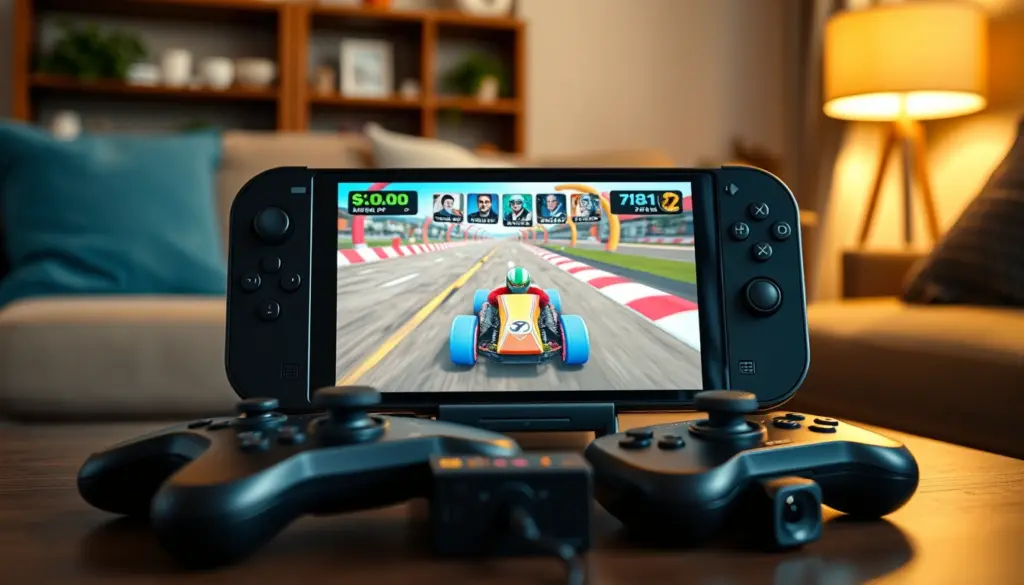
Nintendo pushed out a free update for Mario Kart 8 Deluxe on September 1-2, 2026 (the exact day depends on your time zone), and it is not a small one. Version 4.0.0 bumps the nine-year-old racer up to eight-player local multiplayer, adds a camera feature borrowed from the Switch 2’s GameChat system, and sharpens visuals specifically for owners who moved their old game over to the new console. Nintendo Life and Gematsu both confirmed the patch notes within hours of release, and Nintendo’s own support pages list Mario Kart 8 Deluxe among the Switch 2 free game updates program.
The update matters beyond the patch notes. Mario Kart 8 Deluxe is one of the best-selling games Nintendo has ever shipped, and it is still getting first-party engineering attention nine years after its original 2017 launch. That is a deliberate strategy, not an accident, and it says something about how Nintendo is managing the transition between two console generations at once. Here is what actually changed, why Nintendo is still investing in a game this old, and what it signals about the rest of 2026’s Switch 2 software roadmap.
What’s Actually New in Mario Kart 8 Deluxe Version 4.0.0
The headline change is multiplayer capacity. Mario Kart 8 Deluxe has supported four-player local split-screen since launch, and that ceiling has held for nearly a decade. Version 4.0.0 raises it to eight players on Nintendo Switch 2 hardware. According to the patch notes cited by both Nintendo Life and Gematsu, players can connect up to seven Nintendo Switch controllers (Joy-Con or Nintendo Switch Pro Controllers) to a single Switch 2 console, and reaching the full eight-player count requires at least one Joy-Con 2 controller or a Nintendo Switch 2 Pro Controller.
The update also brings the game’s visuals in line with Switch 2 hardware. Nintendo’s own patch documentation, reproduced in both outlets’ coverage, describes added support for the Nintendo Switch 2 display and high-resolution TVs, which the notes say allows for clearer visuals. Load times before races and battles have also been shortened, though neither Nintendo nor the outlets covering the patch published exact before-and-after loading numbers.
A smaller, easy-to-miss line in the patch notes, per Gematsu’s report, says player speed during races has been increased by the equivalent of one coin. It is a minor balance tweak next to the multiplayer and display changes, but it is the kind of detail that a game with a competitive community built around it does not add casually.
CameraPlay: A GameChat Feature Comes to the Track
The most unusual addition in version 4.0.0 is CameraPlay, a feature that borrows directly from the Switch 2’s built-in GameChat system. It requires a USB camera, sold separately from the console, and it is not switched on by default. Players can toggle it on or off, and per the confirmed patch notes it works in two contexts: local Multiplayer with two to four players, and Online Play.
The online implementation has a specific gate attached to it. To use a camera over the internet, players need to be in an active GameChat session, and the notes specify that camera footage and microphone audio are sent only to other members of that GameChat session, not broadcast more widely. When the feature is active, a player’s face appears on screen during the race, turning what used to be a purely competitive split-screen mode into something closer to a video-chat party game. It is the latest example of Nintendo folding console-level social features into individual gaming titles rather than keeping them siloed at the system level.
“Visuals: Optimized for the Nintendo Switch 2 display and improved image quality.”
Nintendo, Official game publisher — Nintendo Switch 2 free-updates page
Nintendo frames CameraPlay as part of a broader push to make GameChat a selling point of Switch 2 hardware rather than a one-off gimmick tied to a single launch title. Extending it into a nine-year-old racing game, rather than reserving it for new releases, suggests Nintendo wants GameChat compatibility to feel like a standard feature across its back catalogue, not a novelty.
Why Nintendo Is Still Patching a Nine-Year-Old Game
Mario Kart 8 Deluxe first released in April 2017 as a launch-window pillar for the original Switch. Free updates to enhance the gameplay experience on the Nintendo Switch 2 system are being rolled out for select Nintendo Switch games, according to Nintendo’s own hardware documentation, and Mario Kart 8 Deluxe is one of the titles named in that program. The logic is straightforward: millions of households already own the game, and rather than asking them to buy a new Switch 2-native racer, Nintendo can extend the value of hardware they already sold once by making the existing copy noticeably better on newer hardware.
“Free updates to enhance the gameplay experience on the Nintendo Switch 2 system will be released for select Nintendo Switch games.”
Nintendo, Official game publisher — Nintendo Switch 2 hardware page
That program also gives Nintendo a way to keep a title with this much cultural reach relevant without competing against its own new releases, including the newer Mario Kart World, which launched as a native Switch 2 title. Rather than retire Mario Kart 8 Deluxe once a sequel-style entry existed, Nintendo is running both games in parallel, and the free update keeps the older one from feeling like a downgrade option for anyone who upgrades their console.
Mario Kart 8 Deluxe’s Long Update History
Version 4.0.0 is not an isolated event. Nintendo has returned to Mario Kart 8 Deluxe repeatedly over the better part of a decade, sometimes for content (new tracks, characters and the Booster Course Pass DLC), and sometimes purely for platform-level upkeep like this week’s patch. The table below lines up the major version milestones on record.
| Version | Date | Headline Change |
|---|---|---|
| 2.0.0 | March 17, 2022 | Cup list expanded to 12 cups as Booster Course Pass DLC rolled out |
| 2.1.0 | August 4, 2022 | Wave-related balance and stability update |
| Custom Items update | December 7, 2022 | Free feature letting players choose which items appear in offline VS Races and select online modes |
| 3.0.3 | September 12, 2024 | Post-DLC maintenance patch |
| 3.0.4 | May 14, 2025 | Stability and bug-fix update |
| 3.0.5 | May 21, 2025 | Follow-up stability patch one week later |
| 4.0.0 | September 1-2, 2026 | Nintendo Switch 2 enhancements: sharper visuals, shorter load times, 8-player local multiplayer, CameraPlay |
The pattern is notable on its own: a game Nintendo could have simply stopped touching after the Booster Course Pass wrapped in late 2023 has instead received at least three more updates through 2025 and 2026. Few games in any publisher’s catalogue get platform-transition support nine years after release, and fewer still get a feature as visible as an 8-player mode added that late in their life cycle.
Switch 1 vs Switch 2: What Changes and What Doesn’t
Not every Mario Kart 8 Deluxe owner gets the full version 4.0.0 experience. The update installs on both the original Nintendo Switch and Nintendo Switch 2, but the headline features are gated to the newer hardware. The comparison below is drawn directly from the confirmed patch notes.
| Feature | Original Nintendo Switch | Nintendo Switch 2 |
|---|---|---|
| Display optimization | Unchanged | Support for Switch 2 display and high-resolution TVs |
| Load times | Unchanged | Shortened before races and battles |
| Local multiplayer | Up to 4 players | Up to 8 players (requires 7 connected controllers plus one Joy-Con 2 or Switch 2 Pro Controller for the 8th) |
| CameraPlay | Not available | Available in local Multiplayer (2-4 players) and Online Play with a GameChat session |
| Race speed tweak | Applies to both | Applies to both |
That split is a quiet incentive for players still on original Switch hardware to consider an upgrade. Nintendo is not removing anything from the Switch 1 experience, but it is drawing a clear line between what the console can and cannot do with a game people already own, which is a softer sales pitch than a hardware ad but works on the same audience.
The Business Logic Behind Free Cross-Generation Updates
Free updates like this one cost Nintendo relatively little engineering time compared to building a new game, and they generate a specific kind of goodwill: owners of an old, cheap game get a tangible reason to feel their purchase still matters years later. That is a different model from charging for a “remaster” or “definitive edition,” a route several other publishers have taken with older catalogue titles. Nintendo’s free-update path avoids the backlash that comes with asking players to pay twice for the same game, while still giving the company a reason to put an old title back in front of press and players during a slower part of the release calendar.
It also reinforces the value of buying a Switch 2 specifically, without Nintendo having to spend marketing dollars saying so directly. A player deciding whether the upgrade is worth it now has one more concrete answer: the games they already own keep getting meaningfully better on the new hardware, not just faster in the abstract.
Market Impact: What This Signals for the Switch 2 Software Pipeline
Nintendo’s most recent earnings disclosures have shown how much weight the company is putting on Switch 2 momentum, and free updates for beloved back-catalogue titles are a low-cost lever to keep that momentum going between bigger releases. Unlike a price cut, which shows up immediately in hardware pricing and margin conversations, a software update is nearly free to distribute and does not touch the balance sheet the same way, which makes it an easy tool to reach for during quieter stretches of the release calendar.
It also matters for retail. Bundling continued software support with hardware purchases gives retailers something fresh to advertise around ongoing Switch hardware promotions, even for a console generation that has already been on shelves for over a year. A patch note headline is not the same as a sales event, but it keeps a nine-year-old game in gaming news cycles at zero marketing cost, which is a form of free advertising Nintendo has leaned on repeatedly.
Competitive Comparison: How Rivals Handle Aging Hit Games
Nintendo is not the only company managing a console transition through legacy software support. Sony and Microsoft have both pursued versions of the same idea, though usually tied to bigger technical leaps like ray tracing or frame-rate boosts rather than adding new multiplayer modes outright. The difference with Mario Kart 8 Deluxe is scope: an 8-player mode is a genuine gameplay expansion, not just a performance patch, and it is being delivered for free rather than as part of a paid “enhanced edition.”
CD Projekt Red’s approach to The Witcher 3: Wild Hunt — Remastered offers a useful contrast. That title is shipping as a full remaster with new rendering features and a native Switch 2 build, positioned as the definitive way to play the base game going forward. Nintendo’s approach with Mario Kart 8 Deluxe is narrower and cheaper: keep the same game, add specific hardware-gated features, and skip the remaster branding entirely. Both strategies are aimed at the same outcome, extending a game’s commercial and cultural life across a console transition, but Nintendo’s version asks nothing of the player beyond downloading a patch.
Historical Context: Nine Years of Mario Kart 8 Deluxe
Mario Kart 8 Deluxe originally released in April 2017, itself an enhanced port of a Wii U game from 2014. Since then it has become one of the best-selling entries in Nintendo’s history and has stayed in heavy rotation across the entire Switch 1 life cycle. The 2022-2023 Booster Course Pass added 48 remixed tracks across six waves of paid DLC, more than doubling the game’s original track count, and it is that DLC-era engineering work that appears to have set up the custom items and later stability patches referenced in the version history above.
What makes version 4.0.0 different from everything that came before it is that it is the first update explicitly built around a second piece of Nintendo hardware. Every prior patch targeted the same console generation. This one is a bridge update, built specifically to make a Switch 1 game feel native on Switch 2 without Nintendo having to rebuild or resell it.
Multiplayer at Scale: What 8-Player Local Actually Requires
Getting to eight simultaneous local players is not a simple option toggle. Per the confirmed patch notes, players need up to seven Nintendo Switch controllers connected to a single Switch 2 console, whether Joy-Con or Nintendo Switch Pro Controllers, and the eighth player specifically requires either a Joy-Con 2 controller or a Nintendo Switch 2 Pro Controller. That is a hardware-tiered requirement rather than a pure software unlock, meaning the number of households that can actually hit the full eight-player count on day one will be smaller than the number who technically have access to the update.
It is also a meaningful jump in split-screen density for a Nintendo racing game. Four-player split-screen has been the practical ceiling for couch multiplayer racers across most of the last two console generations, largely because of screen real estate and rendering budget. Doubling that number on a single television, even with a nine-year-old game’s relatively modest rendering demands, is the kind of feature that would have been technically difficult on original Switch hardware and is only realistic now because of the Switch 2’s additional processing headroom.
What Players Are Reporting After Installing the Update
Coverage from outlets tracking the rollout describes a straightforward download-and-restart process, consistent with how Nintendo has handled prior Mario Kart 8 Deluxe patches. Nintendo’s support documentation for the Switch 2 free-updates program lists Mario Kart 8 Deluxe among a small but growing set of Switch 1 titles receiving this treatment, and the company has signaled more entries could follow as it continues expanding what free hardware-transition support looks like for its back catalogue.
“Faster loading times.”
Nintendo, Official game publisher — Nintendo Switch 2 free-updates page
“Up to 8 players can now race together in local Multiplayer mode on one system.”
Nintendo, Official game publisher — Nintendo Switch 2 free-updates page
Predictions: Where Nintendo’s Free-Update Strategy Goes Next
A few things look likely from here, based on Nintendo’s own stated program and its patch cadence over the last several years:
- More Switch 1 titles will get similar Switch 2-specific free updates. Nintendo has already described this as a program covering “select” games, not a one-off gesture toward Mario Kart 8 Deluxe alone.
- Expect load-time and display improvements to become the baseline ask for any legacy title getting this treatment, since they are the cheapest changes to implement and the easiest for players to notice immediately.
- CameraPlay is likely to expand into other Nintendo multiplayer titles before it becomes a third-party standard, since GameChat is a first-party Switch 2 feature Nintendo has an incentive to promote across its own lineup first.
- Nintendo will likely continue avoiding paid “remaster” branding for its own catalogue, preferring free incremental updates that keep goodwill high, in contrast to how some third-party publishers monetize legacy titles.
- The version 4.0.0 update is unlikely to be Mario Kart 8 Deluxe’s last. Given the game’s nine-year update history, further balance or feature patches tied to future Switch 2 firmware updates are a reasonable expectation rather than a stretch.
Should You Update Now?
For Switch 2 owners, there is no real reason to wait. The update is free, it does not remove any existing content, and the new multiplayer ceiling and CameraPlay feature are additive rather than replacing anything players already rely on. For players still on the original Switch, the update installs the same way but unlocks fewer of the headline features, since the 8-player mode and CameraPlay both require Switch 2 hardware specifically. Anyone weighing whether to buy a USB camera for CameraPlay should treat it as optional rather than necessary, since it is explicitly an add-on feature layered on top of a fully functional multiplayer mode that works without one.
Frequently Asked Questions
What version number does the new Mario Kart 8 Deluxe update bring the game to?
Version 4.0.0, released September 1-2, 2026 depending on region and time zone, according to Nintendo Life and Gematsu’s coverage of Nintendo’s own patch notes.
Is the Mario Kart 8 Deluxe update free?
Yes. Nintendo’s own hardware documentation describes it as part of a program of free updates for select Nintendo Switch games running on Nintendo Switch 2 hardware.
Do I need a Nintendo Switch 2 to get the new features?
The update installs on both original Nintendo Switch and Nintendo Switch 2, but the 8-player local multiplayer mode, CameraPlay, the display optimizations and the shortened load times are all gated to Switch 2 hardware specifically.
How many controllers do I need for 8-player local multiplayer?
You can connect up to seven Nintendo Switch controllers (Joy-Con or Nintendo Switch Pro Controllers) to a single Nintendo Switch 2 console. Reaching the full eight-player count requires at least one Joy-Con 2 controller or a Nintendo Switch 2 Pro Controller.
What is CameraPlay and do I need to buy anything for it?
CameraPlay lets players display their face on screen during races using a USB camera, which is sold separately and required for the feature. It works in local Multiplayer with two to four players and in Online Play through an active GameChat session, and camera footage and audio are only shared with members of that same GameChat session.
Does the update add any new tracks or characters?
No. Version 4.0.0 is focused on Switch 2 hardware optimization, multiplayer capacity and CameraPlay, not new race content. New tracks previously arrived through the Booster Course Pass DLC, which is a separate, already-completed content wave.
Will other Nintendo Switch games get similar Switch 2 free updates?
Nintendo has described this as an ongoing program covering select Nintendo Switch titles, which suggests more games are likely to receive comparable free updates, though Nintendo has not published a full list of which titles come next.
How do I download the Mario Kart 8 Deluxe update?
The update downloads automatically the next time you launch the game while connected to the internet, consistent with how Nintendo has distributed every prior Mario Kart 8 Deluxe patch since 2017.