
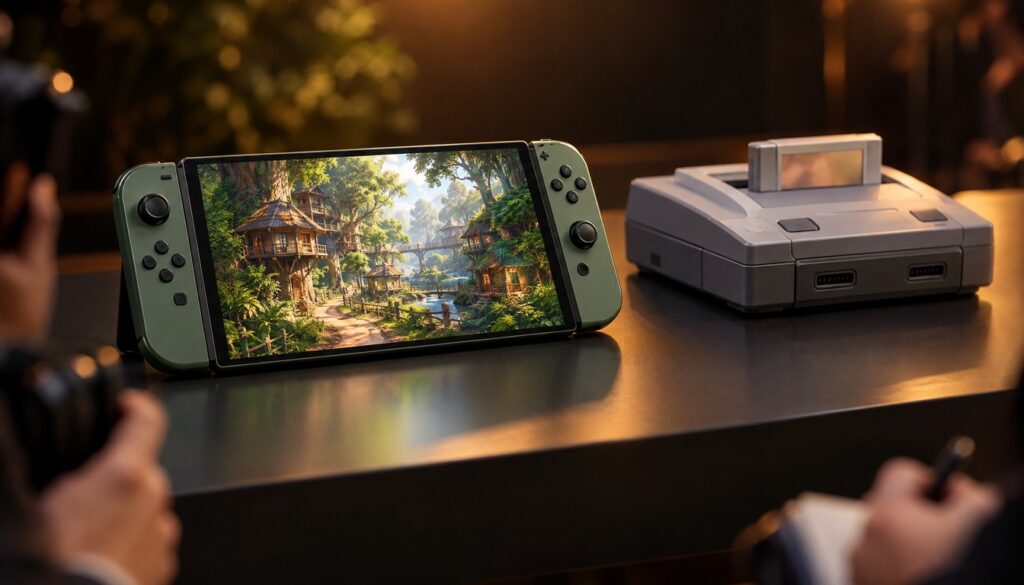
Nintendo let journalists and content creators spend hands-on time with The Legend of Zelda: Ocarina of Time on Nintendo Switch 2 this week, and the first wave of preview coverage landed on October 14, 2026, roughly three weeks before the remake’s November 5 launch. The sessions took place in New York City, and outlets including Mashable, NPR, The Verge, GamesRadar+, and Nintendo Life each came away with a different read on how faithfully Nintendo rebuilt its 1998 classic. None of them called it a simple remaster.
What emerged from the previews is a game that keeps Hyrule’s bones intact while rewiring how players move through it. A dedicated jump button, a new sprint, a pause-menu quest log called “Threads of Time,” and a companion app layer called Zelda Notes all point to a studio trying to modernize a 28-year-old adventure without erasing what made it work. This piece breaks down what’s confirmed, what outlets actually played, and where this remake sits next to Nintendo’s broader wave of Switch 2 remasters.
What Happened: Nintendo’s First Hands-On Preview Window
Nintendo rarely opens a remake to outside hands before launch, so the New York preview event is itself notable. Journalists from multiple outlets got guided time with build sections of Ocarina of Time rather than a scripted demo reel, and the resulting stories, published within hours of each other on October 14, read less like marketing copy and more like genuine first impressions, warts included. Mashable’s hands-on account described the experience as strange and beautiful in places, while also flagging specific design choices it wasn’t sold on yet.
That split reaction, visible across nearly every outlet that attended, is the real story here. This isn’t a victory-lap preview cycle where every publication parrots the same marketing beats. Writers who grew up with the Nintendo 64 original are comparing muscle memory against a rebuilt control scheme, and the early verdict is that the remake plays like a different game wearing a familiar skin. The Verge’s preview leaned into that tension directly, noting the game feels modern in ways that occasionally unsettle longtime fans rather than simply please them.
For context on how this fits into Nintendo’s release calendar, shattered.io covered the confirmed November 5 release date when Nintendo first locked it in, and later reported on the early preorder discount window retailers opened ahead of launch. Both of those pieces focused on logistics. This preview cycle is the first real look at how the game actually plays.
Release Date, Platform, and What Nintendo Has Actually Confirmed
The baseline facts are not in dispute. The Legend of Zelda: Ocarina of Time launches November 5, 2026, as a Nintendo Switch 2 exclusive title, meaning there is no version planned for the original Switch hardware. Nintendo has not published performance targets, resolution figures, file size, or a final price breakdown as part of this preview wave, and outlets covering the hands-on sessions didn’t report those specs either. Readers chasing frame-rate or resolution numbers should treat anything claiming otherwise as speculation until Nintendo publishes a technical rundown closer to launch.
What is confirmed, repeatedly and consistently across the preview coverage, is the scope of the overhaul. This isn’t Nintendo running the N64 cartridge through an upscaler. Environments, lighting, and core traversal mechanics have been rebuilt, and the studio is treating the November 5 date as a full product launch rather than a nostalgia cash-in timed to a console anniversary. The game arrives roughly three and a half weeks from today, October 14, 2026, which puts it squarely in Nintendo’s holiday lineup alongside the rest of its Switch 2 push.
A Jump Button and a Sprint: Rebuilding Link’s Core Moveset
The single biggest mechanical change previewers flagged is also the simplest to explain: Link now has a dedicated jump button. In the 1998 original, jumping was contextual, triggered automatically when Link ran off a ledge or approached specific terrain, a design limitation of the N64 era that most players never questioned because they had nothing to compare it to. The remake replaces that with direct player control, plus a sprint action layered on top of normal movement.
That sounds like a small tweak on paper, but previewers treated it as the change with the widest ripple effects. Context-sensitive jumping shaped how every dungeon puzzle, every ledge, and every piece of platforming in the original game was designed. Handing the player manual control doesn’t just modernize the feel, it potentially opens up movement options the original level design never accounted for. Early hands-on coverage suggests Nintendo kept most puzzle logic intact despite the new moveset, which raises a fair question worth watching closely once the full game ships: does a freer Link accidentally break puzzles the 1998 team balanced around a slower, more restricted character?
Combined with a redesigned item-and-weapon selection system, the control overhaul reads as Nintendo’s attempt to strip out the parts of the original that aged the worst. The N64 game’s pause-and-equip item wheel was functional in 1998 but clunky by any modern standard, forcing players to freeze the action to swap between the slingshot, bombs, and the ocarina itself. The remake ditches that pause-menu navigation in favor of something previewers describe as faster and less disruptive to combat and exploration, though exact button mapping wasn’t detailed in the coverage.
Threads of Time: A Quest Log for a Game That Never Had One
Perhaps the clearest sign of how much game design has shifted since 1998 is “Threads of Time,” a new pause-menu quest log that tracks objectives and story progress. The original Ocarina of Time expected players to remember where they’d left off, who they’d talked to, and what a given NPC wanted, using nothing more than memory, a strategy guide, or trial and error. That was normal for its era. It would be borderline unacceptable in a 2026 release.
Threads of Time addresses that gap directly, giving players a reference point without resorting to a modern open-world map marker system that would feel foreign to the original’s pacing. It’s a notably restrained solution, a log rather than a waypoint-and-arrow system, and it suggests Nintendo is trying to modernize accessibility without flattening the sense of discovery that defined the original Hyrule. Whether it fully threads that needle won’t be clear until the full game is out and players who never touched the N64 version can weigh in alongside veterans.
Zelda Notes: Bringing a 1998 Adventure Into the Companion-App Era
Outside the game itself, Nintendo confirmed integration with Zelda Notes, a companion feature running inside the Nintendo Switch App. This is the same kind of companion-app layer Nintendo has been building out across its first-party lineup, and its presence here signals that Ocarina of Time isn’t being treated as a standalone legacy re-release, it’s getting folded into Nintendo’s current live-service-adjacent app ecosystem the same way newer titles are.
The previews didn’t go deep on exactly what Zelda Notes tracks inside this specific title, but the pattern across Nintendo’s recent companion-app rollouts has been progress tracking, supplementary content, and sometimes social or sharing features tied to a player’s save file. Readers who followed Nintendo’s broader 2026 Zelda push, including the Zelda 40th Anniversary Switch 2 console that sold out within hours of release, will recognize the pattern: Nintendo is treating this anniversary year as a platform for tying its back catalog together through shared app infrastructure, not just shared branding.
Business Scrub Seeds: A Small NPC Mechanic Gets a Rework
One of the more specific mechanical details to surface from the preview build involves the Business Scrubs, the original game’s recurring merchant enemies hidden in bushes around Hyrule. In the remake, players can summon a Business Scrub by throwing a consumable item called a Business Scrub Seed, a new interaction that didn’t exist in the 1998 version. It’s a minor addition in the grand scheme of a full remake, but it’s the kind of detail that tells you Nintendo isn’t just reskinning old systems, it’s actively redesigning how individual NPCs and mechanics are triggered throughout the game.
Small mechanical additions like this one tend to matter more to series veterans than headline features do. Anyone who memorized exactly which bush concealed a Business Scrub in the original game is going to notice immediately that the rules have changed, and previewers treated it as one more data point supporting the broader narrative: layout and puzzle logic survived the jump to Switch 2, but almost every system touching those layouts has been adjusted somewhere.
Inside the Preview Build: Kokiri Forest, Hyrule Field, and the Forest Temple
Across the reported hands-on sessions, previewers got time in five recognizable areas: Kokiri Forest, the Great Deku Tree, Hyrule Field, Castle Town, and the Forest Temple. That’s a meaningful slice of the early-to-mid game, covering Link’s tutorial village, his first dungeon, the overworld hub that connects everything, the game’s central town, and the first major forest dungeon proper. It’s a broad enough sample that outlets could form real opinions about pacing, not just a five-minute vertical slice built to show off a boss fight.
Both NPR and The Verge separately reported roughly 90-minute hands-on sessions, giving writers enough time to move through more than one area and form comparative impressions rather than a single snapshot reaction. That’s a longer leash than most publisher preview events grant, and it shows in the coverage: several outlets flagged specific environmental differences rather than sticking to broad, vibes-based praise.
What Changed and What Stayed the Same in Hyrule
The most interesting tension in the preview coverage is also the hardest to summarize in a single sentence: basic area layouts and puzzle solutions were reported as nearly identical to the 1998 original, even as the studio made real topographical changes to specific zones. Previewers specifically called out alterations to Kokiri Forest and Hyrule Field, and at least one building present in the original Kokiri area was reportedly missing from the preview build. Nintendo has been explicit, through the framing of this preview wave, that the remake is not a one-to-one recreation of the original game.
That’s a meaningfully different approach than, say, a straight visual remaster that keeps every polygon position locked in place. Nintendo appears to be treating the original map as a reference document rather than a blueprint, preserving the puzzle logic that players actually remember while feeling free to adjust the physical geography around it. It’s the same instinct that shows up in Threads of Time and the reworked item menu: respect what worked, rebuild what didn’t.
Ocarina of Time: 1998 Original vs. the 2026 Switch 2 Remake
The table below lays out the confirmed differences between the N64 original and the Switch 2 remake, based strictly on details that have surfaced through Nintendo’s own announcements and the October 14 preview coverage. Anything not confirmed in that material is marked accordingly rather than guessed at.
| Feature | 1998 Original (N64) | 2026 Switch 2 Remake |
|---|---|---|
| Jump control | Context-sensitive, automatic near ledges | Dedicated jump button, player-controlled |
| Movement options | Walk and run only | Adds a sprint action |
| Quest tracking | None; relied on player memory | “Threads of Time” pause-menu log |
| Item/weapon selection | Pause-menu navigation required | Redesigned, avoids full pause navigation |
| Companion app support | None | Zelda Notes via Nintendo Switch App |
| Business Scrub encounters | Hidden in fixed bush locations | Summonable via consumable Business Scrub Seed |
| Platform | Nintendo 64 | Nintendo Switch 2 exclusive |
| Map geography | Fixed reference layout | Adjusted in places (e.g., Kokiri Forest, Hyrule Field) |
| Price, resolution, frame rate | N/A (period hardware) | Not confirmed as of October 14, 2026 |
How This Preview Stacks Up Against Nintendo’s Other Switch 2 Remakes
Ocarina of Time isn’t launching into a vacuum. 2026 has been a remake- and remaster-heavy year for Switch 2, and this preview cycle gives the clearest signal yet of where Nintendo is positioning its highest-profile back-catalog project. Capcom’s approach with its Resident Evil output on the platform leaned on raw sales performance as the pitch, while other publishers have used the hardware jump mostly to fix framerate and loading complaints from launch-era ports.
By contrast, Nintendo’s own previewed changes to Ocarina of Time, the jump button, the sprint, the quest log, the reworked item menu, go well beyond a technical uplift. That’s closer to the philosophy shattered.io covered in its review of Dragon’s Dogma 2: Dark Arisen on Switch 2, where the studio held a steady frame-rate target rather than chasing native resolution, prioritizing feel over spec-sheet bragging rights. It also echoes the file-size and content-bundling choices Square Enix made with Kingdom Hearts III + Re Mind’s Switch 2 port, another case of a publisher treating a Switch 2 release as a full package rather than a quick cash-in conversion.
| Switch 2 Remake/Remaster | Publisher | Approach |
|---|---|---|
| Ocarina of Time (Nov. 5, 2026) | Nintendo | Full control and UI rebuild, adjusted map geography |
| Dragon’s Dogma 2: Dark Arisen | Capcom | Performance-focused port, steady frame-rate target |
| Kingdom Hearts III + Re Mind | Square Enix | Full content bundle port, large install size |
| Resident Evil 2/3/4 Remakes | Capcom | Visual and performance remaster of modern remakes |
| Witcher 3 Remastered | CD Projekt | Remaster parity push across Switch 2 and other platforms |
The pattern across that table is worth sitting with: nearly every major publisher bringing a flagship catalog title to Switch 2 in 2026 chose to go deeper than a simple resolution bump, and Nintendo’s own Ocarina of Time remake, based on this week’s preview coverage, is arguably the most structurally ambitious of the group, since it’s rebuilding core verbs like jumping and sprinting rather than just upgrading how the game looks running them.
Why Nintendo Keeps Remaking Its Own Back Catalog
There’s a straightforward business logic behind remaking a 28-year-old game instead of greenlighting something entirely new: Ocarina of Time already has a built-in audience that spans multiple generations, from players who bought it on N64 in 1998 to those who only know it through emulation, YouTube retrospectives, or hand-me-down consoles. A remake carries dramatically lower creative risk than an original title while still commanding a full-price release, and Nintendo’s 2026 calendar has leaned hard into exactly that formula across its Zelda 40th Anniversary push.
That calendar logic lines up with what shattered.io has tracked throughout the year, including the cluster of four Zelda-related Switch 2 launches packed into a two-week window earlier this fall. Stacking anniversary releases close together isn’t an accident, it’s a deliberate attempt to keep a single franchise’s momentum in the news cycle and on store shelves for as long as possible heading into the holidays, with Ocarina of Time positioned as the capstone release of that push.
Historical Context: What Ocarina of Time Means to the Industry
The Legend of Zelda: Ocarina of Time originally launched on the Nintendo 64 in 1998 and is widely credited, across decades of games-criticism retrospectives, with popularizing conventions that are now considered standard in 3D action-adventure design, including lock-on targeting and context-sensitive interaction systems. Revisiting those same systems 28 years later with a dedicated jump button is a quiet acknowledgment that some of the original’s design shortcuts, forced by N64-era hardware and control limitations, no longer need to exist.
That makes this remake a genuinely interesting test case in a way most remasters aren’t. Plenty of remakes update graphics and leave mechanics alone, or vice versa. Based on the preview coverage, Nintendo is attempting both simultaneously on one of the most influential and most scrutinized games ever made, for an audience that includes people who can recite the game’s dungeon order from memory. GamesRadar+’s preview framed the stakes in similar terms, treating the remake less as a straightforward victory lap and more as a genuine creative gamble on a game many fans already consider untouchable.
What’s Still Unconfirmed Heading Into Launch
It’s worth being precise about the gaps in what’s known right now, on October 14, 2026, three weeks before release. Nintendo has not published final pricing, exact resolution or frame-rate targets, download file size, or the contents of any launch-edition bundle tied to this remake. None of the preview coverage from this week’s New York event detailed those specifications either, which suggests Nintendo deliberately kept this round of access focused on gameplay feel rather than technical benchmarking.
That’s a meaningful gap for anyone trying to budget for the November 5 release, and it leaves room for a second wave of previews, closer to launch, that likely will cover those technical details directly. Readers should treat any specific price or frame-rate figure circulating online right now as unconfirmed until Nintendo or a verified hands-on outlet publishes it directly.
Predictions: What Happens Between Now and November 5
- Expect Nintendo to publish a dedicated technical breakdown, likely covering resolution and frame-rate targets, within the next two weeks, mirroring how it handled previous Switch 2 exclusive launches.
- More hands-on coverage will likely surface from additional outlets that didn’t attend the initial New York event, broadening the sample of areas previewed beyond Kokiri Forest, Hyrule Field, and the Forest Temple.
- The Business Scrub Seed mechanic and the redesigned item menu will probably draw the most detailed breakdown videos once review copies go out, since both are small enough to dissect frame-by-frame but significant enough to affect moment-to-moment play.
- Expect comparison content pitting this remake’s new jump-and-sprint moveset against the original 1998 controls to become one of the most-searched pieces of Zelda content in the run-up to launch.
- Given Nintendo’s pattern this year of stacking Zelda 40th Anniversary content tightly together, a last wave of marketing, trailers, or a final Nintendo Direct segment focused specifically on this remake is likely before November 5.
The Bottom Line for Players Deciding Whether to Buy
Strip away the marketing language, and what’s actually confirmed is this: Nintendo rebuilt Link’s core moveset, added a quest log the original badly needed, folded the game into its companion-app ecosystem, and preserved the broad strokes of a map players have had memorized for nearly three decades while still making targeted changes to it. Every outlet that got hands-on time came away with a nuanced take rather than uncritical praise, which is itself a sign that Nintendo let real impressions through rather than tightly controlling the narrative.
For players weighing a November 5 purchase, the honest answer right now is that the gameplay-feel questions are mostly settled, favorably, while the practical questions, price, performance, and final file size, are not. Anyone holding out for those specifics should expect answers within the next two to three weeks, not at launch.
Frequently Asked Questions
When does the Ocarina of Time Switch 2 remake release?
Nintendo has confirmed a November 5, 2026 release date for The Legend of Zelda: Ocarina of Time on Nintendo Switch 2.
Is the Ocarina of Time remake a Switch 2 exclusive?
Yes. The remake is confirmed as a Nintendo Switch 2 exclusive title, with no version announced for the original Nintendo Switch.
What is new in the Ocarina of Time Switch 2 remake?
Confirmed additions include a dedicated jump button, a sprint action, a pause-menu quest log called Threads of Time, a redesigned item-and-weapon selection system, Zelda Notes integration through the Nintendo Switch App, and a reworked Business Scrub encounter triggered by a consumable Business Scrub Seed.
Which areas were shown in the hands-on preview?
Reported hands-on sessions covered Kokiri Forest, the Great Deku Tree, Hyrule Field, Castle Town, and the Forest Temple.
Is this a 1:1 recreation of the original N64 game?
No. Nintendo and previewers have confirmed it is not a one-to-one recreation. While basic area layouts and puzzle solutions are nearly identical to the original, some environments, including Kokiri Forest and Hyrule Field, show topographical changes.
What is the price of the Ocarina of Time Switch 2 remake?
Nintendo had not confirmed final pricing as of October 14, 2026, the date this preview coverage published. Readers should wait for official pricing details from Nintendo rather than relying on unconfirmed figures.
What is Zelda Notes?
Zelda Notes is a companion feature inside the Nintendo Switch App that integrates with the Ocarina of Time remake, part of Nintendo’s broader push to tie its games into app-based companion tools.
How long were the preview sessions?
NPR and The Verge both reported hands-on sessions of approximately 90 minutes during the New York preview event.