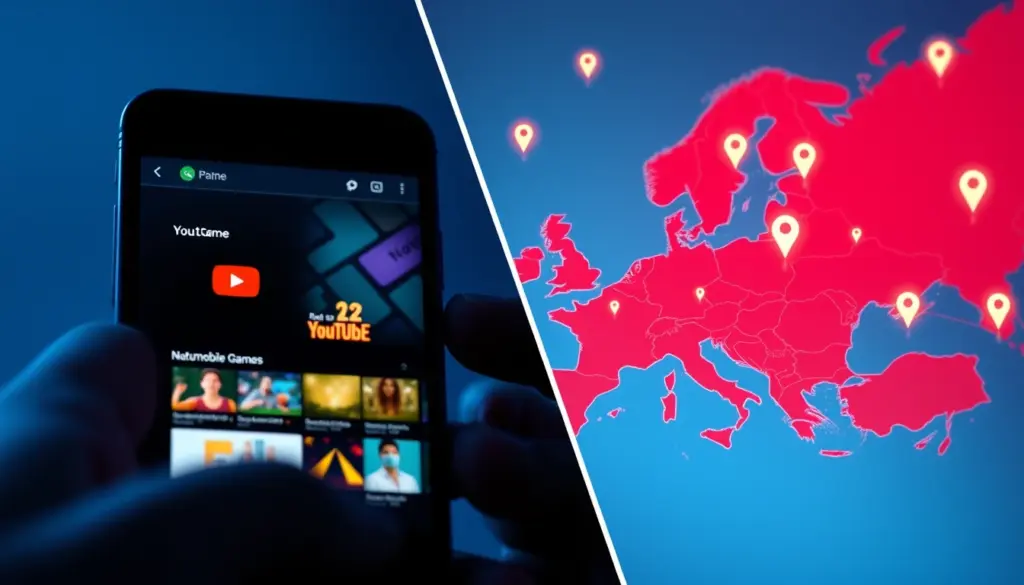
YouTube quietly pushed Playables, its free instant-game hub built into the YouTube app, into more than 50 countries this week, a sevenfold jump from the seven markets it launched with back in 2024. The expansion adds the European Union and the Nordic countries to a lineup that started with the United States, the United Kingdom, Canada, Australia, India, Malaysia, and Türkiye, according to PocketGamer.biz and MobileGamer.biz. There was no keynote, no press event, and no blog post from Google marketing. Joel Jansson, YouTube’s gaming partnerships manager, confirmed the rollout in a LinkedIn post rather than a stage announcement, a low-key move for a product now sitting in front of one of the largest audiences in consumer tech.
The timing matters. Mobile gaming spend is flat to slightly down across most trackers this year, and YouTube is walking into that soft market with a product built on a premise that sounds almost old-fashioned: instant, free, no-download browser games served to people who are already watching video. It is a bet Meta made a decade ago with Facebook Instant Games, and one that mostly fizzled. Google is trying it again, on a platform with billions of logged-in monthly users, and this time with none of the in-app purchase machinery that usually funds mobile games.
From Seven Markets to Fifty in Two Years
YouTube Playables launched in 2024 with 75 titles spread across seven countries. Growth from there was slow and mostly unannounced. Reports place the earliest sighting of the wider rollout around September 24, 2026, with PocketGamer.biz publishing its own confirmation on September 28. Between those two dates, YouTube pushed access past the 50-market mark, adding the EU bloc and the Nordic region in one motion rather than a country-by-country drip.
Neither outlet has published a full country list for the new footprint, and YouTube has not issued its own release naming every territory. What is confirmed is the scale of the jump: a product that spent two years confined to a handful of English-heavy and South Asian markets is now live across most of Europe. That is a meaningful shift for developers who build hypercasual titles, since EU users historically convert at different rates than US or Indian audiences, and ad rates in Nordic markets in particular tend to run well above the global average.
How YouTube Playables Actually Works
Playables are not apps. They run through standard web-platform APIs directly inside the YouTube mobile app and the YouTube website, so a user taps a game tile and starts playing in seconds with nothing to install and nothing to delete afterward. That distribution model removes the single biggest source of friction in mobile gaming: the download-and-open gap where most casual players simply give up.
YouTube added live-streaming and chat functionality to Playables back in September 2025, letting creators play a Playable on stream while viewers jump into the same game from the video page. That feature matters more than it sounds. It turns a YouTube gaming channel into a built-in acquisition funnel for a Playable title, something neither the App Store nor Google Play can replicate without a separate ad buy.
The Games Driving Early Traffic
YouTube has highlighted a small cluster of titles as proof points. Build A Queen, Snake Clash, and Stealth Master have combined for more than 90 million plays, according to MobileGamer.biz. Tall Man Run, published by hypercasual studio Supersonic, had separately reached 106 million plays. Playgama, a Playables-focused publisher, claims it holds the platform’s largest portfolio at roughly 50 active games as of July 2026, generating about 57 million plays in June alone, per a LinkedIn post from its co-founder Pavel Polovinka.
Those numbers need a caveat. Plays are not unique users, and none of the companies involved, YouTube included, have published a monthly active user figure for Playables as a whole. A single player replaying Snake Clash ten times in a session counts as ten plays. Until Google discloses MAU or DAU data, the play counts function more as a marketing signal than a comparable industry metric.
Who Is Building for the Platform
The developer roster reads like a hypercasual all-star list. SayGames, Supercent, Supersonic, Voodoo, Playgama, TapNation, and CrazyLabs all have titles in YouTube’s current highlight rotation. The original 2024 trial ran with a smaller group, including Rovio, Voodoo, ZeptoLab, Homa, Azur, and FRVR, several of which built their entire business on rapid, ad-funded mobile releases long before Playables existed.
For these studios, Playables is a new distribution channel that costs nothing to enter and skips app store review entirely. That is attractive at a moment when hypercasual ad revenue, per Sensor Tower, is running close to flat year over year. A free channel with YouTube’s reach is worth testing even before the monetization terms are fully settled, and several publishers appear to be doing exactly that ahead of any formal revenue-share agreement.
Monetization: Free Today, Ads and Purchases Later
As of September 29, 2026, Playables has no in-app purchases, per PocketGamer.com’s reporting. Users play for free, full stop. That is unusual for a mobile-adjacent gaming product in 2026, when in-app purchases still drive the bulk of industry revenue.
Jansson indicated in his LinkedIn post, as reported by MobileGamer.biz, that Google is targeting a test of in-app-purchase solutions sometime in 2027. On the advertising side, Playgama claims YouTube began testing ad monetization in a limited set of geographies with a restricted developer group back in March 2026, and that its own games averaged roughly $3,100 a month in earnings during that closed beta. Both figures come from the developer, not from YouTube, and should be read as one publisher’s early experience rather than a platform-wide benchmark. Google has not published its own revenue-share terms, ad formats, or payout schedule for Playables.
YouTube Playables vs. Facebook Instant Games
The obvious historical comparison is Facebook Instant Games, the HTML5 instant-play format Meta built into the Facebook app and Messenger starting in 2016. Instant Games leaned on Facebook’s social graph: friend invites, leaderboards pushed into the News Feed, and Messenger-based challenges. It grew fast, then faded as Meta shifted investment toward Reels and, later, VR. Facebook never fully shut the format down, but it stopped being a growth story years ago.
Playables borrows the no-install, browser-based format but swaps Facebook’s social graph for YouTube’s video discovery engine and creator-driven live streams. That is a genuinely different acquisition mechanic. Instead of a friend inviting you to a game, a streamer plays it live and viewers join mid-broadcast. Whether that converts better than social invites did remains untested at scale, since YouTube has not disclosed comparable engagement data.
Feature Comparison: Playables, Instant Games, Arcade, and Play Games
| Feature | YouTube Playables | Facebook Instant Games | Apple Arcade | Google Play Games |
|---|---|---|---|---|
| Distribution | YouTube app and website | Facebook app, web, Messenger | App Store, requires download | Google Play ecosystem |
| Installation required | No | No | Yes | Usually yes |
| Core format | Web-platform instant games | HTML5 instant games | Native downloadable titles | Native and web hybrid |
| Price to user | Free | Free | Paid subscription | Free, ad-supported, or paid |
| In-app purchases | None as of Sept 2026; testing planned 2027 | Historically supported | None within subscription | Common |
| Growth driver | YouTube video and creator streams | Facebook social graph, invites | Curated premium catalog | App store discovery, identity |
Where Playables Sits Against Apple Arcade and Google Play Games
Apple Arcade takes the opposite approach: a paid monthly subscription buys access to a curated catalog with no ads and no in-app purchases inside included titles. It is a premium play aimed at users who want to avoid ad-funded mobile gaming entirely. Playables, by contrast, is closer to disposable, ad-adjacent entertainment squeezed between YouTube videos, free for everyone and monetized (eventually) through advertising and maybe purchases.
Google Play Games occupies a third lane. It is the native distribution and identity layer for Android gaming, handling achievements, cloud saves, and cross-device play for apps that still require installation. Playables does not compete with Play Games so much as sit beside it, offering a lighter-weight, zero-commitment alternative for casual players who would never bother downloading a full game in the first place. That the two products live inside the same company without being merged says something about how differently Google views casual discovery versus committed play.
The Mobile Gaming Market Playables Is Stepping Into
Playables is not launching into a booming market. Sensor Tower’s first-half 2026 figures show mobile games generated roughly $40 billion in in-app-purchase revenue, down 2% year over year, on 24 billion downloads, down 11.9%. Total playtime held close to flat at around 221 billion hours. A separate Sensor Tower breakdown of hypercasual and casual advertising from February through April 2026 put hypercasual ad revenue at approximately $2.02 billion, casual games at $2.01 billion, hybrid-casual at $827 million, and mid-core titles at $190 million.
Newzoo’s 2026 estimates for the mobile segment vary by report, landing anywhere between roughly $103 billion and $121.1 billion depending on which forecast version and revenue scope is cited, against a total global games market Newzoo has pegged near $213.9 billion. That spread, tracked by outlets like Statista, is wide enough that it should be treated as a range rather than a single hard number until Newzoo’s original report is checked directly. Either figure still makes mobile the largest single slice of global game revenue, and it is the slice YouTube is now angling into with a free, ad-only product, a segment shattered.io has tracked closely in its coverage of mobile gaming’s $6.57 billion download quarter.
2026 Mobile Gaming Market Snapshot
| Metric | Figure | Source |
|---|---|---|
| Mobile IAP revenue, H1 2026 | ~$40 billion (down 2% YoY) | Sensor Tower |
| Mobile downloads, H1 2026 | 24 billion (down 11.9% YoY) | Sensor Tower |
| Mobile playtime, H1 2026 | ~221 billion hours (flat YoY) | Sensor Tower |
| Hypercasual ad revenue, Feb-Apr 2026 | ~$2.02 billion | Sensor Tower |
| Casual game ad revenue, Feb-Apr 2026 | ~$2.01 billion | Sensor Tower |
| Global games market, 2026 forecast | ~$213.9 billion (up 6.1%) | Newzoo (reported) |
| Mobile games segment, 2026 forecast | $103B-$121.1B (range, conflicting reports) | Newzoo (reported) |
Why Google Is Pushing This Now
Google is not short on gaming products. It already runs Google Play Games, Stadia’s leftover cloud infrastructure, and YouTube Gaming as a content vertical. Playables gives it something the others do not: a zero-friction entry point tied directly to the single largest video platform on the internet. Every YouTube session is a potential Playables session, with no separate download and no separate account.
That matters more in a market where downloads are falling. Sensor Tower’s 11.9% download decline is not a one-quarter blip. It reflects a broader user fatigue with installing yet another mobile game, one that has been building for a while and that shattered.io examined in detail in its report on mobile gaming’s 25% download drop. Instant, install-free games sidestep that fatigue entirely. If YouTube can convert even a small fraction of its billions of daily video views into game sessions, it does not need a hit rate anywhere near what a traditional app store listing requires to matter at scale.
What It Means for Hypercasual Studios
For hypercasual and casual publishers already squeezed by the ad-revenue plateau documented in Sensor Tower’s numbers, Playables looks like a low-risk way to reach new users without competing for App Store or Play Store visibility. Voodoo, Supersonic, and SayGames built their businesses on volume: launch dozens of cheap titles, keep the ones that stick, cut the rest. Playables lowers the cost of that experimentation further, since there is no build-and-submit cycle through Apple or Google’s review process.
The risk is concentration. Every developer named in the available reporting is already a hypercasual specialist, the same group that has struggled most as install-driven growth has slowed. If Playables becomes just another outlet for an already oversaturated genre, it inherits that genre’s problems rather than solving them. Studio interest in generative tooling to keep output high while budgets tighten, a trend shattered.io covered in its report on Japanese developers adopting generative AI, suggests publishers are already looking for ways to cut production costs regardless of which distribution channel wins.
Historical Context: Instant Games Have Been Tried Before
Browser and instant-play gaming has a long, uneven history. Flash games dominated casual gaming through the 2000s until Flash’s own security problems and Apple’s refusal to support it on iOS killed the format. Facebook Instant Games picked up some of that audience in 2016 before fading as Meta’s priorities shifted. Snapchat has run its own minigames platform with mixed public traction. Each attempt proved the model can work at a moment in time, but none sustained dominant, durable scale the way native app stores eventually did.
YouTube’s advantage over those earlier attempts is reach and habit. Users already open the app dozens of times a week for video, and Playables asks for zero additional intent, just a tap. That is structurally different from asking someone to open Facebook specifically to play a game, or to seek out a dedicated instant-games hub. Whether reach alone is enough to avoid the fade that hit Flash and Instant Games is the open question hanging over the whole expansion.
Competitive and Market Impact
The immediate competitive pressure lands on ad-funded platforms that compete for the same viewer attention, including Twitch, whose own creator ecosystem has already faced pressure from rivals gaining ground, a shift detailed in shattered.io’s coverage of Twitch and Kick’s viewership numbers. A creator who can drop a Playable directly into a livestream on YouTube has a built-in monetization and engagement tool that Twitch does not natively offer in the same form.
It also puts subscription gaming services on notice. Services like Xbox Game Pass and PlayStation Plus already face churn tied to cost, a factor examined in shattered.io’s report on subscription cancellations. Playables does not compete directly with premium console subscriptions, but it does compete for the same discretionary entertainment minutes, and it does so at a price point, free, that no subscription service can undercut.
Five Predictions for Where Playables Goes Next
- Ad monetization expands beyond the small test group Playgama described, likely broadening region by region through 2027 rather than launching everywhere at once.
- In-app-purchase testing begins in 2027 as Jansson indicated, starting in a handful of markets before any global rollout.
- More hypercasual publishers treat Playables as a low-cost user-acquisition channel, following Voodoo and Supersonic’s early participation, which could push play counts well past the 106 million mark Tall Man Run has already reached.
- YouTube discloses a monthly active user or daily active user figure for Playables within the next two to three quarters, once the ad business is mature enough to justify the marketing value of a real number.
- Meta responds with renewed investment in Facebook Instant Games or a successor product, rather than ceding the instant-play category to Google without a fight.
The Risks Nobody Has Answered Yet
Free, install-free games at YouTube’s scale invite the same problems that hit every instant-play platform before it. Ad fatigue is the obvious one: once ads roll out broadly, the frictionless appeal that makes Playables attractive today could erode fast if ad loads climb the way they typically do once a platform proves it can monetize. Click fraud and fake engagement are a second concern, particularly once real money enters the picture through the planned 2027 in-app-purchase tests.
There is also a transparency gap. Google has not published official player numbers, revenue-share terms, or a full list of the 50-plus markets now covered. Developers are largely operating on secondhand reporting and LinkedIn posts from a mid-level partnerships manager rather than an official product page. That opacity is manageable while Playables is small, but it becomes a bigger liability the more studio revenue starts to depend on the platform.
Frequently Asked Questions
What is YouTube Playables?
Playables is a free, instant-play games feature built directly into the YouTube app and website. Users tap a game and start playing immediately, with no separate app download.
How many markets is YouTube Playables available in now?
More than 50, up from the seven markets it launched with in 2024: the United States, United Kingdom, Canada, Australia, India, Malaysia, and Türkiye. The 2026 expansion added the European Union and the Nordic countries.
Does YouTube Playables have in-app purchases?
No, not as of September 29, 2026. YouTube’s Joel Jansson has indicated Google is targeting a test of in-app-purchase options sometime in 2027, but nothing has been confirmed publicly by YouTube itself.
Which developers have games on YouTube Playables?
Highlighted publishers include SayGames, Supercent, Supersonic, Voodoo, Playgama, TapNation, and CrazyLabs. Earlier trial partners included Rovio, ZeptoLab, Homa, Azur, and FRVR.
Is YouTube Playables free to play?
Yes. All Playables titles are currently free with no in-app purchases. Some ad monetization testing has reportedly started in limited markets, according to developer Playgama, though this has not been confirmed as a universal policy by YouTube.
How does YouTube Playables compare to Facebook Instant Games?
Both offer free, no-install browser-based games, but Playables uses YouTube’s video and livestream audience for discovery, while Instant Games relied on Facebook’s social graph and Messenger invites.
How big is the mobile gaming market Playables is entering?
Sensor Tower puts H1 2026 mobile in-app-purchase revenue at roughly $40 billion, down 2% year over year, while Newzoo’s 2026 forecasts for the mobile segment range from about $103 billion to $121.1 billion depending on the report.
Will YouTube Playables replace mobile apps?
Unlikely in the near term. Playables suits short, casual sessions well, but core and mid-core games with deeper systems still depend on native app features that a browser-based format cannot fully replicate yet.