
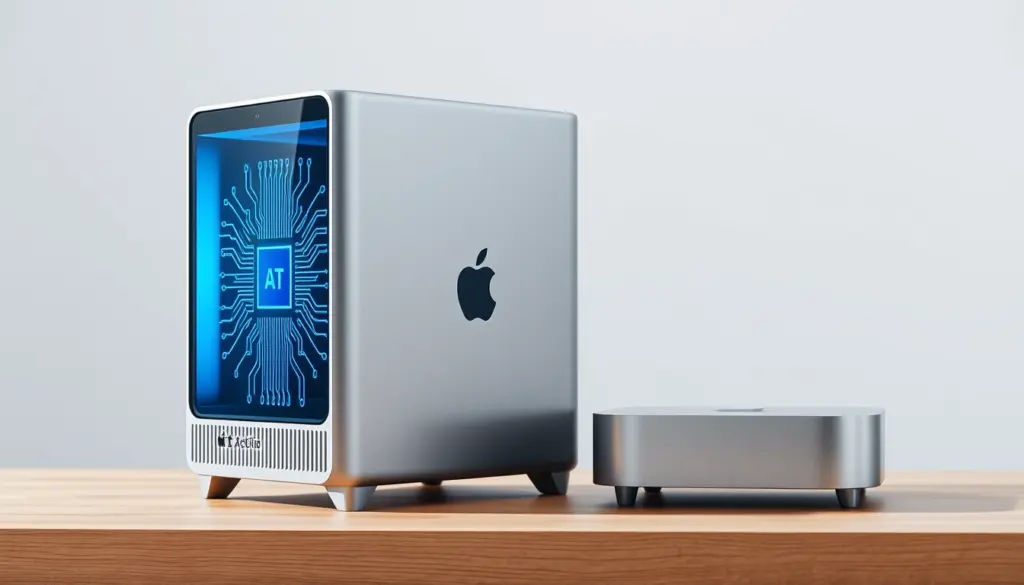
Apple pushed out a Mac hardware update on August 25, 2026, that nobody had on their bingo card for late summer. In a newsroom post from Cupertino, the company introduced two new chips, the M6 and the M5 Ultra, arriving inside a refreshed Mac mini and Mac Studio. Apple said the pair delivers “an extraordinary leap in performance and AI capabilities,” and for once the marketing line lines up with what’s actually inside the box: a first-of-its-kind 2nm process for M6 and a first-ever quad-die design for M5 Ultra.
The timing matters as much as the specs. Apple typically saves hardware news for September keynotes tied to the iPhone. Shipping new Macs a month early, according to Forbes, reads like a company clearing its desktop lineup before the fall device cycle takes over the news. It also reads like a company that wants “local AI compute” in the headline before its rivals get there first.
What Apple actually announced on August 25
The core news is simple: two new chips, two new machines. The M6 debuts inside a new Mac mini. The M5 Ultra debuts inside a new Mac Studio. Both were confirmed in Apple’s own newsroom announcement, dated August 25, 2026, and published from Cupertino, California. Apple framed both chips around the same theme: more raw performance, and a lot more capacity for running AI workloads directly on the machine instead of routing them to a cloud server.
Pre-orders opened the same day the announcement went live. Apple and multiple outlets, including TidBITS, reported that most configurations ship starting Tuesday, September 22, 2026. One configuration is running later than the rest: a Mac Studio with the M5 Ultra chip and 512GB of RAM was reported to arrive in late October, a gap that points to either binning constraints on the highest-memory die or simple manufacturing ramp lag on a brand-new quad-die package.
Pricing anchors matter here too. Mac Studio pricing starts at $2,499, unchanged from the prior generation’s entry point, according to Apple’s own materials. That entry price covers the M5 Max configuration, not the Ultra chip, which is the split Apple has used since it started selling two chip tiers under one Mac Studio name.
M6: Apple’s first 2-nanometer chip
The M6 is the more quietly significant of the two chips, because it marks Apple’s first shipping product built on a 2-nanometer process, as reported by both Tom’s Hardware and CineD. Every prior Apple Silicon generation, from the original M1 through M5, shipped on 3nm or larger nodes. Moving to 2nm is a manufacturing milestone before it’s a consumer one: it’s the difference between Apple riding TSMC’s leading edge and Apple waiting a generation behind it.
On the spec sheet, Apple describes M6 as carrying a 12-core CPU and a 12-core GPU with neural accelerators built into each GPU core, a design Apple first introduced with M5. The bigger change is a new dual 16-core Neural Engine, which multiple outlets reported as roughly doubling the on-device AI compute available to the previous Mac mini generation. For a machine that starts under $1,000, that’s a meaningful jump in how much AI inference work can happen without touching a cloud API.
The Mac mini itself picked up a second CPU option alongside M6, giving buyers a choice between the new chip and a carried-over M5 Pro tier, according to reporting on the launch. That mirrors how Apple has structured its lower-cost desktop line for several generations: a base chip for most buyers, a Pro-class chip one step up, and no Max or Ultra option in that chassis.
M5 Ultra: the first quad-die Apple Silicon chip
M5 Ultra is where Apple is making its loudest claim. The company called it the most powerful chip it has ever shipped, and the architecture backs that up on paper. Apple’s Ultra chips have always been built by fusing two Max-class dies together with a custom interconnect called UltraFusion. M5 Ultra goes a step further: it’s Apple’s first quad-die design, reportedly stitching four dies into a single package rather than two.
The headline number tied to that jump is memory bandwidth. Apple said M5 Ultra delivers 50% more memory bandwidth than its predecessor, the M3 Ultra. That’s the figure that matters most for anyone running large language models locally, since bandwidth, not raw compute, is usually the bottleneck once a model no longer fits comfortably in cache. More bandwidth means a model with more parameters can still produce tokens at a usable pace instead of stalling while data moves back and forth from memory.
Reporting around the launch, including coverage from ServeTheHome, describes the new Mac Studio’s top configuration supporting up to 512GB of unified memory, which is what makes the “run a frontier-scale model entirely on one desktop” pitch plausible instead of theoretical. Apple has leaned on unified memory as its differentiator against GPU-based AI hardware for three generations now, and M5 Ultra pushes that argument further than any Mac has before it.
M6 and M5 Ultra: the specs side by side
| Spec | M6 (Mac mini) | M5 Ultra (Mac Studio) |
|---|---|---|
| Process node | 2nm (Apple’s first) | Built from Apple’s current-gen node |
| Die architecture | Single die | Quad-die via UltraFusion (Apple’s first) |
| CPU cores | 12-core | Not fully disclosed in early coverage |
| GPU | 12-core, with neural accelerators | Not fully disclosed in early coverage |
| Neural Engine | Dual 16-core (new design) | Not fully disclosed in early coverage |
| Memory bandwidth vs. predecessor | Not disclosed | +50% vs. M3 Ultra |
| Host machine | Mac mini | Mac Studio |
| Ships | September 22, 2026 (most configs) | September 22, 2026; 512GB config in late October |
Note the gaps in that table. Apple’s own newsroom post and the fact sheet available at launch confirmed the process node, the die architecture, and the bandwidth increase, but didn’t spell out a full core-count breakdown for M5 Ultra the way it did for M6. That’s consistent with how Apple has rolled out Ultra-class chips before, front-loading the memory and AI-compute story and leaving granular CPU/GPU core counts for spec-sheet pages and third-party teardown testing in the following weeks.
Why Apple is suddenly talking about AI compute, not just speed
For most of Apple Silicon’s run, the sales pitch was efficiency: more performance per watt than Intel, longer battery life, quieter fans. That pitch is still true, but it’s no longer the whole story. Starting with M5 and continuing here, Apple is explicitly selling these chips as local AI infrastructure, not just as fast computers. The neural accelerators built into every GPU core, the doubled Neural Engine in M6, and the memory bandwidth jump in M5 Ultra are all aimed at the same use case: running large models on-device instead of over the network.
That’s a genuine strategic pivot. A Mac Studio with enough unified memory to hold a several-hundred-billion-parameter model isn’t competing with a MacBook Air anymore, it’s competing with a rack of GPUs or a cloud inference bill. Apple is betting that developers, researchers, and privacy-conscious enterprises will pay a premium to keep that workload on a desk instead of in someone else’s data center. It’s the same logic that’s driving Nvidia’s DGX Spark and a wave of AI-focused mini PCs, just approached from Apple’s unified-memory angle instead of a discrete-GPU one.
How the new Macs compare to the desktop AI-compute competition
Apple isn’t the only company selling a small, expensive box for running AI models at your desk. Nvidia’s DGX Spark, which started shipping earlier in 2026, occupies a similar niche: a compact machine built specifically to let developers prototype and run large models locally rather than renting cloud GPU time. The two products make very different trade-offs, and the gap says a lot about how each company thinks about the local-AI-hardware market.
| Spec | Mac Studio (M5 Ultra, top config) | Nvidia DGX Spark |
|---|---|---|
| Unified memory (max) | Up to 512GB | 128GB LPDDR5x |
| Memory bandwidth | +50% vs. M3 Ultra | 273 GB/s |
| Starting price | $2,499 (M5 Max base config) | Around $4,699 as of August 2026 |
| Physical footprint | Desktop tower form factor | About 6 x 6 x 2 inches, 2.6 lbs |
| Clustering | Multiple Mac Studios can be linked for AI workloads | Designed as a standalone dev box |
| Primary pitch | Run very large models locally with high memory headroom | Portable, CUDA-native local dev environment |
The memory gap is the headline. At its top configuration, Apple’s new Mac Studio offers four times the unified memory of Nvidia’s box, according to specs published by Vast.ai’s rundown of the DGX Spark. That matters because memory capacity, not raw compute, is what decides whether a specific model even loads without quantization. DGX Spark’s 273 GB/s of bandwidth is comparatively modest, which is the tradeoff Nvidia made to hit a smaller, more portable form factor and a lower price than a full DGX workstation.
Neither machine wins outright. DGX Spark plugs straight into Nvidia’s CUDA ecosystem, which is still where most published AI research code runs first. The Mac Studio wins on raw memory headroom and on Apple’s own software stack, which increasingly supports running open-weight models locally through Apple’s on-device AI tooling. Buyers picking between the two are really picking between two different bets: CUDA compatibility and portability, or memory capacity and desktop-class multitasking.
Mac clustering: the part that’s easy to miss
One detail from the launch that’s easy to skip past: reports describe Apple positioning multiple Mac Studios as a cluster for AI workloads, not just as standalone desktops. That’s not a new idea in principle, Apple has supported Thunderbolt-based clustering for rendering and compute tasks before, but pairing it explicitly with AI inference is new framing. If a small studio or research team can link a handful of Mac Studios together and get meaningfully faster inference than one machine alone, that changes the calculus against renting cloud GPU clusters for teams that already have Macs on hand for other work.
It’s also a hedge against the memory ceiling. Even 512GB of unified memory eventually runs out against the largest frontier models. Clustering gives Apple a story for what happens next without having to ship a chip bigger than M5 Ultra to answer it.
The historical pattern: Apple Silicon’s six-year AI pivot
Apple announced its transition away from Intel chips to its own Apple Silicon in June 2020, and the first M1 Macs shipped that November. The pitch back then was almost entirely about efficiency and battery life against Intel’s aging chip lineup. AI was a footnote, mentioned mostly in the context of Photos app search and camera processing.
Every generation since has quietly shifted more of the pitch toward AI compute. M1 Ultra introduced the UltraFusion die-fusion approach in 2022. M3 Ultra pushed memory further. M5, launched earlier in this generation cycle, introduced neural accelerators baked into every GPU core instead of relying solely on a separate Neural Engine block. M6 and M5 Ultra are the next step in that same line, not a break from it: smaller process node, more Neural Engine cores, more memory bandwidth, all aimed at the same target of running bigger models on-device.
What’s changed is the framing. In 2020, Apple was selling chips as a better version of a laptop processor. In 2026, Apple is selling chips as an alternative to renting a GPU cluster. That’s a meaningfully different pitch, aimed at a different buyer, even though the underlying hardware lineage is unbroken.
Market impact: what this means for the Mac lineup and Apple’s AI story
The desktop Mac line has been a comparatively small piece of Apple’s overall revenue for years, dwarfed by iPhone. But it plays an outsized role in Apple’s AI narrative, precisely because it’s the part of the product lineup least constrained by battery life or thermal limits. A MacBook can’t carry the cooling needed to sustain the kind of chip Apple just put in the Mac Studio. The desktop line is where Apple gets to show off what its silicon can do without those constraints, and increasingly that means showing off AI compute headroom rather than raw clock speed.
There’s also a signal here for developers and enterprise buyers weighing on-device AI against cloud inference costs. A $2,499 entry point for Mac Studio, with a path up to a 512GB-memory M5 Ultra configuration, gives technical teams a fixed, one-time hardware cost against an open-ended cloud API bill. For teams running inference constantly rather than occasionally, that math increasingly favors owning the hardware, especially with data-residency and privacy requirements pushing some workloads away from third-party APIs entirely.
The unusual late-August timing also does quiet work for Apple’s fall calendar. By clearing the Mac mini and Mac Studio refresh a month before its typical September keynote, Apple keeps its next event focused on iPhone, Watch, and whatever else it has planned, without a Mac announcement competing for headline space. Whether that was intentional sequencing or coincidence, it’s the pattern several outlets, including Forbes, pointed to when the news broke.
What’s still unconfirmed
A few things worth separating from the confirmed facts above. Apple’s newsroom post and the outlets covering it did not publish a full core-count breakdown for M5 Ultra’s CPU and GPU, unlike the more detailed spec sheet given for M6. Exact retail pricing for every M5 Ultra memory tier beyond the $2,499 Mac Studio entry point wasn’t fully itemized in the initial coverage either. Anyone comparing configurations closely should check Apple’s own product pages directly once full spec sheets post, rather than relying on launch-day summaries, including this one, for line-item pricing.
It’s also worth being clear about what’s analysis versus what’s confirmed. Whether this launch is “just the appetizer” for a bigger AI hardware push, and whether Apple is deliberately doubling down on AI computers as a category, is framing and interpretation, not something Apple stated outright in its announcement. The confirmed facts are the chips, the machines, the node, the die architecture, and the ship dates. Everything about long-term strategy beyond that is reasonable inference, not confirmed Apple messaging.
Predictions: where this goes next
- Expect a MacBook Pro refresh built on the same 2nm process within the next two to three quarters. Apple rarely leaves its laptop line on an older node for long once a desktop chip proves the process out.
- Expect more detailed M5 Ultra core-count disclosures within weeks, not months. Apple typically follows a headline launch with fuller spec-sheet detail once review units and teardown coverage start circulating.
- Expect Nvidia and AMD to keep pushing unified-memory desktop AI boxes of their own. The 512GB memory ceiling Apple just set is now the number every competing local-AI desktop product will be measured against.
- Expect enterprise and research buyers to be the loudest adopters of the top M5 Ultra configuration, not consumers. A 512GB Mac Studio is priced and positioned as workstation hardware, not a home computer upgrade.
- Expect Apple to keep separating its September keynote from Mac hardware news going forward. If the late-August timing works for Apple’s news cycle this year, there’s little reason to expect a return to bundling Mac refreshes with iPhone events.
Should you buy now, or wait?
For most buyers, the Mac mini with M6 is the easier call. It starts under $1,000, it’s a straightforward upgrade over the prior Mac mini generation, and the doubled Neural Engine capacity benefits everyday tasks like on-device transcription, photo processing, and any app that’s adopted Apple’s local AI frameworks, not just specialists running large models.
The Mac Studio decision is more specific to workload. If your work involves running large language models locally, the M5 Ultra’s memory ceiling is the reason to buy, and it’s worth waiting for the 512GB configuration in late October rather than settling for a lower-memory tier that can’t hold the model you actually want to run. If your workload is standard creative or development work without heavy local AI inference, the M5 Max configuration starting at $2,499 covers most of what the Mac Studio line has always been good at, without paying an AI-compute premium you won’t use.
Frequently asked questions
When do the new Mac mini and Mac Studio ship?
Most configurations were reported to be available starting Tuesday, September 22, 2026. The Mac Studio configuration with the M5 Ultra chip and 512GB of RAM was reported to arrive later, in late October 2026.
What makes M6 different from previous Apple chips?
M6 is Apple’s first chip built on a 2-nanometer manufacturing process, a step up from the 3nm nodes used across the M1 through M5 generations. It ships with a 12-core CPU, a 12-core GPU with neural accelerators, and a new dual 16-core Neural Engine.
What is a “quad-die” chip, and why does M5 Ultra matter?
Apple’s Ultra-class chips have historically fused two Max-class dies using a custom interconnect called UltraFusion. M5 Ultra is reportedly Apple’s first chip to fuse four dies together, a first for the company’s silicon lineup, and Apple has described it as its most powerful chip to date.
How much does the new Mac Studio cost?
Mac Studio pricing starts at $2,499, which covers the M5 Max configuration. Apple did not publish a full itemized price list for every M5 Ultra memory tier in initial launch coverage, so buyers should check Apple’s own product pages for exact Ultra-configuration pricing.
How does the Mac Studio compare to Nvidia’s DGX Spark for running AI models locally?
The top Mac Studio configuration offers up to 512GB of unified memory versus 128GB on Nvidia’s DGX Spark, giving it more headroom for very large models. DGX Spark, priced around $4,699 as of August 2026, trades memory capacity for a smaller footprint and native CUDA compatibility, which matters for developers working in Nvidia’s software ecosystem.
Can multiple Mac Studios be linked together for AI workloads?
Reports around the launch described Apple positioning multiple Mac Studio units as a cluster option for AI inference workloads, extending clustering capability Apple has offered before for rendering and compute tasks into the AI use case specifically.
Is this the same event as Apple’s September iPhone keynote?
No. This was a standalone newsroom announcement published August 25, 2026, separate from Apple’s typical September hardware event. Several outlets noted the timing as unusual, since Apple has historically bundled Mac announcements closer to its fall iPhone keynote.
Does the M6 Mac mini support the same AI features as the M5 Ultra Mac Studio?
Both chips include neural accelerators and Apple’s on-device AI framework support, but they’re built for different scales of work. M6’s dual 16-core Neural Engine targets everyday on-device AI tasks, while M5 Ultra’s much larger memory pool is built specifically for running large models that wouldn’t fit on a Mac mini at all.