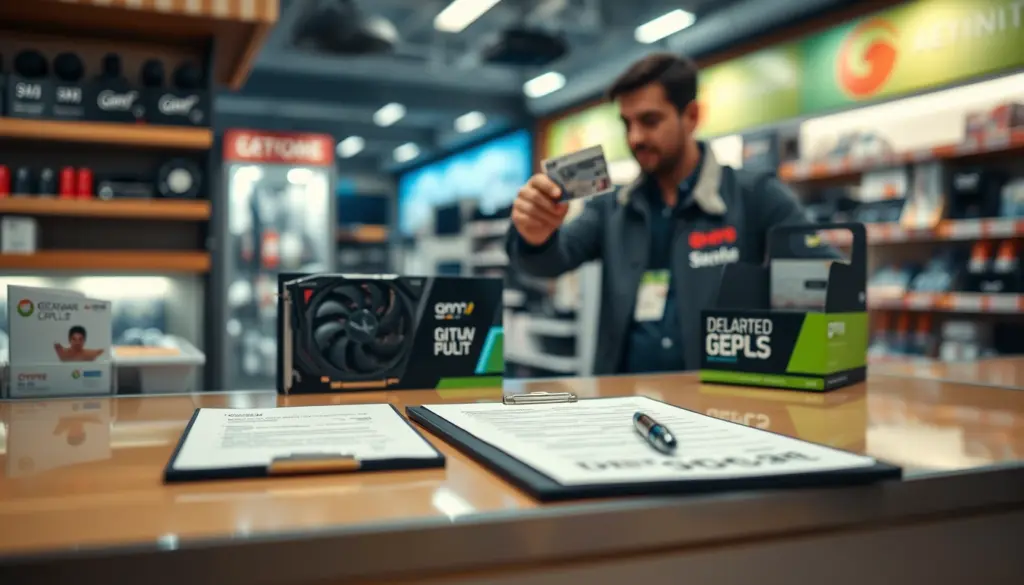
Micro Center has started asking RTX 5090 buyers to prove they are not going to ship the card out of the country. According to reports from PC Gamer, TechSpot, TechRadar, and other outlets starting October 2, 2026, the retailer now asks some RTX 5090 buyers to show a government-issued ID and sign a document titled “Advanced Computing Product Purchaser Declaration” before walking out with the card.
The timing is not a coincidence. Just one day earlier, on October 1, the Department of Justice announced federal charges against a California CEO accused of routing more than $300 million in Nvidia hardware into China. Micro Center’s new checkout friction is the first visible sign that a retailer, rather than a prosecutor, is trying to get ahead of the next case. Here is what the declaration actually says, who else might follow, and what it means for anyone trying to buy the most powerful consumer GPU Nvidia sells.
What Micro Center Is Now Requiring at Checkout
The reporting traces back to a customer at Micro Center’s Tustin, California store who tried to buy a PowerSpec AI90 prebuilt loaded with an RTX 5090, according to The FPS Review. Instead of a normal checkout, staff reportedly scanned the buyer’s driver’s license and had them fill out a form before completing the sale. TechSpot and Gadget Review both described similar experiences from other shoppers buying RTX 5090 systems at different locations that same week.
What is not yet confirmed matters just as much as what is. The reports so far only document in-store transactions, and only for the RTX 5090 or RTX 5090-equipped prebuilts. Nobody has published evidence that Micro Center applies the same rule to online orders, ship-to-home purchases, or cards one tier down like the RTX 5080 or RTX 4090. No outlet has reported a chain-wide policy memo, a stated per-customer purchase cap, or an on-record comment from Micro Center itself confirming how widely the practice runs. Treat this as a documented, spreading practice rather than a formally announced national policy.
Inside the “Advanced Computing Product Purchaser Declaration”
The form’s header line, as reproduced by Gadget Review and other outlets, reads simply: “NO EXPORT – NO EXCEPTIONS.” Buyers are asked to supply their legal name and address, confirm government ID details, list a phone number and email, name the actual end user if that differs from the purchaser, and state where the GPU will be installed and what it will be used for.
The certification underneath those fields covers five points. The buyer attests that the purchase is for legitimate personal or business use inside the United States, that the stated end user is accurate, that the card will stay in the country, that it will not be exported, re-exported, transferred, or resold to anyone planning to take it abroad, and that the purchaser is not acting as an undisclosed agent or straw buyer for someone else. Reports describe this as a retailer-drafted document rather than a form the Bureau of Industry and Security requires by name, and they note Micro Center reserved the right to cancel a sale if the answers raised red flags.
Why Micro Center Moved Now
Retailers do not usually add paperwork to a high-margin sale unless they are worried about something specific. In this case, the worry is straw purchasing: someone buying a consumer GPU on US soil with the intent of shipping it to a buyer in a country where export-controlled chips cannot legally go. Export attorneys have warned for months that straw purchases at retail, rather than bulk orders from server manufacturers, were becoming the easier path around enforcement focused on big corporate shipments.
The RTX 5090’s China-specific sibling cards add to that pressure. Nvidia already sells reduced-performance variants for the Chinese market, referred to in reporting as the RTX 5090D and a follow-up RTX 5090D V2, precisely because the full-spec RTX 5090 is not supposed to reach Chinese buyers through normal retail channels. A declaration that stops that card at the US checkout counter closes one more route around that distinction, at least on paper.
The Smuggling Case That Set the Backdrop
The Justice Department’s October 1 indictment named Greg Lui, also known as Yiu Kong Lui, the 38-year-old operator of Earthmade Computer Inc. Prosecutors allege he used falsified paperwork to route servers loaded with Nvidia A100, H100, and consumer-grade RTX 4090 and RTX 5090 GPUs through Malaysia and Singapore before they reached buyers in China, racking up more than $300 million in alleged diverted hardware. Lui faces charges tied to export control violations, smuggling, and money laundering, with a maximum reported exposure of decades in prison if convicted on every count. The full breakdown of that indictment is worth reading for the mechanics prosecutors say he used, because Micro Center’s new form is clearly built to block the retail version of the same playbook.
That case was not an isolated prosecution. Federal attorneys have filed several similar actions through 2026 involving export-controlled GPUs ending up in China by way of intermediate countries. The pattern keeps repeating: falsified end-user paperwork, freight forwarders in Southeast Asia, and chips that were never supposed to leave the United States without a license.
RTX 5090 Scarcity Made This Almost Inevitable
Supply has been tight all year. The RTX 5090 largely disappeared from US retail shelves earlier in 2026, with resale prices climbing far past its original list price. European buyers have faced their own version of the squeeze, with Nvidia and AMD GPU prices both surging across the region as AI-driven demand pulls supply away from gaming channels. When a part is scarce and valuable enough, it becomes a target for arbitrage, and arbitrage across borders is exactly the behavior export rules exist to catch.
That scarcity also explains why a card modified for extra memory in China, rather than the standard US retail unit, keeps showing up in enforcement-adjacent stories. A modded RTX 5090 with 96GB of VRAM reportedly sells in China for roughly $3,888, a price that only makes sense if the underlying card first had to get there. Micro Center’s declaration is aimed squarely at cutting off that supply at the source rather than chasing it after the fact.
How Other Retailers Compare
So far, Micro Center stands alone. No published report documents Best Buy, Newegg, B&H Photo, or Amazon adopting a comparable ID-and-declaration checkpoint for RTX 5090 sales as of this writing. The FPS Review raised the possibility that other chains could follow, but that remains speculation rather than confirmed policy.
| Retailer | No-export declaration reported | ID required | Scope confirmed |
|---|---|---|---|
| Micro Center | Yes (Oct. 2, 2026) | Yes, in-store | RTX 5090 and RTX 5090 prebuilts, in-store only |
| Best Buy | Not reported | Not reported | None confirmed |
| Newegg | Not reported | Not reported | None confirmed |
| B&H Photo | Not reported | Not reported | None confirmed |
| Amazon | Not reported | Not reported | None confirmed |
The Legal Gray Zone: What BIS Actually Requires
The Bureau of Industry and Security, the Commerce Department division that administers US export controls, does not appear to mandate this exact retail form. Reporting on the Micro Center policy is careful to note that BIS rules target the export transaction itself, meaning the physical movement of restricted hardware out of the country, not necessarily the point-of-sale paperwork at a domestic electronics store. Micro Center’s declaration reads as a voluntary compliance measure, built to shield the company from being accused of looking the other way, rather than a government-issued checkout script.
That distinction matters for buyers who find the process intrusive. Signing a declaration that you will not export a GPU is not the same as a federal license requirement, and nothing in the reporting suggests Micro Center shoppers face criminal exposure just for buying a card. The risk sits with anyone who signs the form and then breaks the promise, since a signed declaration gives prosecutors a clean paper trail if a card does turn up overseas.
Consumer GPUs vs Data-Center Chips: A Different Export Tier
Not every Nvidia chip faces the same level of scrutiny, and the Lui indictment is a useful map of where the lines sit. The complaint named four specific products moving through the alleged scheme: Nvidia A100 and H100 data-center accelerators, and PNY-branded GeForce RTX 4090 and RTX 5090 consumer cards. The two tiers are treated differently under export rules, but the indictment shows both ended up on the same smuggling route.
| Product | Category | Export status | Named in Lui indictment |
|---|---|---|---|
| Nvidia A100 | Data-center accelerator | Export-controlled, license required for restricted destinations | Yes |
| Nvidia H100 | Data-center accelerator | Export-controlled, license required for restricted destinations | Yes |
| GeForce RTX 4090 (PNY) | Consumer GPU | Subject to controls above a compute threshold | Yes |
| GeForce RTX 5090 (PNY) | Consumer GPU | Subject to controls above a compute threshold | Yes |
| GeForce RTX 5090D / 5090D V2 | Consumer GPU, China-market variant | Reduced spec, sold directly in China | Not named; referenced in Micro Center coverage |
A Short History of Chip Export Enforcement in 2026
Export enforcement against Nvidia hardware did not start with Lui’s arrest. Prosecutors have brought a string of comparable cases through the year, and a Bloomberg investigation cited in coverage of the Lui indictment found that Nvidia’s own shipment-screening process has repeatedly missed transactions that outside reviewers considered obvious red flags. Chinese firms have separately been reported weighing purchases of Nvidia’s enterprise-tier RTX Pro 5500 through legal channels, underscoring just how much demand exists on the other side of the control line, legal or not.
The common thread across 2026’s cases is paperwork, not technology. Every indictment so far describes false end-user statements and layered shipping routes through Malaysia, Singapore, or Hong Kong rather than any new smuggling method. Micro Center’s declaration targets that exact weak point by trying to get a truthful answer, or at least a signed one, before the hardware leaves the store.
Market Impact: Buyers, Resellers, and the Grey Market
For ordinary gamers, the practical effect is a slower checkout line and an extra form, not a blocked purchase. The bigger impact falls on resellers and grey-market exporters who rely on buying cards at US retail prices and shipping them to markets willing to pay a premium. Nvidia still commands roughly 90 percent of desktop GPU shipments according to recent market-share tracking, meaning any friction added to RTX 5090 sales ripples through a GPU market that Nvidia already dominates almost completely.
If the declaration spreads to more stores, expect resale activity to shift further toward private sales, marketplaces, and secondhand listings that never touch a retail checkout counter in the first place. A signed form at Micro Center does nothing to stop someone from buying a card used from a stranger online and shipping it onward, which is likely why several outlets framed this as a meaningful but incomplete fix.
Nvidia’s Position Between Compliance and Sales
Nvidia has not issued a public statement addressing Micro Center’s new checkout process, and none of the outlets covering the story reported one. That silence puts Nvidia in an awkward spot. The company wants to keep selling every RTX 5090 it can make, and it also does not want its retail partners to look like an unmonitored pipeline into a federal smuggling case. Letting individual retailers write their own compliance forms, rather than issuing a company-wide standard, keeps Nvidia at arm’s length from the enforcement conversation while leaving partners like Micro Center to manage the reputational risk on their own.
What Comes Next: 5 Predictions
None of the following is confirmed. These are reasoned predictions based on the pattern so far, not statements of fact.
- Other big-box electronics chains will likely test similar ID-and-declaration steps for RTX 5090 sales within the next few months, once they see whether Micro Center’s approach draws complaints or praise.
- Online checkout will probably stay friction-free longer than in-store sales, since shipping a signed physical form through an e-commerce flow is harder to enforce, making web orders the more attractive route for anyone trying to avoid the paperwork.
- Scrutiny is likely to shift toward secondhand and marketplace resale, since a one-time retail declaration cannot follow a card once it changes hands again.
- More companies tied to high-end GPU sales may start publishing their own compliance language, if only to avoid being named in a future indictment the way Earthmade Computer’s manufacturers were cited as unwitting suppliers.
- Pressure on Nvidia to formalize distributor-level screening guidance will probably grow, especially if the Bloomberg-reported gaps in its own shipment review keep surfacing in future prosecutions.
What RTX 5090 Buyers Should Know Before They Shop
If you are buying an RTX 5090 for your own PC, the declaration should not change much beyond a longer checkout. Bring a government-issued ID, be ready to confirm your name and address, and expect to state plainly that the card is staying in the country and is for your own use. The form appears aimed at catching bulk or suspicious transactions, not at slowing down a single gamer walking in for one card.
Buyers planning to resell a card internationally, or to buy on behalf of someone overseas, face real exposure now that a signed document exists tying their name to a no-export promise. Given how aggressively prosecutors have pursued the 2026 cases involving far larger shipments, a false statement on a retail form is not a risk worth taking for the price difference on a single GPU.
It is also worth setting expectations about what the declaration does not do. Signing the form does not reserve a card, does not guarantee stock, and does not speed up a purchase during a shortage. Store staff interviewed by TechSpot and The FPS Review described the process as an added few minutes at checkout rather than a background check with a waiting period. Shoppers who have already dealt with limited RTX 5090 allocations this year should expect the paperwork to sit on top of, not replace, the usual scramble for stock.
Frequently Asked Questions
Does Micro Center require this form for every GPU purchase?
No. Reporting documents the requirement specifically for the RTX 5090 and RTX 5090-equipped prebuilt systems. No outlet has confirmed it applies to lower-tier cards like the RTX 5080 or RTX 4090.
Is this a government-mandated requirement?
Reports describe it as a Micro Center compliance measure, not a form the Bureau of Industry and Security requires by name. It appears to be a voluntary step the retailer added on its own.
Does the policy apply to online orders?
The documented cases so far are all in-store purchases. No report has confirmed the same declaration applies to Micro Center’s online or ship-to-home orders.
Is this connected to the Nvidia GPU smuggling indictment?
There is no confirmed direct link between Micro Center’s policy and the specific case against Greg Lui and Earthmade Computer Inc. The timing, one day after the indictment became public, lines up with a broader 2026 pattern of enforcement against Nvidia GPU diversion that outlets have connected contextually.
Have other retailers adopted a similar policy?
Not as of this writing. No published report documents Best Buy, Newegg, B&H Photo, or Amazon requiring a comparable no-export declaration for RTX 5090 purchases.
What happens if I sign the form and sell the card abroad anyway?
Nothing in current reporting spells out a specific penalty tied to the Micro Center form itself. Signing a false declaration and then exporting controlled hardware would still expose a buyer to the same federal export-control and smuggling statutes used in cases like the one against Greg Lui.
Why is the RTX 5090 specifically targeted rather than other GPUs?
It is Nvidia’s highest-performance consumer card and the one most likely to cross the compute threshold that triggers export scrutiny. It has also been named directly in federal indictments involving diverted hardware, which likely made it the obvious starting point for a retailer trying to reduce its own legal exposure.