
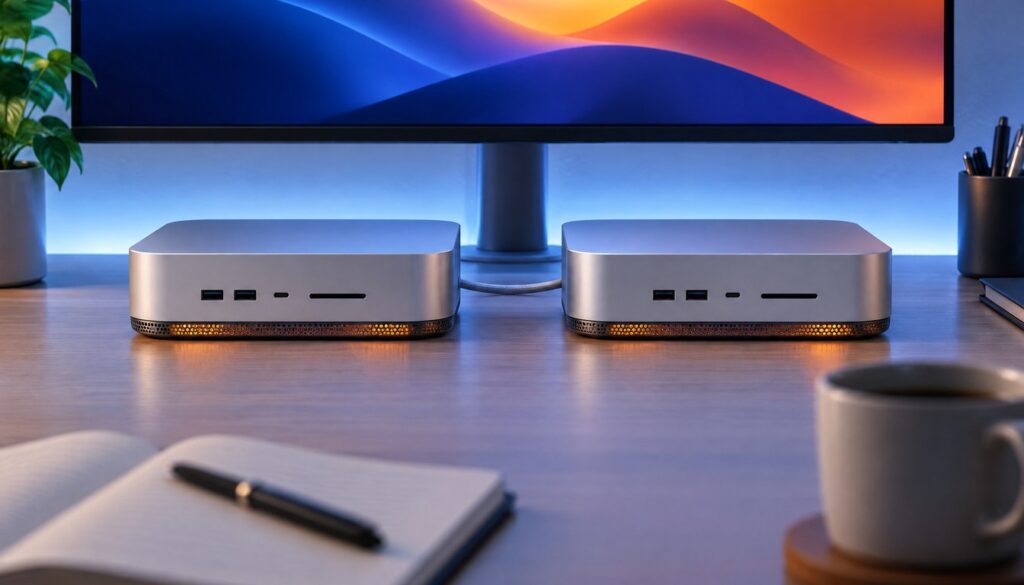
Apple and Meta confirmed on October 15, 2026, that they worked together to make Meta’s new open-weight model, Muse Spark Open, run on Apple hardware, a pairing that would have sounded unlikely a year ago. The model, built on a mixture-of-experts architecture with 816 billion total parameters and 42 billion active parameters, is tuned to run locally across two to four Apple M5 Ultra Mac Studio systems using Apple’s MLX framework. Meta says the weights are available today through Hugging Face.
The news landed across outlets including The Verge, TradingView, and Longbridge, and it matters for reasons beyond the model itself. This is a hardware story first: it is a public signal that Apple’s unified-memory Mac Studio lineup has become a credible local-inference platform for frontier-scale open models, at a moment when Nvidia’s RTX Spark and DGX Spark boxes are fighting for the same desk space. It is also a software story, since Apple’s MLX framework, once a side project for Apple Silicon researchers, is now doing real work optimizing a 816-billion-parameter model built by a company that competes with Apple on nearly everything else.
Inside Muse Spark Open: 816 Billion Parameters, 42 Billion Active
Muse Spark Open uses a mixture-of-experts design, meaning the full model carries 816 billion parameters but only activates 42 billion of them for any given token. That gap between total and active parameters is the whole point of mixture-of-experts architectures: it lets a model carry far more stored knowledge than a dense model of similar inference cost, because most of the network stays idle on any single pass. Meta previously detailed a smaller sibling in this same model family, which this site covered when Muse Spark Open first debuted, and the architecture carries over into this Apple-optimized release.
The model also ships with a 1 million token context window, which is large enough to hold a sizable codebase, hours of transcribed audio, or a long video analysis session in a single pass. Meta positions the model for coding, video analysis, and other agentic tasks that benefit from both the long context and the local execution. Running Muse Spark Open entirely on-device, rather than through a cloud API, means a developer’s code, video, or audio never has to leave their desk, which is the pitch Apple and Meta are making to privacy-conscious engineering teams.
| Spec | Detail |
|---|---|
| Total parameters | 816 billion |
| Active parameters | 42 billion |
| Architecture | Mixture-of-experts |
| Context window | 1 million tokens |
| Availability | Hugging Face, released October 15, 2026 |
| Required hardware | Two to four Apple M5 Ultra Mac Studio units |
| Memory per unit (cited setup) | 512GB unified memory |
| Optimization framework | Apple MLX |
Why This Needs Two Mac Studios: The Unified Memory Math
A model with 816 billion parameters, even stored in a compressed format, takes an enormous amount of memory just to hold in place, before a single token gets generated. That is why Apple and Meta’s cited configuration calls for two Mac Studio systems, each with an M5 Ultra chip and up to 512GB of unified memory, splitting the model across both machines so neither one has to carry the full weight alone. Apple and Meta also describe setups using two to four connected Mac Studios, which suggests the split is flexible depending on how much memory headroom a developer wants for the surrounding workload.
This is where Apple’s “unified memory” design, where the CPU, GPU, and neural engine all draw from the same pool of RAM instead of shuttling data between separate CPU and GPU memory, becomes the actual story. Nvidia’s data center GPUs are faster per chip, but a single Nvidia card tops out at far less onboard memory than a maxed-out Mac Studio, which forces large-model inference onto multi-GPU clusters with their own networking overhead. Apple’s pitch, reinforced by this partnership, is that a pair of Mac Studios sitting on a desk can do a version of what used to require a server rack, at least for inference on models in this parameter range.
The Apple M5 Ultra Chip Behind the Headline
The M5 Ultra is the chip doing the heavy lifting in Apple’s cited configuration, and it is worth remembering how recently it arrived. This site reported on the M5 Ultra’s debut, when Apple positioned the chip’s bandwidth and core count as a direct answer to the growing demand for local AI inference on Apple Silicon. Pairing that chip with a model built by one of the biggest names in AI, released through Hugging Face rather than locked behind a Meta-only app, is a different kind of validation than a spec sheet. It is Meta effectively saying the M5 Ultra is capable enough to be worth the engineering time to optimize for.
That matters for Apple’s broader positioning in the AI hardware conversation, which for most of 2026 has been dominated by Nvidia’s RTX Spark and DGX Spark lines. Apple has largely sat outside that conversation as a “consumer” hardware maker, even as Mac Studio’s memory ceiling kept creeping up. A named AI lab choosing to optimize for Apple Silicon, rather than simply tolerating it as an afterthought port, is the kind of signal that shows up in developer forums and procurement conversations long before it shows up in a quarterly earnings call.
MLX: Apple’s Open-Source Framework Gets Its Moment
Apple’s MLX framework is the software layer that makes this collaboration work, and it has been a comparatively quiet project relative to the hardware it runs on. MLX is Apple’s open-source array framework built specifically for Apple Silicon’s unified memory architecture, designed to let researchers run and fine-tune large models locally without routing everything through Nvidia’s CUDA ecosystem. Meta’s own description of the work, cited by multiple outlets, frames Muse Spark Open as having been built to run well on Mac Studio specifically because of what the latest version of MLX can do with Apple’s chip architecture.
For a tool that started as something closer to a research curiosity, MLX getting direct engineering attention from Meta is a meaningful endorsement. It suggests Apple’s bet on building its own machine-learning tooling, rather than depending entirely on third-party frameworks tuned for Nvidia hardware, is starting to pay off in the form of external developers choosing to build for it. Whether that attention extends past this one release, or whether Muse Spark Open ends up as an isolated showcase rather than the start of a pattern, is one of the open questions this partnership raises rather than answers.
From Feud to Alliance: Apple and Meta’s AI Thaw
Apple and Meta have spent years as adversaries on privacy policy, app tracking rules, and App Store terms, which is part of why this collaboration drew attention beyond the usual AI model release cycle. Axios characterized the news as the two companies setting aside that history for the sake of an AI partnership, a framing that captures just how unusual it is to see Meta’s AI research arm publicly crediting Apple’s hardware team, and vice versa, in the same announcement. Apple’s side of that announcement is notable too, given that the company confirming the partnership is now led by a different executive than it was a year ago. Apple’s CEO transition earlier this year, which put John Ternus in charge, coincides with a visibly more open posture toward outside AI labs building for Apple Silicon.
Neither company has described this as the start of a broader alliance, and nothing in the record suggests Apple and Meta are resolving their underlying disputes over tracking, app distribution, or data practices. What changed is narrower and more practical: Meta needed a hardware platform that could run its largest open model locally, and Apple’s Mac Studio line, at this specific moment, happened to be the platform that could do it without a server rack. That is a transactional kind of cooperation, not a truce, and it is worth watching whether it extends to future model releases or stays a one-off.
The Open-Weight Model Race in Fall 2026
Muse Spark Open did not launch into a quiet field. Open-weight releases have piled up through the second half of 2026, and Muse Spark Open’s 816 billion total parameters puts it near the top of that pack by raw size, though not by active-parameter efficiency. Mistral AI’s Large 4, internally nicknamed “Le Chonk” and covered on this site over a parameter-count dispute, carries 675 billion parameters by Mistral’s official count with 41 billion active. Tencent’s Hy4, which this outlet reported narrowly beat GLM-5.3, lands at 770 billion total parameters. Nvidia’s own Nemotron 3.5 ships far smaller at 30 billion parameters today, with a roadmap aimed at a trillion-parameter model down the line.
| Model | Maker | Total Parameters | Active Parameters | Hardware Angle |
|---|---|---|---|---|
| Muse Spark Open | Meta | 816 billion | 42 billion | Runs on 2-4 Apple M5 Ultra Mac Studios via MLX |
| Large 4 (“Le Chonk”) | Mistral AI | 675 billion (official) | 41 billion | Cloud-first deployment |
| Hy4 | Tencent | 770 billion | Not disclosed | Competes directly with GLM-5.3 |
| Nemotron 3.5 | Nvidia | 30 billion (today) | Not disclosed | Targets enterprise GPU clusters, 1T-parameter roadmap |
What sets Muse Spark Open apart in that lineup is not its size but its target hardware. Every other model in that table is built with cloud or enterprise GPU clusters as the default deployment path. Muse Spark Open is the only one of the four with a named, consumer-purchasable hardware configuration, a pair of Mac Studios, built into its own announcement. That is a different kind of distribution strategy, and it is one only Apple’s memory-rich Mac Studio line could currently support at this parameter count without requiring a data center.
Competitive Landscape: Mac Studio vs Nvidia’s DGX Spark and RTX Spark
Nvidia has spent much of October 2026 pushing its own local-AI hardware story, with RTX Spark shipping this same week and explicitly targeting Apple’s memory lead, and its DGX Spark line splitting into separate 64GB and 128GB tiers for buyers who need more headroom. Nvidia’s hardware wins on raw compute throughput for a given dollar, which is why it remains the default choice for training and for high-throughput inference at scale. But Muse Spark Open’s launch is a reminder that memory capacity, not just compute speed, is the binding constraint for running the largest open models locally, and that is the exact area where Apple’s unified-memory Mac Studios currently have room that single consumer GPUs do not.
That does not make Mac Studio a universal winner. Nvidia’s CUDA ecosystem has a decade of tooling, library support, and developer familiarity that MLX cannot match overnight, and most production AI workloads in enterprises are still built around Nvidia hardware by default. What Muse Spark Open’s Apple optimization does is carve out a specific niche: individual developers and small teams who want to run an 816-billion-parameter class model without provisioning a GPU cluster or paying ongoing cloud inference costs. For that specific use case, two Mac Studios on a desk is a genuinely different proposition than anything Nvidia currently ships at a comparable footprint.
What Apple and Meta Are Not Saying: Price and the Muse App Confusion
Two things are missing from this announcement that are worth flagging directly. First, neither company has published an official, confirmed retail price for the Mac Studio configuration needed to run Muse Spark Open. One report put a starting price for a qualifying 256GB Mac Studio at $10,799, but that figure has not been established as an official Apple price point in the coverage available so far, and should be treated as unconfirmed. This site’s own hands-on coverage of the M5 Ultra Mac Studio, published earlier this year, reported a $12,299 price tag on the configuration it tested, which gives a rough sense of the range buyers should expect, though not a guaranteed figure for the exact two-unit setup this partnership describes.
Second, and more important for anyone who saw the headlines and assumed their existing Meta AI app just got a local-Mac upgrade: this partnership is specifically about Muse Spark Open, the open-weight research release distributed through Hugging Face. It is not about the consumer Muse app or Meta’s cloud-hosted Muse models, which continue to run through Meta’s own servers as before. Macworld published a piece directly addressing this confusion, arguing that despite the headlines, Meta’s regular Muse product is not what is running locally on Mac. That distinction matters for anyone evaluating what this news actually changes for them day to day, since the answer, for most consumer Muse app users, is nothing.
Market Reaction: Caution Beats Hype
It is tempting to assume a partnership between two companies this large moved stock prices, but the available reporting does not support a specific, verified market reaction tied directly to this announcement. There is no confirmed closing-price change, analyst target revision, or quantified investor response for Apple or Meta tied specifically to the Muse Spark Open news as of this writing. What outlets have characterized consistently is the unusual nature of the partnership itself, an AI collaboration between two companies that compete on nearly every other front, rather than any immediate financial market verdict on it.
That absence of a clear market signal is itself informative. It suggests investors are treating this as a product and developer-relations story rather than a financial one, at least for now. A single open-weight model release, even one this large, is unlikely to move either company’s valuation on its own. The more relevant financial question, which remains unanswered, is whether this kind of collaboration becomes a recurring pattern that changes how much hardware Apple sells into the AI developer market, a slower-moving question that will not resolve in a single trading session.
Historical Context: Apple Silicon’s Long March to AI Relevance
Apple Silicon’s unified memory architecture was not originally built with frontier AI models in mind. It was built to make Macs faster and more power-efficient than their Intel predecessors, starting with the M1 generation in 2020. The side effect, that unified memory could scale to hold enormous AI models without the CPU-to-GPU data transfer bottleneck that limits traditional PC architectures, only became a major talking point once the generative AI boom made local model size a mainstream concern. Each generation since, M1 Ultra, M2 Ultra, M3 Ultra, and now M5 Ultra, has pushed that memory ceiling higher, and each jump has made a slightly larger class of model plausible to run at home.
What makes the Muse Spark Open partnership a milestone in that history, rather than just another spec bump, is that it is the first time a major outside AI lab has built and announced a flagship open-weight release with Apple hardware as a named, first-class deployment target, rather than something the community figured out how to port after the fact. Previous generations of large open models that ended up running on Mac hardware generally got there through third-party community tooling, not through the model maker’s own optimization work. That shift, from community workaround to vendor-endorsed configuration, is the real headline underneath the parameter counts.
What Executives Are Saying
Meta CEO Mark Zuckerberg announced the release directly, writing that “Muse Spark Open — weights releasing today — runs great on new Mac Studios thanks to work with @johnternus and Apple,” according to CNBC’s reporting on the announcement. Apple CEO John Ternus replied publicly, saying “Congrats to the team! Amazing to run a model of Muse Spark Open’s caliber and scale this efficiently, right from your desk. Mac Studio keeps pushing the boundaries of on-device AI,” a response first reported by MacDailyNews.
Meta’s Chief AI Scientist, Yann LeCun, framed the work in terms of what it unlocks for users rather than just the engineering behind it, saying “We worked with Apple to bring leading Agent capabilities to your desktop for the first time on the Apple M5 Ultra Mac Studios,” per the same MacDailyNews report. In a separate company statement reported by Cult of Mac, Meta described the software side of the work this way: “Leveraging the latest version of MLX, Muse Spark Open was optimized to run on Mac Studio with M5 Ultra, and together they’re the best way to run a powerful model on your own desktop.”
What This Means for Developers and AI Builders
For developers already working inside Apple’s ecosystem, this partnership lowers the barrier to experimenting with an 816-billion-parameter class model without standing up cloud infrastructure or paying per-token API costs. A small studio or independent engineer who already owns, or can justify buying, two Mac Studios gets access to a model in the same size class as recent releases from Mistral and Tencent, running entirely on hardware they control. That matters for teams working with sensitive codebases or proprietary video and audio data, where sending material to a third-party API is a hard no regardless of how good the model is.
A simplified download pattern for a Hugging Face-hosted model release typically looks like the snippet below, though builders should always confirm the exact repository name and required MLX version from Meta’s own release notes before running it:
# illustrative pattern only -- confirm exact repo ID and MLX version before running
huggingface-cli download <muse-spark-open-repo-id> --local-dir ./muse-spark-open
python -m mlx_lm.generate --model ./muse-spark-open --prompt "test prompt"
For developers outside the Apple ecosystem, the practical calculus is less dramatic. Nvidia hardware remains the default for most production workloads, and nothing about this release forces a migration. But it does add a genuine option for a specific slice of the market, local, privacy-sensitive, large-context agentic work, that previously had no good consumer-hardware answer at this model size.
Predictions: Where This Goes Next
- Expect Apple to lean harder on MLX in its own marketing for the Mac Studio line through the rest of 2026, using Muse Spark Open as the proof point that outside labs, not just Apple’s own research team, see the hardware as credible for frontier-scale models.
- Other open-weight model makers, particularly those already publishing multiple size tiers like Mistral and Tencent, are likely to face pressure to publish their own Apple Silicon-optimized variants once developers start comparing local-run options.
- Nvidia will keep pushing RTX Spark and DGX Spark pricing and memory tiers aggressively in response, since Apple’s unified-memory advantage at the high end is the one lever Nvidia cannot simply out-discount with GPU price cuts.
- Confusion between Muse Spark Open and the consumer Muse app is likely to persist for weeks, and expect further clarification pieces similar to Macworld’s, since the two products share a name but not a deployment model.
- Do not expect this to resolve Apple and Meta’s underlying disputes over app tracking, App Store terms, or data practices. This remains a narrow, product-specific collaboration rather than a broader corporate reconciliation.
Frequently Asked Questions
Does Meta’s regular Muse app now run on my Mac?
No. This partnership covers Muse Spark Open, a separate open-weight research release distributed through Hugging Face. The consumer Muse app and Meta’s cloud-hosted Muse models still run on Meta’s own servers.
How many parameters does Muse Spark Open have?
It has 816 billion total parameters, with 42 billion active at any given time due to its mixture-of-experts architecture.
What Mac hardware do I need to run it?
Apple and Meta describe setups using two to four Apple M5 Ultra Mac Studio units, with the cited configuration using two Mac Studios each equipped with up to 512GB of unified memory.
How much will that hardware cost?
Apple has not published an official, confirmed price for the specific two-unit configuration. One report cited a starting price of $10,799 for a qualifying 256GB Mac Studio, but that figure is not confirmed as an official Apple price for this exact setup.
Where can I download Muse Spark Open?
Meta says the weights are available through Hugging Face as of October 15, 2026.
What is MLX, and why does it matter here?
MLX is Apple’s open-source array framework built for Apple Silicon’s unified memory architecture. Meta optimized Muse Spark Open specifically to run well with the latest version of MLX on Mac Studio hardware.
Does this mean Apple and Meta have resolved their other disputes?
No. This is described as a product-specific technical collaboration. Nothing in the announcement suggests the companies have resolved disagreements over app tracking, App Store policy, or data practices.
How does Muse Spark Open compare to other large open models released in 2026?
By total parameter count, it sits above Mistral’s Large 4 (675 billion official) and close to Tencent’s Hy4 (770 billion), but it is the only one of the three built around a named consumer hardware configuration rather than cloud-first deployment.