
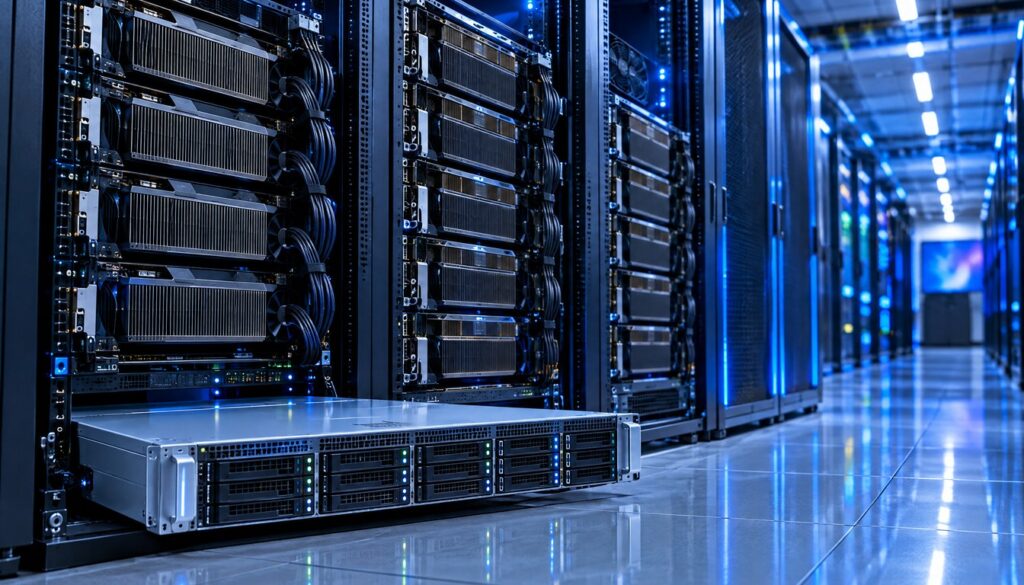
Four and a half months after Hewlett Packard Enterprise walked onto a Computex stage in Taipei with a server built around NVIDIA’s new Vera CPU, the hardware is no longer the only story. The HPE ProLiant Compute DL394 Gen12 now has to prove itself against a lineup of rivals racing toward the same bet: that agentic AI workloads need a different kind of processor, not just more GPUs stacked into a rack. AMD, Intel, Dell and Supermicro have all shipped or previewed competing answers since June 1, 2026, and investors keep returning to HPE (NYSE: HPE) every time the Vera story resurfaces in financial coverage.
This is where the HPE Vera CPU server stands today: a single-SKU bet that turned into a referendum on how the entire data center industry thinks about CPU-GPU balance for agentic AI. Below is a look at what HPE actually built, how NVIDIA’s Vera chip compares with the CPU and GPU platforms chasing the same workloads, and what the market reaction says (and does not say) about where this goes next.
What HPE Actually Shipped at Computex
The HPE ProLiant Compute DL394 Gen12 is a 2U server built around the NVIDIA Vera CPU, a chip NVIDIA designed specifically for the kind of workloads that do not fit neatly into either classic enterprise computing or raw GPU-driven model training. HPE’s own product documentation lists the Vera configuration at 88 cores and 176 threads, paired with LPDDR5X memory that delivers up to 1.2 TB/s of aggregate bandwidth, or roughly 14 GB/s per core. That bandwidth figure is the number HPE keeps repeating in its marketing, because it is the number meant to separate this machine from a conventional x86 server.
HPE built the server for agentic AI, reinforcement learning, real-time analytics and large-scale data processing, workloads that spend more time moving data between memory and compute than they spend on raw floating-point math. The DL394 Gen12 ships with HPE’s iLO 7 management controller and plugs into HPE Compute Ops Management for centralized monitoring, which matters for enterprise buyers who want AI infrastructure that still behaves like infrastructure they already know how to operate. HPE said the server would reach general availability in fall 2026 as part of its NVIDIA AI Computing by HPE portfolio, a timeline that NVIDIA’s own blog later complicated by stating that Vera CPU availability through HPE Private Cloud AI, a separate turnkey package, would not land until 2027.
That gap between a fall 2026 server SKU and a 2027 full-stack AI factory offering is not a contradiction so much as a sign of how HPE is segmenting the rollout. Enterprises that want the bare DL394 Gen12 can apparently get it sooner. Enterprises that want the fully managed, co-engineered AI factory experience with NVIDIA are looking at next year.
Inside the Vera CPU: The Memory Bandwidth Math
NVIDIA’s pitch for Vera rests almost entirely on memory bandwidth and determinism, not raw clock speed. According to NVIDIA’s own framing of the chip, Vera was built to orchestrate AI factories, and the company has said it delivers twice the efficiency and faster task completion than x86 alternatives. HPE’s product page backs that framing with hard numbers: 1.2 TB/s aggregate memory bandwidth and up to 14 GB/s per core, achieved through LPDDR5X rather than the DDR5 that dominates traditional server CPUs.
Why does that matter for agentic AI specifically? An AI agent chaining together tool calls, retrieval steps and reasoning passes does not behave like a single large training run. It behaves more like a database workload crossed with a real-time analytics pipeline, constantly shuttling smaller chunks of data in and out of memory. Classic x86 server chips were built for a world of predictable batch jobs and virtualized workloads, where memory bandwidth could lag behind core count without crippling performance. Vera inverts that priority, treating memory bandwidth as the primary bottleneck to solve rather than a secondary spec.
HPE is not claiming the DL394 Gen12 replaces GPU-heavy training clusters. The company positions it as a companion system, handling the CPU-side orchestration, data preparation and agent logic that feeds GPU clusters running the actual model inference and training. That complementary framing is also where the competitive comparison gets interesting, because AMD, Intel and NVIDIA’s own GPU lines are making a different argument about where that same work should happen.
Monolithic Architecture: Betting Against the Chiplet Trend
One detail that separates Vera from most modern server silicon is architectural. Reporting on the chip describes it as using a monolithic design rather than the multi-chiplet approach that AMD popularized with EPYC and that has since become an industry default for high core count chips. Chiplet designs cut manufacturing costs and improve yields, but they introduce non-uniform memory access, or NUMA, effects, where some cores reach memory faster than others depending on which chiplet they sit on.
For a conventional server workload, NUMA variability is a manageable inefficiency. For an agentic AI pipeline making latency-sensitive decisions in real time, inconsistent memory access timing can show up as unpredictable response times, which is a harder problem to tune around in production. By staying monolithic, Vera trades some of the manufacturing economics that chiplet designs enjoy for more consistent, predictable latency across every core. That is a deliberate bet, and it puts Vera at odds with where AMD, Intel and even NVIDIA’s own GPU interconnect strategies have been heading for the past several years.
How the DL394 Gen12 Stacks Up Against Rival AI Server Platforms
Comparing the DL394 Gen12 directly against GPU-dense racks is a bit like comparing a sedan to a freight truck. They solve different problems. But buyers shopping for agentic AI infrastructure budgets are weighing all of these options against each other regardless, because the dollars come out of the same capital expenditure line. The table below lines up HPE’s CPU-first platform against the GPU-centric and hybrid systems it is effectively competing with for data center floor space and procurement budget.
| Platform | Primary Compute | Key Spec | Target Workload | Availability |
|---|---|---|---|---|
| HPE ProLiant Compute DL394 Gen12 | NVIDIA Vera CPU | 1.2 TB/s aggregate memory bandwidth, LPDDR5X | Agentic AI, reinforcement learning, real-time analytics | Fall 2026 (server); 2027 (HPE Private Cloud AI) |
| AMD Helios rack platform | AMD EPYC CPU plus GPU accelerators | 72 GPUs per rack, per AMD’s own disclosures | Hyperscale AI clusters, large language model training | 2026 shipments underway |
| Intel Crescent Island (D-series) | Discrete data center GPU | Roughly 1.3 PFLOPS, 480GB memory, per Intel’s published specs | AI inference at scale | 2026 rollout |
| NVIDIA DGX Spark (64GB) | NVIDIA GPU plus Arm CPU | 64GB unified memory | Desktop-scale AI development | Shipping in 2026, priced around $4,999 |
| NVIDIA DGX Spark (128GB) | NVIDIA GPU plus Arm CPU | 128GB unified memory | Larger local model workloads | Shipping in 2026, priced around $6,950 |
The spread in that table tells its own story. HPE is the only vendor here selling CPU-first memory bandwidth as the headline feature. Everyone else, including NVIDIA’s own DGX Spark line, is still selling GPU throughput as the main event. That is precisely the gap HPE is trying to occupy before AMD or Intel build a comparable CPU-first pitch of their own.
The NYSE Deal: Why a Stock Exchange Wants a CPU-First AI Server
The most concrete adoption signal for the Vera CPU server so far has nothing to do with a hyperscaler or an AI lab. It is the New York Stock Exchange. NYSE Group has been named as an early enterprise organization exploring Vera CPU hardware in collaboration with HPE and Redpanda, the streaming data company. That pairing makes sense once you consider what an exchange actually needs: extremely low, extremely consistent latency across a message pipeline processing enormous transaction volume, not raw GPU throughput for training large models.
NYSE Group President Lynn Martin described the collaboration in terms that track closely with HPE’s own pitch for the chip, framing the goal as scaling capacity while optimizing latency to support a resilient, AI-ready market infrastructure (see the quotes section below for the full statement). That is a very different use case from the agentic AI chatbots and coding assistants most readers associate with 2026’s AI buildout. It suggests HPE and NVIDIA are chasing financial services and other latency-sensitive enterprise verticals as the first wave of Vera adopters, ahead of the broader agentic AI software market that is still maturing.
Whether that bet pays off depends on how many other organizations have NYSE-style latency problems and NYSE-size budgets. Financial services firms, high-frequency trading operations and large-scale real-time analytics shops are a real but narrow market relative to the broader enterprise AI infrastructure spend NVIDIA and AMD are both chasing with their GPU lines.
Nvidia’s Dual Track: GPUs for Training, Vera for Everything Else
NVIDIA’s decision to build a CPU-first chip at all is worth pausing on, given the company’s dominance in GPU-accelerated computing. NVIDIA is not walking away from GPU-centric systems. Its GB200 and GB300 rack-scale platforms remain the company’s primary vehicle for generative AI training and inference at the largest scale, and nothing about the Vera launch changes that roadmap. What Vera represents is NVIDIA extending its reach into the CPU-side orchestration layer that sits around those GPU clusters, rather than ceding that territory to Intel Xeon or AMD EPYC chips.
That is a meaningful strategic shift. For years, NVIDIA was content to let server vendors pair its GPUs with whatever CPU the customer preferred. Vera signals NVIDIA wants a stake in both halves of the rack, GPU and CPU, for workloads where it believes a purpose-built chip beats a general-purpose one. Jensen Huang made that framing explicit in NVIDIA’s own words at launch, telling HPE’s audience that agentic AI has arrived and it needs a new CPU. It is a short line, but it reframes NVIDIA from a GPU company dabbling in CPUs into a company that thinks it needs to own the whole agentic AI compute stack, not just the training-heavy half of it.
AMD’s Helios Answer: GPU-Dense Racks, Not a CPU Pivot
AMD’s competitive response has taken a different shape entirely. Rather than chasing NVIDIA into a CPU-first design, AMD has doubled down on GPU density with its Helios rack platform, which AMD has said packs 72 GPUs into a single rack alongside its EPYC CPUs for hyperscale AI clusters and large language model training. That is a philosophically different bet than HPE’s DL394 Gen12. AMD is betting that most agentic AI buildouts will still be GPU-bottlenecked, not CPU-bottlenecked, and that the winning move is cramming more accelerators per rack rather than rethinking the CPU underneath them.
Supermicro has marketed its own AMD EPYC 9005-series platforms around the same hyperscale AI cluster pitch, reinforcing that AMD’s ecosystem is leaning into volume GPU deployment rather than a Vera-style CPU redesign. Whether that is a missed opportunity or simple pragmatism depends on how large the CPU-first segment of the agentic AI market actually turns out to be. If NYSE-style latency-sensitive workloads remain a niche, AMD’s GPU-density strategy wins on raw economics. If more enterprises discover they are CPU-bandwidth bound rather than GPU bound, HPE and NVIDIA’s bet looks early rather than wrong.
Intel’s Crescent Island and the Discrete GPU Gambit
Intel’s most relevant competing announcement this year is Crescent Island, a discrete data center GPU reported at roughly 1.3 PFLOPS of performance and 480GB of memory, aimed squarely at AI inference workloads. That positions Intel closer to AMD’s camp than to HPE’s. Intel is still fighting to establish a credible accelerator business after years of ceding that market to NVIDIA, and Crescent Island is an inference-focused product rather than a CPU-first agentic AI play.
That leaves Intel in an odd position relative to the Vera story. The company’s Xeon server CPU line is exactly the kind of x86 product that NVIDIA is implicitly criticizing with the Vera launch, yet Intel does not currently have a monolithic, memory-bandwidth-first CPU answer of its own in market. Intel’s near-term strategy appears to be competing on the GPU side with Crescent Island while continuing to sell Xeon as the default enterprise CPU, a strategy that works until enough buyers start asking for Vera-style memory bandwidth specifically.
Dell, Supermicro and the Broader Server Market Squeeze
Dell and Supermicro occupy a different competitive lane than HPE, AMD or Intel, because neither company designs its own silicon. Both compete primarily on systems integration, breadth of accelerator options and price, building servers around whichever chips customers want, NVIDIA, AMD or Intel alike. That flexibility is an advantage when the market is still deciding whether CPU-first or GPU-dense designs win for agentic AI, since Dell and Supermicro can simply offer both rather than betting the company on one architecture.
It is also a vulnerability. If Vera-class CPU-first servers become a meaningful product category, HPE has a multi-month head start on a reference design, a management stack in iLO 7 and Compute Ops Management, and a flagship customer in the New York Stock Exchange to point to. Dell and Supermicro would need NVIDIA to offer Vera CPUs through their own channels to compete directly, something NVIDIA has not announced. For now, HPE appears to hold an exclusive or near-exclusive position on NVIDIA’s CPU-first server design, which is a meaningfully different competitive position than the GPU server market, where NVIDIA sells silicon to practically every system builder.
Timeline: How the Agentic AI Hardware Race Has Moved Since June
Tracking the announcements against each other by date shows how compressed this competitive window has become. Every major server vendor touched here has made a move in the same roughly six-month stretch, even though their underlying bets point in different directions.
| Date | Vendor | Milestone |
|---|---|---|
| June 1, 2026 | HPE / NVIDIA | DL394 Gen12 with NVIDIA Vera CPU announced at Computex 2026 |
| 2026 (rollout) | AMD | Helios rack platform ships with 72 GPUs per rack, per AMD’s disclosures |
| 2026 (rollout) | Intel | Crescent Island discrete GPU detailed at roughly 1.3 PFLOPS, 480GB |
| 2026 (shipping) | NVIDIA | DGX Spark splits into 64GB ($4,999) and 128GB ($6,950) configurations |
| Fall 2026 | HPE | Planned general availability of the standalone DL394 Gen12 server |
| 2027 | HPE / NVIDIA | Vera CPU availability through HPE Private Cloud AI, per NVIDIA’s own blog |
That compressed timeline is unusual even by the standards of a hardware industry that has been moving at AI-driven speed since 2023. Four separate vendors made significant architectural commitments to agentic AI infrastructure inside a single calendar year, and none of them picked the same approach.
Market Impact: Reading the Stock Chatter Carefully
HPE shares have drawn repeated attention from financial media outlets including Stocktwits, SiliconANGLE and BigGo Finance in the weeks around the DL394 Gen12 news, with coverage describing renewed investor optimism tied to the Vera CPU server. That attention is real and worth noting. What is not yet independently verifiable from the available reporting is a precise, confirmed percentage move or a settled claim that the stock is on track for a new all-time closing high purely because of this one server line.
That distinction matters for anyone reading the HPE story as an investment signal rather than a hardware signal. A single server SKU announcement rarely moves a company’s full-year revenue outlook on its own. What it can do, and appears to be doing here, is shift sentiment about whether HPE has secured a differentiated position in the AI infrastructure buildout that NVIDIA, AMD, Dell and Supermicro are all fighting over. Sentiment-driven moves can reverse quickly if HPE does not follow through with disclosed order volume or revenue attributable to Vera-based systems in upcoming earnings calls.
Historical Context: From GPU Scarcity to the CPU Rethink
The Vera CPU server did not appear in a vacuum. It is the latest chapter in a data center hardware cycle that started with GPU scarcity. Through 2023 and 2024, the entire AI infrastructure conversation centered on who could secure enough NVIDIA H100 and H200 GPUs to train frontier models. That scarcity pushed prices up across the board and forced enterprises to treat GPU allocation as a strategic resource rather than a routine procurement line item.
By 2025 and into 2026, the conversation started splitting in two directions. One track kept chasing bigger, denser GPU clusters, the path AMD’s Helios rack and NVIDIA’s own GB200 and GB300 systems represent. The other track, which Vera belongs to, asked a different question: what happens once an enterprise has GPU access and still finds its agentic AI pipelines bottlenecked somewhere else entirely, specifically in the CPU-side memory bandwidth needed to feed data to those GPUs and manage agent logic in between model calls. HPE and NVIDIA are betting that second bottleneck is now common enough to justify a dedicated chip. It is a narrower bet than the GPU race, but if it is correct, it opens an entirely new product category that AMD, Intel, Dell and Supermicro will all eventually need an answer for.
What Executives Are Saying
HPE President and CEO Antonio Neri framed the launch around a broader industry shift, saying the move from generative models to agentic systems is redefining the role of compute across the enterprise, and that these workloads require high-performance servers with exceptional CPU performance to enable real-time reasoning across agentic AI and financial services applications, adding that HPE’s new ProLiant Compute server delivers a new class of infrastructure to help customers accelerate insights and operate with confidence in the most demanding environments, according to HPE’s own announcement.
NVIDIA founder and CEO Jensen Huang made the chip’s purpose unambiguous, stating “Agentic AI has arrived, and it needs a new CPU,” and separately describing the broader design goal by saying “Vera was built to orchestrate AI factories, delivering 2x the efficiency and faster task completion than x86,” according to NVIDIA’s own press materials. Huang also tied the chip directly to its first flagship customer, saying, “With HPE ProLiant Compute DL394 Gen12, enterprises can put Vera to work, and NYSE shows what purpose-built AI infrastructure can do in the world’s most demanding environments.”
NYSE Group President Lynn Martin explained why an exchange needs this kind of hardware in the first place, saying, “At the NYSE, our focus is to optimize the latency, throughput, and reliability of the systems underpinning our unrivaled infrastructure. The NYSE processes more than 1.1 trillion messages per day, and in collaboration with Redpanda and HPE, using NVIDIA Vera CPUs, we will be scaling our capacity while further optimizing latency to power a high-performance, resilient, and AI-ready market infrastructure,” according to HPE’s product page for the DL394 Gen12. That 1.1 trillion messages per day figure gives outside observers a rare, concrete sense of the scale a Vera-based deployment actually needs to handle, well beyond what a typical enterprise analytics workload would require.
Five Predictions for the Agentic AI Server Market
Based on the competitive positions staked out so far, a few outcomes look more likely than others heading into 2027.
- AMD and Intel will both need to respond to the CPU-first argument within the next 12 to 18 months, even if their initial answer is marketing rather than a new chip architecture, because ceding the “CPU built for agentic AI” narrative to NVIDIA and HPE indefinitely risks losing enterprise mindshare in financial services and real-time analytics verticals.
- Dell and Supermicro will push NVIDIA for broader access to Vera CPUs outside the HPE-exclusive arrangement once enterprise demand signals become clearer, since both companies’ business models depend on offering customers every major silicon option rather than steering them toward a single vendor’s server line.
- The gap between HPE’s fall 2026 standalone server availability and the 2027 HPE Private Cloud AI turnkey package will narrow or disappear as HPE works to avoid confusing enterprise buyers about which product they can actually order first.
- More financial services and trading infrastructure firms beyond NYSE will be named as Vera CPU customers before any major AI lab announces a large-scale deployment, because the latency-sensitive, CPU-bound use case fits that vertical more naturally than frontier model training.
- HPE’s stock sentiment tied to Vera will face its real test at the next earnings call that reports actual order volume or revenue tied to DL394 Gen12 shipments, rather than announcement-driven optimism, and that disclosure will matter more to the stock’s trajectory than any further press coverage of the Computex launch itself.
What This Means for Enterprise AI Buyers
For IT and infrastructure teams evaluating agentic AI deployments today, the practical takeaway is not that everyone needs a Vera CPU server. It is that the industry just gained a second axis to plan around. Procurement decisions that used to boil down to “how many GPUs can we get” now also need to account for whether a workload is actually GPU-bound or CPU-bandwidth bound in the first place. Teams running latency-sensitive agent pipelines, fraud detection systems or real-time analytics at financial-services scale have a new reason to benchmark their CPU-side bottlenecks before assuming more GPU capacity solves the problem.
That said, buyers should treat HPE’s fall 2026 availability window and NVIDIA’s 2027 Private Cloud AI timeline as two separate purchasing decisions with two separate levels of product maturity. A standalone DL394 Gen12 order and a fully managed AI factory deployment are not interchangeable commitments, and enterprises evaluating either should expect pricing and support terms to still be settling over the coming months.
Frequently Asked Questions
What is the HPE ProLiant Compute DL394 Gen12?
It is a 2U enterprise server built around NVIDIA’s Vera CPU, designed by HPE for agentic AI, reinforcement learning and large-scale data processing workloads that depend heavily on memory bandwidth.
What makes the NVIDIA Vera CPU different from a standard server chip?
Vera uses a monolithic architecture rather than a multi-chiplet design, and it pairs with LPDDR5X memory to deliver up to 1.2 TB/s of aggregate bandwidth, or around 14 GB/s per core, prioritizing consistent memory access over the core-count-first approach of most modern server CPUs.
When can enterprises buy the DL394 Gen12?
HPE said the standalone server would reach general availability in fall 2026. NVIDIA separately stated that Vera CPU access through the fully managed HPE Private Cloud AI package would arrive in 2027.
Does the HPE Vera CPU server compete directly with NVIDIA’s GB200 and GB300 systems?
Not directly. GB200 and GB300 are GPU-accelerated rack-scale systems built for generative AI training and inference. The DL394 Gen12 is a CPU-first platform meant to handle orchestration, data processing and agent logic around those GPU clusters, not replace them.
Who is actually using the Vera CPU server right now?
The New York Stock Exchange has been named as an early enterprise organization exploring the chip, working alongside HPE and streaming data company Redpanda to scale capacity and optimize latency across its trading infrastructure.
How does AMD’s Helios platform compare to HPE’s approach?
Helios takes the opposite bet, packing GPU density (72 GPUs per rack, according to AMD) around EPYC CPUs for hyperscale training clusters, rather than redesigning the CPU itself the way NVIDIA did with Vera.
Is HPE stock actually hitting a record high because of this server?
Financial outlets have reported renewed investor attention and positive sentiment tied to the Vera CPU server news. A precise, independently confirmed record-high stock move attributable specifically to this announcement has not been established in available reporting, so that claim should be treated as developing rather than settled.
Will Dell or Supermicro offer their own Vera CPU servers?
Nothing has been announced. NVIDIA’s current arrangement with the Vera CPU appears tied specifically to HPE’s ProLiant line, leaving Dell and Supermicro to compete with broader multi-vendor accelerator offerings instead.