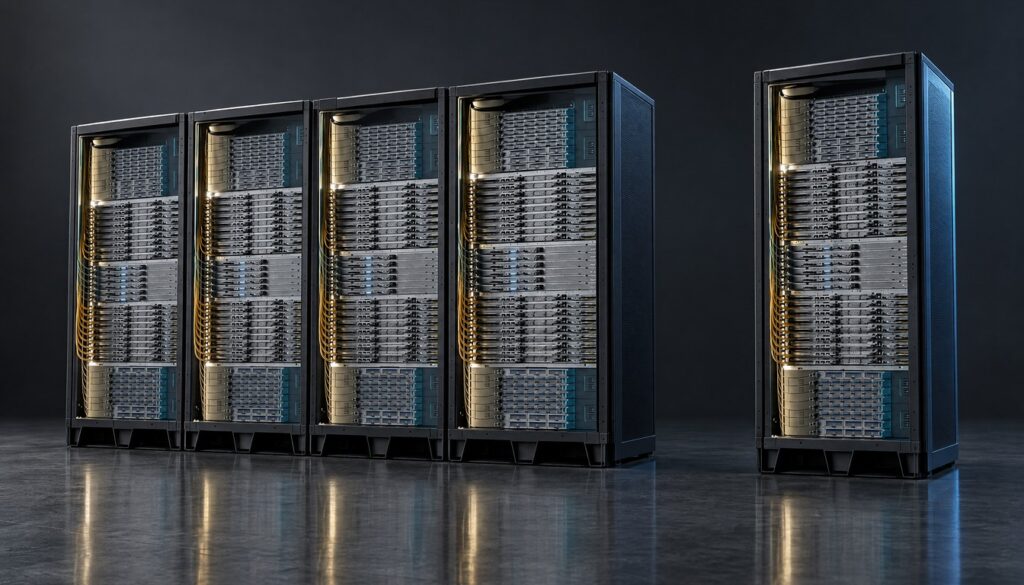
AMD’s rack-scale AI platform, Helios, is now shipping in production form, and the company says it is built to run agentic AI workloads at a scale most data centers have never attempted. But a version of the story circulating online this week describes Helios as a “CPU-only” design under the name “Helion.” Neither claim holds up against AMD’s own published specifications. The real Helios rack pairs 72 AMD Instinct MI455X GPUs with 18 sixth-generation AMD EPYC “Venice” CPUs, a combination AMD has described publicly since its Advancing AI event in July 2026.
The mix-up matters because it muddies a genuinely important hardware story. AMD (NASDAQ: AMD) is making its most aggressive push yet into the rack-scale AI infrastructure market that Nvidia has dominated, and it is doing so by leaning on a decades-old strength: EPYC server CPUs. Here is what AMD has actually confirmed about Helios, what remains unverified, and why the CPU is suddenly back at the center of the AI hardware conversation.
What AMD Helios Actually Is
Helios is AMD’s name for a rack-scale reference design that bundles four of its own technologies into a single deployable unit: AMD Instinct GPUs, AMD EPYC CPUs, AMD Pensando networking, and the ROCm open software stack. AMD first described Helios as a reference-design solution in October 2025, positioning it for large-scale inference, frontier-model training, fine-tuning, sovereign AI deployments, and agentic AI workloads, according to AMD’s investor relations announcement.
By July 23, 2026, AMD said Helios rackscale solutions had moved from reference design to production, with deployment planned by leading AI companies at gigawatt scale. That is a fast turnaround for a full rack-scale system, and it is a signal of how much pressure AMD is under to show up as a credible alternative to Nvidia’s rack-scale offerings, not just a GPU vendor selling individual accelerators.
The name itself is a point of confusion worth clearing up. AMD’s own materials consistently use “Helios,” not “Helion.” Readers searching for the latter name are likely encountering a transcription error that has spread across aggregator sites. For anyone tracking AMD’s AI infrastructure roadmap, Helios is the term to search.
Inside the Rack: GPUs, CPUs, and Networking Working Together
The confirmed Helios architecture is a combined compute design, not a CPU-only box. A full rack houses 72 AMD Instinct MI455X GPUs, built on AMD’s CDNA 5 architecture, alongside 18 sixth-generation AMD EPYC “Venice” processors, a ratio of four GPUs for every CPU. That ratio is itself informative: it tells you AMD still treats the GPU as the primary compute engine for AI math, while giving the CPU a much larger role in orchestration, data movement, and the kind of branching logic that agentic AI pipelines lean on heavily.
The EPYC “Venice” chips belong to the EPYC 9006 series and are built on AMD’s Zen 6 core design. Reported configurations scale up to 256 cores and 512 threads per chip, with 16 memory channels, up to 1GB of L3 cache, PCIe 6.0 connectivity, and support for CXL 3.1. That is a substantial jump in per-socket capability, and it is the kind of CPU muscle that agentic workloads, which chain together many smaller reasoning and tool-calling steps rather than one giant matrix multiplication, actually benefit from.
Tying the rack together is AMD Pensando networking, covering front-end, scale-up, and scale-out traffic through what AMD calls Pensando AI-NICs and Vulcano NICs. The software layer runs on AMD’s ROCm stack, the company’s open alternative to Nvidia’s CUDA ecosystem. AMD has built Helios to be Open Compute Project (OCP) compliant and supports both UALink and Ultra Ethernet, two interconnect standards aimed at giving hyperscalers more flexibility than a single-vendor networking stack would allow.
The Spec Sheet: 31TB of HBM4 and 2.9 Exaflops Per Rack
AMD’s published numbers for a full Helios rack are aggressive. The 72 MI455X GPUs carry HBM4 memory, with the full rack delivering 31 terabytes of aggregate HBM4 capacity and 1.7 petabytes per second of aggregate memory bandwidth. Scale-up bandwidth inside the rack, using AMD’s UALoE (UALink over Ethernet) approach, reaches 260 terabytes per second, while scale-out bandwidth to systems beyond the rack hits 43 terabytes per second.
On raw throughput, AMD lists peak low-precision compute at 2.9 exaflops in FP4 and 1.4 exaflops in FP8 per rack. Those numbers only matter in context, so here is the full spec sheet AMD has published for a complete Helios deployment.
| Component | Specification |
|---|---|
| GPUs per rack | 72x AMD Instinct MI455X (CDNA 5) |
| CPUs per rack | 18x 6th Gen AMD EPYC “Venice” (EPYC 9006 series) |
| CPU core count | Up to 256 cores / 512 threads per socket |
| CPU memory channels | 16 per socket |
| CPU cache | Up to 1GB L3 per socket |
| CPU I/O | PCIe 6.0, CXL 3.1 |
| Aggregate GPU memory | 31TB HBM4 |
| Aggregate memory bandwidth | 1.7 PB/s |
| Scale-up bandwidth | 260 TB/s (UALoE) |
| Scale-out bandwidth | 43 TB/s |
| Peak FP4 compute | 2.9 exaflops |
| Peak FP8 compute | 1.4 exaflops |
| Networking | AMD Pensando (front-end, scale-up, scale-out), Vulcano NICs |
| Software stack | AMD ROCm (open source) |
| Rack standard | OCP-compliant, UALink and Ultra Ethernet support |
AMD also claims Helios delivers up to 30% more tokens per dollar than what it calls “the leading competitive solution,” a comparison figure from AMD’s own materials rather than an independently audited benchmark. Readers evaluating that claim should treat it the way they would any vendor-supplied efficiency number: directionally useful, but not a substitute for workload-specific testing.
Why the “CPU-Only Helios” Claim Doesn’t Hold Up
Some coverage this week framed Helios, or a variant called “Helion,” as a CPU-only rack purpose-built for agentic AI, implying AMD had decided GPUs were no longer necessary for this class of workload. That framing does not match anything AMD has published. Every description of Helios, from the July 2026 Advancing AI event through AMD’s most recent production updates, centers on a combined GPU-and-CPU design: 72 MI455X accelerators doing the heavy AI math, with 18 Venice CPUs handling orchestration, memory-intensive steps, and the broader system logic that agentic pipelines require.
It is worth separating two different ideas that have gotten blended together in recent coverage. The first is accurate: agentic AI workloads are pulling CPUs back into relevance in a way that pure GPU-bound training jobs never did, because agents spend a lot of their time on branching logic, tool calls, and data retrieval rather than dense matrix math. The second is not supported by AMD’s own specs: that this shift has produced a CPU-only rack. AMD is doing the opposite, building a rack that leans harder on CPUs than prior GPU-centric designs did, while keeping GPUs as the dominant compute resource.
That nuance is exactly what AMD executive Keith Dicker described in comments reported by SiliconANGLE around the Advancing AI event. “If you looked at GPU being the center of a lot of these workloads, what’s happened over time as agentic has unfolded is a realization that it’s … as much a CPU workload as it is a GPU workload,” Dicker said, according to SiliconANGLE’s report. That is a shift in balance, not a replacement of one chip type with another.
AMD’s Open Rack-Scale Bet
Dicker also framed AMD’s broader strategy as deliberately open rather than vertically closed. “Instead of building systems themselves and competing with our customers, we took the approach of open and building a rack-scale architecture, publishing a spec, engaging the ecosystem,” he said, per the same SiliconANGLE report. He called the resulting collaboration “a coming together of the entire industry to go develop a solution,” a contrast AMD likes to draw against Nvidia’s more tightly controlled rack and networking stack.
Lisa Su’s Pitch: GPUs and CPUs, Not GPUs Instead of CPUs
AMD Chair and CEO Lisa Su has been the most direct voice tying Helios to the agentic AI narrative. Introducing the platform at Advancing AI, Su said: “We recognize this agentic era would require the highest performing GPUs and CPUs working together,” according to comments collected by CEO Interviews. That statement alone undercuts any reading of Helios as a CPU-only platform; Su’s framing is explicitly additive, pairing AMD’s GPU and CPU lines rather than swapping one for the other.
Su went further in describing what a Helios rack physically contains, telling the same event, per the CEO Interviews transcript: “That’s what it takes to run agentic AI at scale,” referring to a rack built from AMD GPU compute units, Zen CPU cores, and HBM4 memory working as one system rather than separate boxes stitched together after the fact. It is a pitch AMD has made before with individual chips; Helios is the company’s attempt to make that pitch at the rack level, where hyperscalers increasingly make their purchasing decisions.
How Helios Stacks Up Against Nvidia’s Vera Rubin NVL72
AMD has not been shy about naming its target. The company has publicly compared Helios directly against Nvidia’s Vera Rubin NVL72 rack, the GPU maker’s own next-generation rack-scale system. According to AMD’s comparison figures, Helios delivers up to 15% more AI compute, up to 50% more HBM capacity, and up to 50% more scale-out bandwidth than Vera Rubin NVL72. Those are AMD’s own published comparison numbers, not results from an independent third-party benchmarking lab, and should be read with that caveat attached.
| Metric | AMD Helios (AMD’s stated comparison) | Nvidia Vera Rubin NVL72 |
|---|---|---|
| AI compute | Up to 15% more, per AMD | Baseline reference point |
| HBM capacity | Up to 50% more, per AMD | Baseline reference point |
| Scale-out bandwidth | Up to 50% more, per AMD | Baseline reference point |
| Tokens per dollar | Up to 30% more than “leading competitive solution,” per AMD | Not independently confirmed |
| Source of figures | AMD published comparison | AMD published comparison |
These figures are worth watching closely over the next few quarters. Vendor-supplied comparisons tend to favor whichever metric makes the newer product look best, and AMD’s selection of AI compute, HBM capacity, and scale-out bandwidth as the three headline categories is itself a strategic choice. Independent benchmarking from cloud providers actually running both racks side by side, rather than AMD’s own slide decks, will be the real test of whether the 15% and 50% figures hold up in production.
Market Impact: AMD’s Bid for Rack-Scale Credibility
The stakes here go beyond a single product launch. For years, AMD’s AI chip story has mostly been about catching up to Nvidia on individual GPU specs, chip generation by chip generation. Helios is a different kind of move: an attempt to compete at the level hyperscalers actually buy at, which is increasingly the whole rack, not the individual accelerator. StockTitan’s coverage of the Advancing AI announcement framed Helios explicitly as AMD’s full-stack answer to that shift, built to be judged on tokens-per-dollar economics rather than raw FLOPs alone.
That framing matters for AMD’s broader AI business, which has already been scaling fast on the strength of AI chip demand that CEO Lisa Su has said is outpacing supply into 2028. A production-ready rack-scale platform gives AMD a product to point to when hyperscale customers ask not just “how fast is your GPU” but “can you sell me a rack I can drop into my data center today.” That pitch has already found at least one buyer: HPE has committed roughly $1.2 billion to an AMD Helios deployment alongside cloud provider Vultr, a concrete early data point behind AMD’s broader claim that leading AI companies are planning gigawatt-scale Helios deployments. Beyond that one confirmed deal, AMD has not named additional specific customers or deployment sizes in the material reviewed for this story.
Industry analysis from TBRi described AMD as having moved into what it called the “execution phase” of its full-stack AI strategy, a framing that fits the Helios timeline: a reference design unveiled in October 2025, followed by a confirmed production milestone less than a year later, according to TBRi’s special report. That is a faster cadence than AMD’s historical pace on major platform launches, and it reflects how much competitive pressure the company is under from Nvidia’s own rack-scale roadmap.
Historical Context: AMD’s Rack-Scale Pivot
AMD’s Instinct GPU line has gone through several architecture generations in a relatively short span, culminating in the CDNA 5-based MI455X used in Helios. What is new with Helios is not the GPU generation itself, but the decision to package GPUs, CPUs, networking, and software into a single reference design that AMD actively markets as a rack, not a chip. That is a notable departure from AMD’s historical approach of selling components and letting system integrators and hyperscalers assemble the rest.
The approach also tracks broader movement in the data center hardware market, where Nvidia has pushed its own CPU-plus-GPU rack designs, including the Vera CPU paired with Rubin GPUs at cloud providers like CoreWeave. Both chipmakers appear to have reached a similar conclusion at roughly the same time: as AI workloads shift from pure training runs toward agentic systems that juggle reasoning, retrieval, and tool use, the CPU’s share of the compute budget inside a rack needs to grow, even as the GPU remains the dominant resource for the underlying math.
Competitive Landscape: AMD, Nvidia, and the Rest of the Rack-Scale Field
Nvidia remains the dominant force in AI accelerators, and its Vera Rubin NVL72 rack is the explicit target of AMD’s Helios comparison figures. But the competitive picture is broader than a two-player race. Hyperscalers are increasingly building or commissioning their own silicon, a trend that has already reshaped parts of the market AMD is trying to enter. AMD’s own GPU supply decisions elsewhere in its lineup, including the kind of chip-allocation tradeoffs Nvidia has made between its RTX Pro and consumer GPU lines, show how tight the overall AI and graphics silicon supply chain has become across the industry, not just for AMD.
On pricing and component costs, AMD has also had to navigate rising memory prices across its lineup, a dynamic visible in AMD’s recent GDDR6 price increase, which landed around the same time Nvidia held its GDDR7 pricing steady. Memory economics matter for Helios too: a rack built around 31TB of HBM4 is exposed to the same supply constraints squeezing memory prices across the broader chip market, and any shortage or price spike in HBM4 supply could affect how quickly AMD can scale Helios production to meet the demand it says it is seeing.
What’s Still Unconfirmed
Several details circulating about Helios remain unverified and should be treated as such until AMD or a named outlet confirms them directly. There is no confirmed pricing for a complete Helios rack in AMD’s public materials reviewed for this story. There is no on-record quote tying a specific “CPU-only” rack design to AMD under either the Helios or “Helion” name. And while AMD has said leading AI companies plan gigawatt-scale deployments, the company has not published a customer list or deployment timeline with specific dates attached to specific buyers in the sources available for this report.
That gap between confirmed specs and circulating claims is a useful reminder for anyone tracking fast-moving AI hardware news: a rack-scale platform this complex, spanning four separate product lines inside one chassis, is exactly the kind of story that gets simplified and occasionally garbled as it spreads across aggregators. The safest approach is to anchor to AMD’s own numbers, which are themselves aggressive enough without embellishment.
What Comes Next for AMD’s AI Infrastructure Roadmap
A few trends look likely to play out over the coming quarters based on AMD’s current trajectory and public statements:
- Expect AMD to publish independent or third-party benchmark validation for Helios’s tokens-per-dollar claims, since vendor-only figures will draw scrutiny from analysts and customers evaluating a multi-million-dollar rack purchase.
- Watch for AMD to name specific hyperscale or sovereign AI customers deploying Helios at scale, which would convert the current “leading AI companies” language into concrete proof points.
- CPU core counts and memory channels in future EPYC generations will likely keep climbing, since AMD’s own framing of agentic workloads as CPU-hungry gives the company a reason to keep investing in that side of the rack rather than treating EPYC as a secondary product line.
- Nvidia will almost certainly respond with its own updated rack-scale comparison figures against Helios, continuing the pattern of dueling vendor benchmarks that has defined this phase of the AI hardware race.
- Expect continued confusion in secondary coverage between “Helios” and incorrect names like “Helion,” along with oversimplified CPU-only framing, until AMD’s own marketing materials become the dominant source outlets rely on.
Frequently Asked Questions
Is AMD Helios a CPU-only rack?
No. AMD’s published specifications describe a combined design with 72 AMD Instinct MI455X GPUs and 18 sixth-generation AMD EPYC “Venice” CPUs per rack. Claims describing Helios, or a variant called “Helion,” as CPU-only are not supported by AMD’s own materials.
Is the platform called “Helios” or “Helion”?
AMD’s official materials consistently use the name “Helios.” The name “Helion” appears to be a transcription error that has spread across some secondary coverage.
When is AMD Helios shipping?
AMD described Helios as a reference design starting in October 2025 and said on July 23, 2026, that Helios rackscale solutions were in production, with deployment planned by leading AI companies at gigawatt scale.
How does Helios compare to Nvidia’s Vera Rubin NVL72?
AMD has published comparison figures claiming up to 15% more AI compute, up to 50% more HBM capacity, and up to 50% more scale-out bandwidth than Nvidia’s Vera Rubin NVL72. These are AMD’s own figures rather than independent third-party benchmarks.
What CPU does AMD use inside Helios?
Helios uses sixth-generation AMD EPYC “Venice” processors from the EPYC 9006 series, with reported configurations scaling up to 256 cores and 512 threads per socket, 16 memory channels, up to 1GB of L3 cache, PCIe 6.0, and CXL 3.1 support.
How much memory does a Helios rack have?
A full Helios rack delivers 31TB of aggregate HBM4 capacity across its 72 GPUs, with 1.7 petabytes per second of aggregate memory bandwidth.
Why are CPUs becoming more important for AI workloads?
Agentic AI workloads spend more time on branching logic, tool calls, and data orchestration than traditional training jobs, which shifts some of the compute burden back toward CPUs even as GPUs remain the dominant resource for the underlying math.
Has AMD confirmed pricing for a full Helios rack?
No. AMD has not published rack-level pricing for Helios in the materials reviewed for this story. Any specific dollar figure circulating for a complete rack should be treated as unconfirmed.