
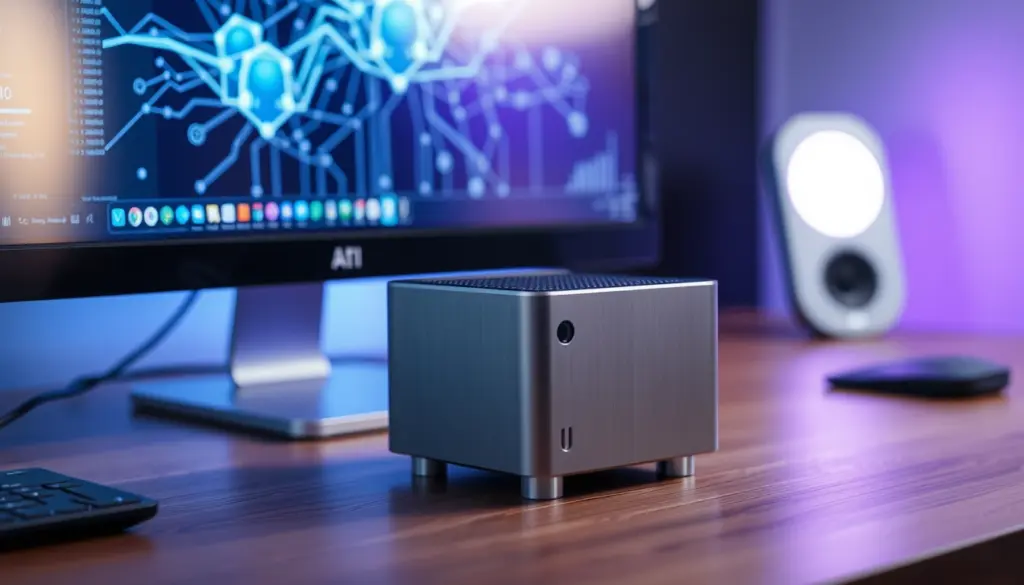
ASUS put a new stake in the ground for desktop AI hardware on September 17, 2026, unveiling the Ascent QN10 mini PC at an event in Fremont, California. The company is calling it the first agentic AI mini PC on the market, built around Qualcomm’s Snapdragon X2 Elite processor and an 80 TOPS neural processing unit that doubles Microsoft’s Copilot+ PC baseline. At $1,349 for the base configuration, the ASUS Ascent QN10 makes a pointed argument: ARM silicon, not just x86 chips from Intel and AMD, can now carry serious on-device AI workloads inside a box the size of a hardcover book.
ASUS Unveils the Ascent QN10, Its First Agentic AI Mini PC
ASUS positioned the Ascent QN10 as more than another small-form-factor desktop. Per the company’s own launch materials, the device “redefines AI computing in an ultracompact form factor,” a line ASUS used to frame the QN10 as a machine built specifically to run local AI agents rather than just browse the web or edit documents. HotHardware covered the launch and called it the world’s first mini PC to pair Qualcomm’s Snapdragon X2 Elite with an 80 TOPS NPU, framing the device as a mini PC first rather than a repurposed laptop chassis.
CNX Software described the Ascent QN10 as the first mini PC powered by a Snapdragon X2 Elite 18-core Armv9 processor, a detail that matters because most Snapdragon X2 Elite silicon so far has shipped in laptops, not desktop boxes. Windows Central reported that ASUS had already started shipping units, tying the launch to the same September 17 date. The push into desktops follows a broader pattern this year of ARM vendors chasing markets that x86 chips from Intel and AMD have long owned outright.
Inside the Silicon: Snapdragon X2 Elite, 18 Cores, Adreno X2-90
The Ascent QN10 runs on Qualcomm’s Snapdragon X2 Elite, an 18-core Oryon CPU paired with an integrated Adreno X2-90 GPU, according to HotHardware’s launch coverage. That core count sits well above typical consumer x86 chips in this price class, though ASUS and reviewers have not yet published head-to-head benchmarks against Intel Core Ultra or AMD Ryzen AI mini PCs. The Gadgeteer’s summary of the launch matched the same trio of numbers: 18-core Oryon CPU, Adreno X2-90 graphics, and an 80 TOPS neural engine, giving the spec sheet consistent backing across multiple outlets.
What’s still missing from the public record is a clean performance comparison. No outlet in the current coverage has published Cinebench, Geekbench, or 3DMark results pitting the Ascent QN10 against comparable Intel or AMD mini PCs, so any ranking beyond raw core count and NPU throughput would be speculation. ASUS is selling this machine on AI capability first, general compute second, and the marketing reflects it: the emphasis lands almost entirely on what the neural processing unit can do rather than on traditional CPU or GPU benchmarks.
The 80 TOPS NPU: Doubling the Copilot+ PC Bar
The number driving most of the coverage is 80 TOPS, the throughput rating ASUS assigns to the Hexagon NPU inside the Snapdragon X2 Elite package. Both CNX Software and 3DNews pointed out that this figure sits at exactly double the 40 TOPS threshold Microsoft requires for a system to carry the Copilot+ PC label. That 40 TOPS bar has become the industry’s shorthand for AI-ready hardware since Microsoft introduced the Copilot+ certification, and it’s the same baseline that tripped up other recent launches, including the Acer Swift Air 16, which shipped with only 17 TOPS against the 40 TOPS requirement.
Clearing that bar by a factor of two gives ASUS headroom to market the QN10 as capable of running multiple AI workloads at once, a claim the company’s product page backs up by describing support for “multiple intelligent workloads simultaneously,” including agentic AI applications. In practice, the NPU rating measures peak throughput for AI inference, not real-world task completion time, so buyers evaluating the QN10 against rival mini PCs are still working from a single headline number rather than a full benchmark suite.
Pricing, Configurations, and US Availability
ASUS listed the Ascent QN10 at $1,349 for its US launch configuration, available starting September 17, 2026 through Best Buy, Newegg, B&H Photo Video, and the ASUS eShop. That base configuration pairs 16GB of LPDDR5x memory clocked at 8533MHz with 512GB of PCIe 4.0 NVMe storage, according to ASUS’s own launch announcement.
Outlet coverage points to at least one additional tier. Windows Forum reported a 32GB LPDDR5x / 512GB SSD variant carrying a higher price than the base model, though the exact figure wasn’t specified in that report. Notebookcheck’s summary of the US release confirmed pricing starting at $1,349 with configurations reaching up to 32GB of RAM, along with USB4 connectivity and 2.5 GbE wired networking built in. ASUS’s own “where to buy” listing goes further on storage, specifying one M.2 2280 PCIe Gen5 NVMe slot and one PCIe Gen4 slot, supporting 512GB, 1TB, or 2TB modules for up to 4TB of total storage across both slots.
Memory, Storage, and Ports
The dual M.2 setup is a meaningful detail for a mini PC in this class. Many small-form-factor desktops cap out at a single NVMe slot, forcing buyers to choose between capacity and future upgrades at purchase time. ASUS’s approach, mixing a faster Gen5 slot with a Gen4 companion, gives the Ascent QN10 room to grow without requiring a full teardown, assuming ASUS’s published slot specifications hold across retail units.
On networking and I/O, Notebookcheck’s report lists USB4 ports and 2.5 GbE Ethernet as standard, both of which matter for the kind of local AI workloads ASUS is targeting. USB4 supports high-bandwidth external accelerators and displays, while 2.5 GbE keeps large model downloads and dataset transfers from bottlenecking on a 1 Gbps port, a limitation that still shows up on cheaper AI-branded mini PCs like the MINIX N304-AI.
What “Agentic AI” Means on a Desktop Box
ASUS built its entire marketing pitch around the word agentic, and HotHardware’s coverage backs that framing, describing the QN10 as intended to run AI workloads and autonomous agents locally rather than routing every request to a cloud API. The distinction matters for privacy-conscious buyers and for enterprises wary of sending proprietary data to third-party model providers. An agent that plans multi-step tasks, calls local tools, and holds context across a session needs sustained inference throughput, which is exactly what a dedicated 80 TOPS NPU is built to deliver without pulling power from the CPU or GPU.
Whether the Ascent QN10 can actually run today’s most capable agentic models locally, at usable speed, remains untested in public benchmarks. The hardware clears Microsoft’s certification bar with room to spare, but running a large agentic workload end-to-end on-device is a different test than passing a TOPS rating, and reviewers have not yet published that data.
ASUS Ascent QN10 vs Rival AI Mini PCs
Measured purely on NPU throughput, the Ascent QN10 leads the current crop of AI-branded mini PCs and compact laptops covered on this site so far in 2026. The table below lines up publicly confirmed NPU ratings against Microsoft’s Copilot+ PC requirement.
| Device / Benchmark | NPU Rating (TOPS) | Vs. Copilot+ Minimum | Source |
|---|---|---|---|
| Microsoft Copilot+ PC requirement | 40 TOPS | Baseline | Microsoft |
| ASUS Ascent QN10 (Snapdragon X2 Elite) | 80 TOPS | 2x minimum | ASUS, HotHardware, CNX Software |
| MINIX N304-AI mini PC | 24 TOPS | Below minimum | Shattered.io launch coverage |
| Acer Swift Air 16 (Copilot+ branded) | 17 TOPS | Below minimum | Shattered.io launch coverage |
The gap between the QN10’s 80 TOPS and the sub-25 TOPS figures on cheaper AI-labeled machines shows how wide the spread has gotten within a single product category. Buyers shopping by TOPS rating alone are comparing hardware that ranges from below Microsoft’s own bar to double it, all marketed under the same AI PC umbrella.
Spec-by-Spec: Base vs Higher-Tier Configuration
Reported configurations for the Ascent QN10 vary across outlets, likely reflecting different retailer SKUs rather than conflicting reporting. The table below separates the confirmed base configuration from the higher-tier variant referenced by Windows Forum and Notebookcheck.
| Spec | Base Configuration | Higher-Tier Configuration |
|---|---|---|
| CPU | Snapdragon X2 Elite, 18-core Oryon | Same |
| GPU | Adreno X2-90 (integrated) | Same |
| NPU | 80 TOPS Hexagon | Same |
| RAM | 16GB LPDDR5x, 8533MHz | Up to 32GB LPDDR5x |
| Storage | 512GB PCIe 4.0 NVMe | Up to 4TB across Gen5 + Gen4 M.2 slots |
| Ports | USB4, 2.5 GbE LAN | Same |
| Launch price (US) | $1,349 | Higher, exact figure unconfirmed |
| US availability | Sept. 17, 2026 – Best Buy, Newegg, B&H, ASUS eShop | Same channels |
ARM vs x86: The Fight Moves to the Desktop
Snapdragon X2 Elite chips have spent most of 2026 competing inside laptops, where ARM’s power efficiency advantage over x86 has been the primary sales pitch. The Ascent QN10 changes the venue. A mini PC plugged into wall power doesn’t need battery-life arguments the way a laptop does, so ASUS is instead selling raw NPU throughput as the differentiator against Intel Core Ultra and AMD Ryzen AI desktop parts.
That’s a notable shift in framing. Earlier Snapdragon X launches leaned heavily on battery life and fanless design to win over Windows laptop buyers away from Apple Silicon and Intel. A desktop box removes that variable entirely and forces the comparison onto compute throughput, where ARM’s growing share of the PC market has been building steadily through 2026 even without a dedicated agentic-AI angle. If the QN10 sells well, expect more ARM-based desktop hardware to follow the same script: skip the battery pitch, lead with the NPU number.
Windows on ARM software compatibility used to be the sticking point holding back exactly this kind of move. Native ARM64 app support has broadened steadily since 2024, and most of the productivity and developer tooling a buyer would run on a mini PC, including containerized workloads and browser-based AI tools, now runs without emulation overhead on Snapdragon X-series chips. That shift removes one of the last practical objections to putting ARM silicon in a desktop box rather than reserving it for laptops chasing battery life.
From Copilot+ Laptops to Agentic Desktops: A Short History
Microsoft’s Copilot+ PC program set the 40 TOPS NPU floor in 2024 as a certification requirement for laptops running on-device Windows AI features like Recall and Live Captions. Through 2025 and into 2026, chipmakers largely treated that number as a ceiling to clear rather than a floor to build past, which is why so many recent launches, including budget Copilot+ laptops, have landed right around 40 to 50 TOPS.
The Ascent QN10 breaks that pattern by roughly doubling the requirement in a desktop form factor rather than a laptop. It follows a wave of agentic AI PC branding that picked up through mid-2026 as software vendors, including Google’s Gemini app arriving on Windows, pushed local AI assistants further into everyday desktop use. ASUS previewed elements of the agentic AI PC concept at Microsoft Build 2026 before formalizing the QN10 launch in September, according to earlier event coverage tied to the product.
Market Impact: Qualcomm, Intel, and AMD
For Qualcomm, a Snapdragon chip winning a design slot in a mini PC rather than another laptop is a meaningful expansion of Snapdragon X2 Elite’s addressable market. Desktop wins carry less unit volume than laptops but higher visibility among the enthusiast and developer buyers who set purchasing trends for the rest of the market. Qualcomm has been raising prices across its AI PC chip lineup this year even as it pushes into new categories, a sign the company sees enough demand to support both moves at once.
Intel and AMD haven’t responded publicly with a matching desktop AI mini PC announcement as of this writing. Intel’s Core Ultra lineup and AMD’s Ryzen AI Max chips, including the 192GB-capable Ryzen AI Max PRO 400, remain the dominant x86 options for AI-branded desktops and mobile workstations, but neither company has confirmed a mini PC specifically built to chase the agentic label the way ASUS has with the QN10. That gap gives Qualcomm and ASUS a short window to define the category on their own terms before x86 rivals respond.
For system builders and IT buyers, the QN10 also lands at a moment when component costs are climbing across the board. Memory pricing pressure has pushed up the cost of RAM-heavy configurations industry-wide in 2026, which makes ASUS’s decision to ship a 16GB base configuration, rather than defaulting straight to 32GB, look like a deliberate move to hold the $1,349 price point rather than a spec compromise forced by the silicon itself.
Security and Enterprise Positioning
ASUS is also pitching the Ascent QN10 at developers and enterprise buyers, not just AI hobbyists. Earlier ASUS event coverage tied to the product described a goal of bringing private, on-device AI to developers, prosumers, and enterprise teams, a pitch that leans on the same privacy argument driving broader interest in local inference: sensitive data never has to leave the machine to get processed by an AI model.
That local-processing pitch runs parallel to a security conversation that has intensified across the industry in 2026, as companies weigh the risk of routing proprietary data through cloud AI services against the convenience those services offer. A machine that can run agentic workloads entirely on local silicon sidesteps at least one category of that risk, though it introduces its own requirements around device-level security and patch management that enterprise IT teams will need to evaluate before wide deployment.
Predictions: Where Agentic Mini PCs Go From Here
- Expect at least one Intel or AMD-based rival mini PC marketed specifically as agentic AI hardware within the next two quarters, given how quickly TOPS ratings have become a headline spec across the industry.
- Independent benchmark suites comparing the Ascent QN10 against Intel Core Ultra and AMD Ryzen AI mini PCs should surface within weeks of retail availability, filling the current gap in head-to-head performance data.
- Qualcomm will likely push Snapdragon X2 Elite into additional desktop form factors beyond mini PCs, following the same playbook that took Snapdragon X chips from laptops into this category.
- NPU throughput claims across the wider mini PC market will keep climbing past 40 TOPS as vendors chase the same double-Copilot+ marketing angle ASUS used for the QN10.
- Enterprise procurement teams evaluating on-device AI hardware will increasingly ask for local-inference benchmarks specific to agentic workloads, not just generic TOPS figures, as buyers grow more skeptical of headline NPU numbers alone.
None of these are guaranteed outcomes. They follow directly from the pattern the AI PC market has shown through 2026: fast spec escalation, thin early benchmark data, and rival chipmakers reacting to whichever number gets the most headlines first.
Frequently Asked Questions
What is the ASUS Ascent QN10?
It’s a mini PC ASUS launched on September 17, 2026, built around Qualcomm’s Snapdragon X2 Elite processor with an 80 TOPS NPU, which ASUS markets as the first agentic AI mini PC on the market.
How much does the ASUS Ascent QN10 cost?
The base configuration, with 16GB of LPDDR5x memory and 512GB of PCIe 4.0 storage, launched at $1,349 in the US, according to ASUS.
What chip powers the Ascent QN10?
An 18-core Snapdragon X2 Elite Oryon CPU paired with an integrated Adreno X2-90 GPU and an 80 TOPS Hexagon NPU, per HotHardware and CNX Software’s launch coverage.
Does the ASUS Ascent QN10 qualify as a Copilot+ PC?
Yes. Its 80 TOPS NPU rating is double Microsoft’s 40 TOPS minimum requirement for Copilot+ PC certification, as noted by CNX Software and 3DNews.
Where can I buy the ASUS Ascent QN10 in the US?
ASUS listed the device as available through Best Buy, Newegg, B&H Photo Video, and the ASUS eShop starting September 17, 2026.
How much storage does the Ascent QN10 support?
ASUS’s product listing specifies one PCIe Gen5 M.2 slot and one PCIe Gen4 M.2 slot, supporting 512GB, 1TB, or 2TB modules each for up to 4TB of total storage.
How does the Ascent QN10 compare to other AI mini PCs?
At 80 TOPS, it rates well above competing AI-branded mini PCs covered so far in 2026, including the MINIX N304-AI at 24 TOPS, though no independent outlet has published direct performance benchmarks between them yet.
Is the Ascent QN10 meant for consumers or businesses?
ASUS is marketing it to both, describing target users as developers, prosumers, and enterprise teams looking to run AI workloads locally rather than through cloud services.