
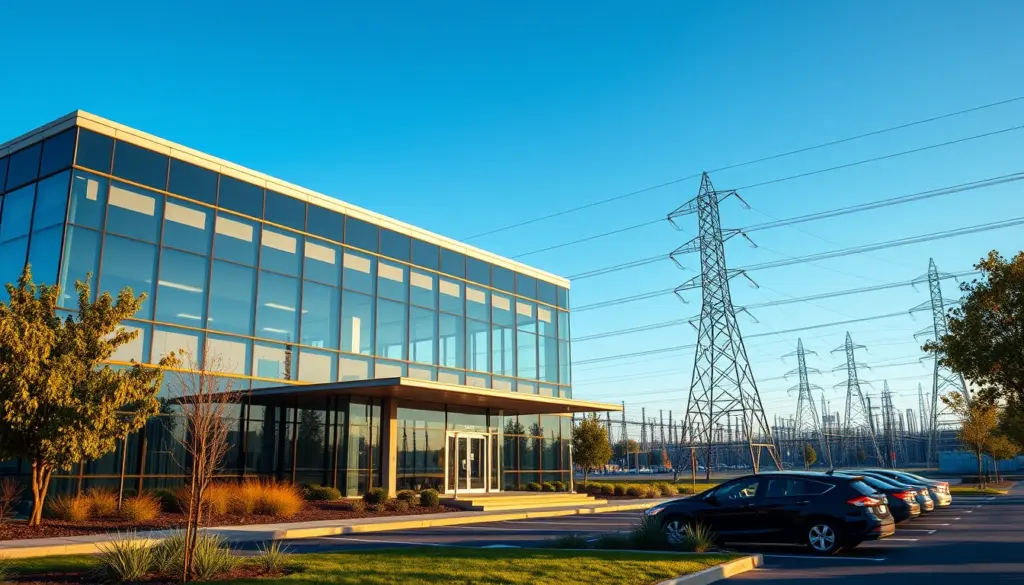
Blackstone Real Estate has paid $99.6 million for a Sunnyvale office building leased entirely by Nvidia, according to county filings reviewed by Hoodline and The Registry Northern California Real Estate. The transaction closed on the 134,200-square-foot building at 350 Cobalt Way and was recorded with the Santa Clara County Recorder’s Office on September 22, 2026.
The price is more than triple what the previous owner paid just three years ago. It also lands at a moment when Silicon Valley landlords are chasing a different kind of tenant amenity: raw electrical capacity. The building carries 10 megawatts of power capacity, a figure that outlet reporting ties directly to why Blackstone moved on the asset now rather than waiting.
The $99.6 Million Deal, Line by Line
Blackstone acquired the property through an affiliate. Nvidia leases the entire two-story building, which sits roughly five minutes from the chipmaker’s headquarters. The lease reportedly runs through August 2036, giving Blackstone a 12-year runway of guaranteed rent from one of the largest companies by market capitalization on the planet.
| Detail | Figure |
|---|---|
| Buyer | Blackstone Real Estate (via affiliate) |
| Seller | PSAI Realty Partners |
| Property | 350 Cobalt Way, Sunnyvale, CA |
| Building size | 134,200 sq ft, two-story office and R&D |
| Tenant | Nvidia (full building) |
| Lease term | Through August 2036 |
| 2026 sale price | $99.6 million |
| 2023 sale price | $31 million |
| Price change | Up roughly 221% in three years |
| Electrical capacity | 10 megawatts |
| Built / renovated | 1978 / 2022 |
| County filing date | September 22, 2026 |
| Marketed by | JLL |
Correcting the Record on the Purchase Price
Not every early report landed on the same number. At least one outlet framed the deal as a $95 million purchase of a power-rich Nvidia building. That figure does not match the documents filed with Santa Clara County. Hoodline, The Registry Northern California Real Estate, and coverage tracked by The Real Deal all cite $99.6 million as the recorded sale price, more than triple the $31 million PSAI Realty Partners paid in 2023. Readers searching for the deal should treat $99.6 million as the confirmed figure and the $95 million number as an early, unconfirmed estimate that circulated before county records became public.
From $31 Million to $99.6 Million in Three Years
The building’s ownership history explains part of the jump. Fujitsu originally occupied 350 Cobalt Way and sold it to PSAI Realty Partners in January 2023. At the time of that sale, Fujitsu’s own lease was set to expire that September, leaving the building without a tenant lined up. PSAI picked up the property for $31 million, a price that reflected an empty office building with an uncertain near-term lease outlook.
Nvidia’s arrival as tenant changed the calculus entirely. A vacant office asset became a fully leased research facility backed by one of the most creditworthy tenants in tech, with a stated 3.0% annual rent escalation built into the term. That shift, from empty building to Nvidia-anchored asset with a 12-year lease, is most of the reason the price roughly tripled between 2023 and 2026.
Why Nvidia Needs a Building With 10 Megawatts of Power
Office buildings do not typically need serious electrical headroom. Lighting, HVAC, and standard plug loads for computers and monitors rarely push a building anywhere near industrial power draw. A 10-megawatt allotment on a 134,200-square-foot footprint is a different category of asset, and it is why JLL marketed the building around its infrastructure rather than its square footage alone.
Reports describe 350 Cobalt Way as one of Nvidia’s few research and development labs that also houses data center facilities on site. Nvidia is reportedly carrying out tenant improvements at the property, including upgrades that could support additional data-center-style capacity down the line. That combination, R&D staff working alongside power-hungry compute infrastructure, is increasingly what distinguishes a “generic” office lease from what brokers now market as a hardened, power-secured asset.
The Power-Per-Square-Foot Math
The stated numbers on the deal make the point better than any adjective can. Divide the building’s electrical capacity by its floor area and the gap between a standard office and 350 Cobalt Way becomes clear.
10,000,000 watts / 134,200 sq ft = ~74.5 watts per sq ft

$99,600,000 / 134,200 sq ft = ~$742 per sq ft
Both figures sit well above what a conventional Silicon Valley office building commands or requires. The power density explains why Nvidia wants the space badly enough to sign through 2036, and the price per square foot shows what landlords can now charge when they own one of the buildings that can actually deliver that kind of capacity.
JLL’s Pitch: Mission-Critical Infrastructure
JLL, which marketed the property for sale, described the building in blunt terms. According to JLL, “350 Cobalt is one of Nvidia’s few research and development labs with data center facilities, operating as mission-critical infrastructure.” That framing matters for how investors are pricing office assets tied to AI compute. A building is no longer valued purely on rent per square foot and lease length. Power capacity, backup infrastructure, and proximity to a hyperscaler’s campus now factor directly into the appraisal.
Blackstone’s Bigger Bet on Data Center Real Estate
The Sunnyvale purchase is a small line item next to Blackstone’s broader data center push. The firm’s real estate arm deployed billions into data center development through its QTS platform in the first half of 2026, with those buildouts described as fully pre-leased to investment-grade tenants. In April 2026, Blackstone Digital Infrastructure Trust filed for an initial public offering, and the REIT hit its $1.75 billion initial target at debut, selling shares at a fixed $20 price and targeting already-built data centers occupied by hyperscalers valued between $250 million and $1.5 billion, rather than ground-up development.
Blackstone has also been trimming stakes in existing data center joint ventures. In June 2026, Digital Realty agreed to buy Blackstone’s interest in three fully leased Northern Virginia data centers carrying 288 megawatts of total IT capacity, a deal valued at $7.8 billion on a gross basis. As of March 31, 2026, data centers made up roughly 23% of Blackstone’s real estate portfolio, trailing only rental housing at 43%, alongside industrial property at 21%. Against that backdrop, a $99.6 million office building with 10 megawatts of capacity is a rounding error in dollar terms but a useful signal of where the firm sees value: any building that can host power-dense compute, not just purpose-built data centers.
How This Deal Compares to Other AI Infrastructure Plays in 2026
The Cobalt Way sale fits a pattern that has shown up across the hardware sector all year. Capital is following power capacity, not just compute chips. Arm and AMD have been drawn into a data center capex race pegged at roughly $10 billion per gigawatt of build-out, a scale that dwarfs a single Sunnyvale office building but runs on the same underlying constraint: finding sites with enough grid access to run AI hardware at full tilt.
Closer to home, Emerald AI raised $150 million to help power Santa Clara’s FLIP project, a few miles from 350 Cobalt Way, aimed at squeezing more usable capacity out of an already strained regional grid. Nvidia’s own production numbers add more weight to why buildings like this matter. The company’s Vera Rubin platform shipped into full production this fall, and Nvidia posted a $96.2 billion quarterly revenue record as rivals tried to close the gap. When a chip supplier is moving that much hardware, the office space where its engineers design the next generation stops being an afterthought and starts competing for the same power allocations as the data centers running the chips.
The Historical Pattern: Real Estate Chasing Compute
Silicon Valley has cycled through several eras of what makes a building valuable. In the dot-com years, proximity to venture capital on Sand Hill Road mattered most. During the mobile boom, campuses built for open floor plans and large engineering headcounts commanded premiums. The current cycle prizes something more basic: whether the local substation can actually deliver enough electricity.
That shift shows up across the chip sector beyond real estate too. Memory and wafer supply have tightened enough that analysts now expect wafer prices to climb further into 2027 on AI-driven demand, and the same scarcity logic applies to power-ready buildings in established chip hubs. There are only so many properties in Sunnyvale, Santa Clara, or San Jose with the substation capacity, backup generation, and permitting history to support 10-megawatt loads. Owning one of them, even a modest two-story office, now carries a scarcity premium that would have sounded strange a decade ago.
Earlier real estate cycles rewarded proximity and floor plate flexibility. This one rewards interconnection queues and substation headroom, resources a landlord cannot simply build more of on short notice. Utilities in built-out Silicon Valley submarkets face years-long timelines to add meaningful new capacity, which means the supply of power-ready buildings stays effectively fixed in the near term even as demand from chipmakers keeps climbing. That mismatch is a big part of why a 48-year-old two-story office building can command roughly $742 per square foot in 2026.
Market Impact: What This Means for Silicon Valley Office Values
Commercial office markets across the U.S. have struggled since 2020, with vacancy rates elevated in most metros as remote work reshaped demand. Silicon Valley has not been immune to that broader trend. But the Cobalt Way sale suggests a split market is forming within the office sector itself: ordinary office space continues to face soft pricing, while power-capable buildings tied to AI tenants are pricing more like infrastructure than like office space.
That split has real consequences for landlords holding older Silicon Valley office stock. A building with meaningful electrical headroom and proximity to a hyperscaler campus can now command a price per square foot several multiples above a comparable building without that capacity, even if both were built in the same decade. Brokers marketing similar properties are likely to lean harder on power specs in listings going forward, following the template JLL used here.
The AMD, Chip Market Backdrop
The Sunnyvale deal also lands against a hardware market that has been unusually active all year. AMD crossed a $1 trillion market capitalization in 2026 as investors bet on its share of AI infrastructure spending, putting more pressure on real estate near both AMD’s and Nvidia’s engineering hubs. When two of the largest chip companies by market value are both scaling headcount and compute needs in the same geographic radius, the pool of available power-ready buildings shrinks fast, and prices for the ones that remain climb accordingly.
What Comes Next for 350 Cobalt Way
Nvidia’s tenant improvement work at the property is ongoing, according to reporting on the deal, and includes upgrades described as laying groundwork for possible future data-center-style capabilities. Nothing in the public record confirms a formal data center build-out at the site, and the building remains classified as an R&D lab with on-site data center facilities rather than a stand-alone data center. Blackstone, for its part, now holds a bond-like income stream from the property through 2036, backed by 3.0% annual escalations and Nvidia’s balance sheet.
For Blackstone, the calculus is straightforward even without a data center conversion. A single-tenant building leased to an investment-grade chipmaker through 2036, with rent stepping up 3.0% a year, behaves like a fixed-income instrument wrapped in real estate. If Nvidia does eventually push the site toward heavier data center use, the same power infrastructure that justified the $99.6 million price tag today would likely support another round of appreciation whenever Blackstone chooses to sell or refinance.
Predictions: Where AI-Driven Real Estate Goes From Here
- More Silicon Valley landlords will start marketing electrical capacity as a headline spec, the same way they currently lead with square footage and parking ratios.
- Expect additional Blackstone-style acquisitions of small, power-dense office and R&D buildings near chipmaker campuses, priced closer to infrastructure multiples than traditional office cap rates.
- Utilities serving Sunnyvale, Santa Clara, and San Jose will face rising requests for substation upgrades tied to AI tenants, adding to interconnection queues already strained by data center demand.
- Sale prices on comparable power-ready buildings in the same submarket are likely to reference the $99.6 million and 10-megawatt figures from this deal as a new benchmark.
- Blackstone’s data center REIT strategy, built around buying already-leased assets rather than developing from raw land, will likely extend to more hybrid office-and-compute buildings like 350 Cobalt Way.
Comparable AI Power and Infrastructure Deals in 2026
Placed next to other infrastructure transactions from this year, the Cobalt Way sale looks small in dollar terms but consistent in logic. Every deal below ties back to the same scarce resource: usable electrical capacity near existing chip and AI hubs.
| Deal | Location | Key Figure | Focus |
|---|---|---|---|
| Blackstone buys Nvidia building (350 Cobalt Way) | Sunnyvale, CA | $99.6M / 10MW | R&D lab with on-site data center facilities |
| Blackstone Digital Infrastructure Trust REIT | National | $1.75B raised at debut | Pre-leased hyperscaler data centers |
| Digital Realty buys Blackstone JV stake | Northern Virginia | $7.8B / 288MW | Fully leased data center capacity |
| Emerald AI, Santa Clara FLIP | Santa Clara, CA | $150M raised | AI power orchestration |
| Arm / AMD data center capex race | Global | ~$10B per gigawatt | Data center build-out benchmark |
Frequently Asked Questions
How much did Blackstone pay for Nvidia’s Sunnyvale building?
Blackstone paid $99.6 million for the building at 350 Cobalt Way in Sunnyvale, California, according to county filings and reporting from Hoodline and The Registry Northern California Real Estate. An earlier, lower figure of $95 million circulated in some coverage but does not match the recorded sale price.
Is this Nvidia’s new headquarters?
No. 350 Cobalt Way is described as one of Nvidia’s research and development labs with on-site data center facilities, located about five minutes from Nvidia’s main campus. It is not being reported as a headquarters relocation.
Why did the building’s price nearly triple since 2023?
PSAI Realty Partners bought the building for $31 million in 2023 when it was vacant, after Fujitsu’s lease expired. Once Nvidia signed on as the sole tenant with a lease through 2036, the property’s income stream and infrastructure value both increased sharply, driving the price up to $99.6 million.
How long is Nvidia’s lease at the property?
Reporting on the deal describes a 12-year lease running through August 2036, with a 3.0% annual rent escalation built in.
What does “power-rich” mean for an office building?
It refers to how much electrical capacity a property can deliver, measured in megawatts. 350 Cobalt Way carries 10 megawatts of capacity, well beyond what a conventional office building of the same size would need, which is why it can support both R&D staff and on-site data center facilities.
Who sold the building to Blackstone?
PSAI Realty Partners, which had purchased the property from Fujitsu in January 2023, sold the building to a Blackstone Real Estate affiliate in the transaction recorded with Santa Clara County on September 22, 2026.
Does Blackstone own other data center real estate?
Yes. Blackstone deployed billions of dollars into data center development through its QTS platform in the first half of 2026 and launched Blackstone Digital Infrastructure Trust, a REIT that hit a $1.75 billion initial fundraising target. The firm has also sold down stakes in existing data center joint ventures, including a $7.8 billion deal with Digital Realty covering 288 megawatts of capacity in Northern Virginia.
Who marketed the 350 Cobalt Way sale?
JLL marketed the property, describing it as one of Nvidia’s few research and development labs with data center facilities, and framing it as mission-critical infrastructure for the chipmaker.