Google’s space-based AI computing bet has a name now, and it is not a grand one. The refrigerator-sized satellite that reached low-Earth orbit on October 1, 2026 is called MVP, and it rode to space as one passenger among dozens on SpaceX’s Transporter-18 rideshare mission out of Vandenberg Space Force Base. The launch marks the first real-world test of Project Suncatcher, Google’s research effort to find out whether solar-powered data centers in orbit could one day help run artificial intelligence workloads. The company is not calling it a breakthrough. A Google representative, Ben Beals, described the satellite plainly as “a very minimal test.”
That modest framing is the real story here. While headlines across the tech press have chased the idea of thousands of AI satellites forming an orbital data center network, the actual payload that just left Earth carries four Tensor Processing Units, roughly the compute of a single data-center server, according to reporting on the mission. This piece looks at what the MVP satellite’s launch mechanics, naming, and messaging actually tell us about Google’s timeline, and how that stacks up against the power-hungry reality of terrestrial AI infrastructure in late 2026.
What Actually Launched on October 1
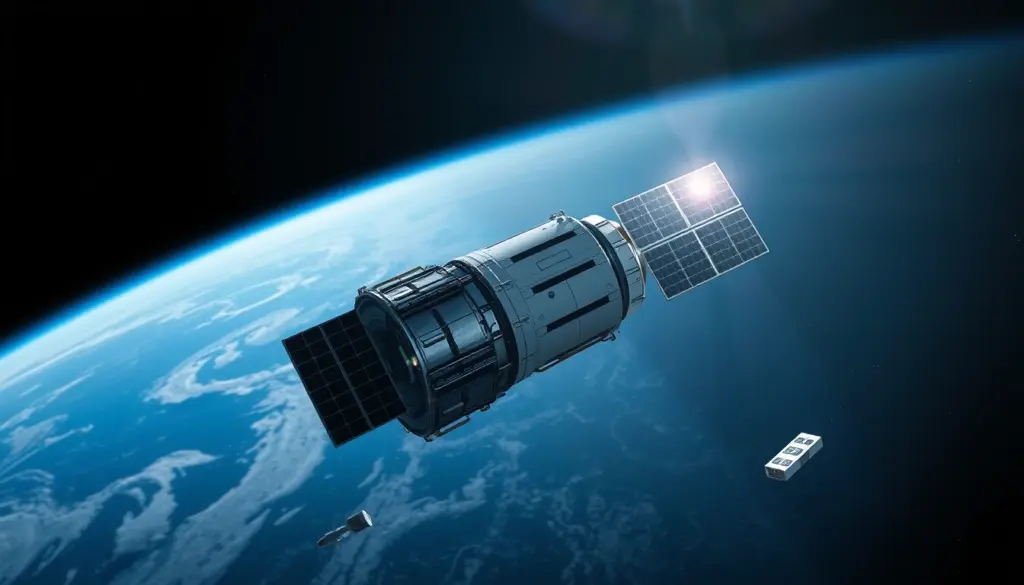
MVP left Vandenberg Space Force Base in California aboard a Falcon 9 rocket, flying as a rideshare passenger on SpaceX’s Transporter-18 mission. Rideshare launches bundle dozens of small satellites from different customers onto a single rocket to cut cost, and Google opted for that route rather than a dedicated launch, a choice consistent with the project’s early, exploratory stage. The satellite is solar-powered, sized roughly like a household refrigerator, and designed specifically to test how Google’s AI chips hold up outside Earth’s atmosphere.
The mission’s core question is narrow: can TPUs survive the vibration of launch and the radiation environment of space without failing or degrading. That is a hardware-survivability test, not a demonstration of a working orbital data center. Readers who followed Google’s 4-TPU payload confirmation ahead of the October 1 launch will recognize the chip count, but the launch-vehicle and rideshare details are new information that only became clear once the mission flew.
Why Google Named It MVP
In software and product development, MVP usually stands for minimum viable product: the smallest version of an idea that can still prove or disprove a concept. Google’s choice to name its first Suncatcher satellite MVP signals how the company wants the mission read. This is not a pilot data center. It is a stripped-down experiment meant to answer one yes-or-no question before any larger investment follows. Google Research’s own announcement framed the effort directly, stating that the company was launching a prototype satellite to test if its artificial intelligence hardware can survive the harsh conditions of space.
That framing matters for how investors and competitors should weigh this news. A satellite named MVP is explicitly disposable in concept. If the TPUs fail, Google loses one small, inexpensive test article, not a strategic asset. If they survive, the company gains data that informs a second, more ambitious mission already on the calendar. It is a deliberately low-stakes way to test a very high-stakes idea: whether the sun’s practically unlimited energy output could eventually replace grid power as the constraint on AI compute.
Travis Beals on the Logic Behind Suncatcher
Travis Beals, the Senior Director who leads Project Suncatcher, laid out the underlying thesis in comments carried by NPR. “The sun puts out almost all of the power in our solar system. All of the other power sources that humanity has tapped into are just a tiny fraction of a percent. So in some sense, this project is about tapping into the best way to use solar power to run AI compute,” Beals told NPR. That is the long-term pitch in one sentence: instead of building more gas turbines and transmission lines on the ground, put the compute where the sun always shines and skip the grid entirely.
Google Research made a similar case in its own announcement, stating that the company was launching a new research moonshot to one day scale machine learning in space. The MVP launch is the first concrete step toward testing that premise rather than just describing it on a blog.
Confirmed vs. Unconfirmed: Separating Fact From Hype
Coverage of Project Suncatcher since the launch has mixed solid reporting with speculative extrapolation. Some outlets have repeated a claim that the satellite can run Gemini models for 15 minutes at a time, a detail covered in our earlier look at the Gemini satellite runtime claim, but that figure has not been confirmed by Google’s own published materials. Similarly, reports about the satellite’s operational lifetime diverge sharply, with some citing roughly one year and others suggesting up to six years in orbit. Neither figure has been verified against an authoritative Google source. The table below separates what is solidly sourced from what remains unverified.
| Detail | Status | Notes |
|---|---|---|
| Launch date: October 1, 2026 | Confirmed | Reported by multiple outlets covering the Transporter-18 mission |
| Satellite name: MVP | Confirmed | Named in mission coverage of the Project Suncatcher launch |
| Launch vehicle: SpaceX Falcon 9 | Confirmed | Flew as a rideshare payload on Transporter-18 |
| Launch site: Vandenberg Space Force Base | Confirmed | Standard West Coast site for SpaceX rideshare missions |
| Payload: four Tensor Processing Units | Confirmed | Compute described as roughly equivalent to one data-center server |
| Power source: solar | Confirmed | Core to the project’s energy thesis |
| Next mission: two prototype satellites with Planet by early 2027 | Confirmed | Stated as Google’s next milestone in its research publication |
| Operational lifetime (1 year vs. up to 6 years) | Unconfirmed | Sources disagree; no official figure published |
| Gemini models running 15 minutes per session | Unconfirmed | Reported by secondary sources, not in Google’s own materials |
| Future constellation of thousands of satellites | Unconfirmed | Speculative extrapolation, not a stated Google plan |
The Overlooked Detail: Free-Space Optical Links
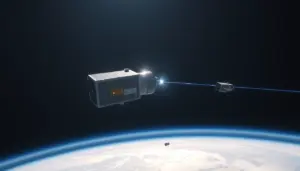
Buried under the TPU headlines is arguably the more consequential engineering bet: Google’s stated plan to connect future satellites using free-space optical links, meaning laser-based communication between spacecraft instead of radio. Training large AI models requires constant, high-bandwidth data exchange between chips. On the ground, that happens over fiber and copper measured in meters. In orbit, it would need to happen over kilometers of open space, and lasers are the only technology that can plausibly deliver the bandwidth AI training demands at that distance.
SpaceX has already proven inter-satellite laser links work at scale through its Starlink constellation, so the physics is not unproven. What is unproven is whether Google can network TPU clusters this way with enough bandwidth and reliability to actually train models rather than just run small inference tasks. MVP itself does not appear to test this capability, since it is a single satellite. That test is almost certainly what the next milestone, a learning mission with Planet involving two prototype satellites by early 2027, is actually designed to answer.
Four TPUs, One Server: Sizing Up the Payload
It is worth being precise about scale here, because the gap between MVP’s actual payload and the “AI data center in space” framing used in some coverage is large. Four TPUs with the compute output of a single server is a meaningful engineering test, but it is nowhere near the scale needed to train or even meaningfully serve a modern large language model. For comparison, Google’s terrestrial Ironwood TPU pods, which Google priced against Nvidia hardware earlier this year, run thousands of chips networked together in a single facility. MVP is four chips on one satellite. The distance between those two numbers is the entire reason Google is calling this a minimal test rather than a demonstration.
That gap is not a knock on the project. Every space-hardware program starts with a small survivability test before scaling up, and Google’s own messaging has been consistent about that sequencing from the start. Pichai himself summed up the test’s purpose in a public post about the launch: “Can our TPUs survive and operate in space? Well, we’re going to find out.”
He went on to note the satellite was “hitching a ride aboard @SpaceX’s Transporter-18 mission, testing a prototype satellite built in partnership with @planet,” closing the post with a nod to spaceflight history: “One small step for TPUs….”
Space Compute vs. Ground Compute: The Trade-offs
Project Suncatcher’s entire premise rests on a simple trade: give up the convenience of ground-based infrastructure in exchange for nearly unlimited, uninterrupted solar power. Sundar Pichai, Alphabet and Google’s CEO, framed the scale of that opportunity starkly in remarks reported by Quartz, saying one of Google’s moonshots is figuring out how to one day have data centers in space to better harness energy from the sun, which he described as one hundred trillion times more energy than humanity produces on Earth today. Whether that framing becomes a real product roadmap or stays a research thesis depends on solving problems that have no equivalent on the ground.
| Factor | Space-Based Compute (Suncatcher Concept) | Terrestrial Data Center |
|---|---|---|
| Power source | Continuous solar, no grid dependency | Grid power, often supplemented by on-site generation |
| Cooling | Radiative cooling into vacuum, largely unproven at AI scale | Mature liquid and air cooling systems |
| Land and permitting | No land use, but orbital slot and launch licensing required | Site acquisition, zoning, water rights, local permitting |
| Deployment speed | Limited by launch cadence and satellite manufacturing | Limited by construction timelines and power interconnection queues |
| Hardware maintenance | Effectively impossible once in orbit | Routine chip swaps and repairs |
| Inter-chip networking | Experimental free-space optical links | Mature fiber and copper interconnects |
| Current maturity | Single-satellite survivability test (MVP) | Decades of operational refinement |
Why This Is Happening Now
Project Suncatcher is not happening in a vacuum, pun intended. AI companies across the industry have spent 2026 wrestling publicly with power availability as the binding constraint on how fast they can expand compute capacity, a dynamic visible in deals like the capex race between Arm, AMD, and other chipmakers chasing data-center contracts. Google itself has been racing to add TPU capacity on the ground, and the company’s push into orbital compute reads as a long-horizon hedge against a problem that terrestrial grid buildout cannot fully solve on its own. Solar power satellites are not a new idea. Engineer Peter Glaser proposed orbital solar collectors beaming power to Earth as far back as 1968, and NASA studied the concept extensively in the 1970s. What is new is pairing that old idea with modern AI chips instead of power transmission alone.
How Project Suncatcher Compares to Other Orbital Compute Bets
Google is not the only company with satellites doing more than relaying signals. SpaceX’s Starlink constellation already runs inter-satellite laser links across thousands of spacecraft, the same core technology Google says it needs for a future TPU constellation, which is one reason Google partnered on a rideshare rather than building independent launch capacity. Planet, Google’s partner for the 2027 learning mission, brings its own experience operating large fleets of small, relatively low-cost satellites for Earth imaging, a skill set directly applicable to deploying a Suncatcher constellation cheaply if the concept proves out.
No other major cloud provider has publicly launched a comparable orbital AI-chip test as of this writing. That gives Google a first-mover position in a category that does not meaningfully exist yet, though “first mover” in a market with no confirmed economics is a modest claim rather than a dominant one.
The Rideshare Economics Behind the Decision
The choice to fly on Transporter-18 instead of booking a dedicated rocket says almost as much about Project Suncatcher’s current status as the satellite’s name does. SpaceX built its Transporter line specifically to let companies split the cost of a Falcon 9 launch across dozens of small payloads, cutting the price per satellite dramatically compared with a solo flight. For an experiment explicitly framed as minimal, riding alongside other companies’ payloads is the obvious move. It keeps the cost of a potential failure low and signals that Google is not yet ready to commit dedicated launch infrastructure to the idea.
That calculus will likely change once Google moves past single-satellite testing. Coordinating free-space optical links between two or more spacecraft, as the Planet mission is expected to attempt, generally requires more control over orbital placement and timing than a shared rideshare slot allows. Readers tracking Google’s broader cloud and AI infrastructure spending, including the Planet partnership details for the 2027 satellite pair, should watch whether that next mission flies as a rideshare or on a dedicated launch, since the choice will hint at how much budget and orbital precision Google is willing to commit at this stage.
Historical Context: A Fifty-Year-Old Idea Meets Modern Silicon
The notion of harvesting solar power in orbit predates AI by decades. Physicist Peter Glaser’s 1968 proposal for satellites that would collect sunlight and beam the energy down to Earth as microwaves was studied seriously by NASA and the Department of Energy through the late 1970s, before cost and launch limitations shelved the concept for a generation. Falling launch costs, driven largely by SpaceX’s reusable Falcon 9 fleet, have revived interest in orbital solar power across several countries and companies over the past few years.
Google’s twist on the old idea is to skip the hardest part of the original concept, the power-beaming step, and instead do the computing in orbit itself, then send down only the results. That sidesteps the transmission-loss problem that doomed earlier solar power satellite proposals, but it introduces a new one: keeping sensitive, expensive AI chips alive and networked in an environment no cloud provider has ever had to operate in before. Whether that trade works out is exactly what MVP and the Planet mission are designed to find out.
Market Reaction and What Investors Should Watch
Google representative Ben Beals’ description of MVP as “a very minimal test” doubles as useful guidance for anyone trying to price this news into Alphabet’s stock or the broader AI infrastructure trade. This is a research milestone, not a revenue event, and nothing about the October 1 launch changes near-term TPU production, cloud pricing, or data-center capex plans. The meaningful signal for markets will arrive with the Planet learning mission’s results in early 2027, since that is the point where Google either demonstrates working inter-satellite optical links or discovers the engineering obstacles are harder than expected. Until then, Suncatcher is a long-dated option on a radically different compute architecture, not a near-term line item.
What Could Still Go Wrong
Space radiation remains the central unknown. TPUs were never designed for the radiation environment outside Earth’s protective magnetosphere, and chip failures from cosmic ray strikes or cumulative radiation damage are a well-documented risk for any electronics in orbit. That is precisely why MVP exists: to gather real data instead of relying on ground-based radiation simulations. Beyond hardware survival, Google has not published figures on how it would physically service or replace a satellite once deployed, meaning any future constellation would need chips reliable enough to run unattended for years with zero in-person maintenance, a bar terrestrial data centers never have to clear.
Predictions: Where Project Suncatcher Goes From Here
- Google will publish MVP’s radiation and survivability data gradually through 2026 and early 2027 rather than in one single report, consistent with how it has drip-fed Suncatcher details so far.
- The Planet learning mission’s two satellites, due by early 2027, will likely be the first real test of free-space optical links between TPU-carrying spacecraft, and its outcome matters far more to the project’s future than MVP’s launch did.
- Expect competitors, particularly companies already operating large satellite fleets, to publicly evaluate similar concepts once Google’s learning-mission data becomes available, even if none commit to launches before 2028.
- Google will continue framing every near-term milestone conservatively, as it did by naming this satellite MVP and calling it a minimal test, to manage expectations after the exaggerated claims that have already circulated about Gemini runtime and constellation size.
- A commercially meaningful, revenue-generating orbital compute product remains years away at minimum, and any claim of an imminent operational space data center should be treated skeptically until Google itself confirms one.
The Bigger Picture for AI Infrastructure
Project Suncatcher sits at an unusual intersection of two trends shaping the AI industry in 2026: the scramble for enough electricity to keep training ever-larger models, and the willingness of the biggest AI labs to fund speculative, decade-horizon research bets alongside near-term product launches. Google Research’s own announcement called Suncatcher a moonshot, language the company rarely uses loosely. The MVP launch does not prove that space-based AI compute works. It proves Google is serious enough about the question to put real hardware into orbit and find out, starting with the smallest, least risky version of the idea it could build.
Frequently Asked Questions
What is Project Suncatcher?
Project Suncatcher is Google’s research effort investigating whether solar-powered, space-based satellites carrying AI chips could one day support AI computing infrastructure, reducing dependence on terrestrial power grids.
What is the MVP satellite?
MVP is the name of the refrigerator-sized, solar-powered satellite Google launched on October 1, 2026 to test whether its Tensor Processing Units can survive the radiation and conditions of low-Earth orbit.
How did the MVP satellite get to orbit?
It launched aboard a SpaceX Falcon 9 rocket as part of the Transporter-18 rideshare mission from Vandenberg Space Force Base in California.
How many AI chips does MVP carry?
The satellite carries four Tensor Processing Units, with combined compute capacity described as roughly equivalent to one data-center server.
Can the MVP satellite run Gemini AI models?
Some reports claim it can run Gemini models for about 15 minutes per session, but that figure has not been confirmed in Google’s own published materials and should be treated as unverified.
How long will the satellite operate?
Google has not published an official operational lifetime. Secondary reports vary widely, from roughly one year to as long as six years, so this detail remains unconfirmed.
What is Google’s next step after MVP?
Google’s research publication states the next milestone is a learning mission with Planet involving two prototype satellites, targeted for early 2027, which is expected to test inter-satellite communication.
Will Google really build thousands of AI satellites?
That claim has circulated in some coverage but is not an officially confirmed Google plan. The company has described only the MVP test and the upcoming two-satellite Planet mission as concrete next steps.