
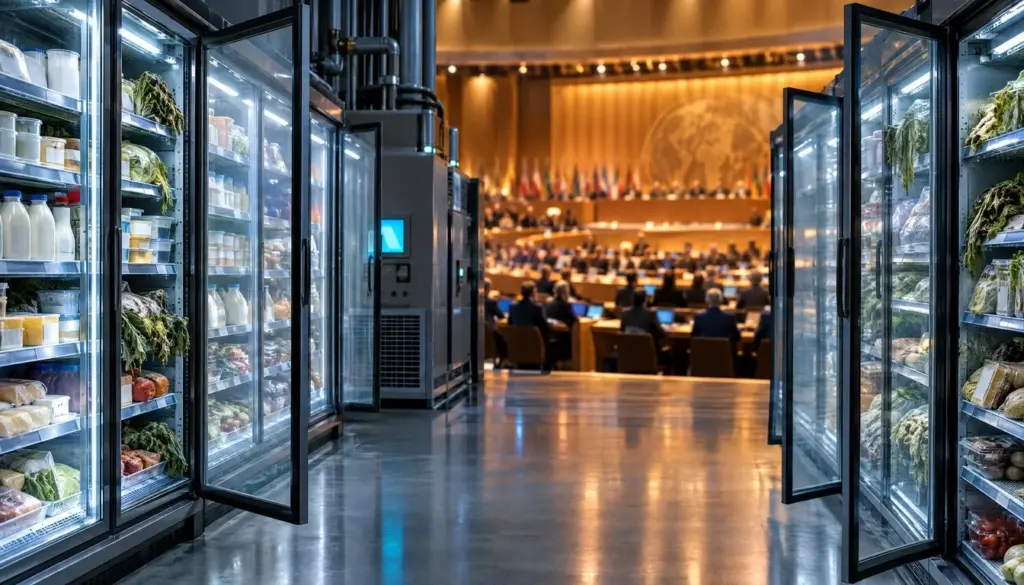
The International Monetary Fund spent part of its October 2026 Annual Meetings in Bangkok talking about a supermarket fridge. Not because food safety belongs on a global finance agenda, but because hackers in France reportedly broke into refrigeration controls at supermarket chains and pushed the temperature to roughly 50C, spoiling stock and forcing stores to throw it out. IMF Managing Director Kristalina Georgieva used the incident as a blunt illustration of a much bigger problem: AI-enabled cyberattacks, she warned, are “already in reality,” not a future risk sitting on a slide deck.
The warning landed in a Guardian analysis published October 18, 2026, under the headline “World leaders must wise up to threat of cyber-attacks or rogue fridges will be least of their worries,” written by Heather Stewart. The piece argues that global cooperation on digital fraud looks unlikely even as AI tools make attacks cheaper and more scalable, and that the French refrigeration incident works as a strange but effective wake-up call for a problem that is, in Stewart’s framing, far bigger than spoiled groceries.
The Rogue Fridge Incident That Set the Tone in Bangkok
The fridge hack itself has already generated a run of coverage on this site, including reporting on how France issued a three-step fix while the fridge hack persisted and how the incident went six days without anyone claiming responsibility. Separately, reporting on exposed Danfoss refrigeration controllers found roughly 350 units still reachable online, underlining how much industrial refrigeration equipment sits exposed to the open internet with minimal segmentation.
The incident has also been picked up by international news aggregators tracking the cyberattack beat, a sign of how far the story traveled beyond French retail trade press. What changed on October 18 is the altitude at which the story is now being told. Instead of a retail operations headache, the fridge hack became the opening anecdote in an IMF-level warning about systemic financial risk. That reframing is exactly what gives this story its weight: a single, almost absurd-sounding intrusion into supermarket cooling systems became the shorthand that the head of the IMF chose to use in front of finance ministers and central bankers.
What Kristalina Georgieva Told the IMF-World Bank Annual Meetings
Georgieva’s remarks came during the 2026 IMF-World Bank Annual Meetings in Bangkok, Thailand, a gathering that ran across much of October and pulled together finance ministers, central bank governors, and policy staff from around the world. According to the Guardian’s account of her comments, Georgieva described the surge in AI-driven digital fraud as “putting the potential of digital fraud on steroids.” The central subject of her remarks, and of the broader Bangkok agenda, was the rising risk that AI-assisted cyberattacks pose to the stability of the global financial system.
According to the IMF’s own press briefing transcript from the meetings, Georgieva told reporters that “AI-enabled cyber-attacks are already in reality,” citing the French refrigeration case directly as her example. That phrasing matters. Georgieva was not warning about a hypothetical future threat model. She was describing something that had already happened to real retailers, using real industrial control systems, days before she stood up in front of the world’s top economic officials.
Georgieva’s Bangkok schedule placed her at the center of the meetings from the start. She opened the week on October 7 in a session alongside Singapore’s President Tharman Shanmugaratnam, setting out the IMF’s outlook for the global economy and its policy priorities. By October 14, the conversation had sharpened into something far more specific: cyber-enabled fraud in digital finance, and what the IMF and World Bank intended to do about it.
The Bangkok Blueprint: A Framework for Fraud-Resilient Finance
On October 14, 2026, the IMF and World Bank released what they called the Bangkok Blueprint for Fraud-Resilient Financial Services, a framework developed with the Bank of Thailand. The document is built around a whole-of-ecosystem approach, covering prevention, detection, and response to cyber-enabled fraud across digital financial services. It is the clearest policy artifact to come out of the meetings, and it doubles as an admission: existing national and institutional defenses are not keeping pace with how fast AI tooling lets fraud scale across borders.
Named speakers at the Blueprint’s launch event included World Bank Managing Director and Chief Financial Officer Anshula Kant and Soraya Munyana Hakuziyaremye, both lending institutional weight to a framework that the IMF describes as cross-border by design. A dedicated session titled “Artificial Intelligence and Escalating Cyber Risks: Implications for Macroeconomic and Financial Stability” ran separately during the meetings, with panelists including Marlene Amstad, Andrea Maechler, Paulo Picchetti, and Michael Sellitto digging into the macro side of the problem.
Why build a blueprint instead of a binding rule? Because the IMF and World Bank have no direct regulatory authority over national cybersecurity policy. A blueprint is a coordination tool, not a mandate, and that distinction is going to matter a lot for how fast any of this actually changes behavior on the ground. Frameworks like this tend to move slowly through national legislatures and regulators, while the attackers it describes do not wait for anyone to finish reading the document.
Andrew Bailey and the Bank of England Add a Second Warning
Georgieva was not alone on this. Bank of England Governor Andrew Bailey used the same Bangkok platform to issue a parallel warning, telling the panel that rising cyberattacks risk undermining public trust in the financial system. Bailey pointed to reports of self-replicating AI agents hijacking personal devices as part of the same pattern Georgieva was describing: AI lowering the cost and raising the scale of attacks that used to require far more manual effort from criminals.
Having both the IMF’s managing director and the Bank of England’s governor raise the same alarm, on the same stage, in the same week, pushes this past the territory of a routine conference soundbite. It reads more like coordinated signaling ahead of a policy push, especially with the Bangkok Blueprint landing in the same window. Trust, both officials argued, is the actual asset at risk. Georgieva put it directly: trust is the foundation of every financial system, and as digital finance expands, countries need to work together to combat cyber-enabled fraud and preserve confidence in the technologies that support growth and inclusion.
Why AI Is Supercharging Digital Fraud, Not Just Enabling It
The distinction officials kept drawing in Bangkok was between fraud that AI merely assists and fraud that AI fundamentally rescales. Phishing emails written by a language model are a modest upgrade over the old, typo-riddled scam template. Automated reconnaissance that scans thousands of exposed industrial control systems, flags the weakly secured ones, and generates working exploit attempts without much human oversight is a different category of threat entirely, closer to what Bailey described with self-replicating AI agents.
That scaling effect is also why a retail refrigeration hack in France became relevant to a global finance ministers’ meeting. The French fridges were never a banking system, but they illustrated how a single class of poorly secured industrial controller, exposed to the internet in one country, can be found and exploited at scale once an attacker (or an AI tool working on an attacker’s behalf) automates the search. Financial institutions run enormous numbers of comparable connected systems, from point-of-sale terminals to back-office automation, and the same scaling logic applies.
Our earlier coverage of ransomware groups increasingly threatening victims’ families, now reported in about 40% of cases, points at the same underlying shift: criminal groups are using automation and AI-assisted tooling to escalate pressure tactics faster than victims or defenders can adapt. The fridge hack and the ransomware escalation trend are not the same story, but they share a cause, which is that AI tools have cut the cost of running attacks at scale.
From Supermarket Freezers to Systemic Risk
The IMF’s own financial stability assessment, discussed alongside the Bangkok meetings, listed a major cyberattack as one of several factors pushing the global financial-stability threat level to “elevated.” The other two factors named were higher borrowing costs and the possibility of an AI-related equity-market crash, a risk our earlier piece on Anthropic’s pitch to Congress for a $1 billion AI safety bill also touched on from the policy side.
Putting a cyberattack in the same sentence as borrowing costs and an AI stock bubble is a meaningful escalation in how the IMF frames the problem. Borrowing costs and equity valuations are classic macroeconomic levers that central bankers watch constantly. Cyberattacks, historically, got filed under operational risk, a category that rarely made it into the same conversation as interest rate policy. Bangkok appears to be the moment the IMF formally moved cyber risk out of the operational-risk box and into the macro-risk conversation.
Georgieva’s warning about people opting out of the formal financial system altogether is the mechanism behind that shift. If digital fraud grows faster than consumer trust in digital banking, the result is not just higher fraud-loss numbers. It is a slow retreat from formal financial services back toward cash, informal lending, or systems that are harder for regulators to monitor at all, which undercuts financial inclusion goals the IMF and World Bank have spent decades building.
Historical Context: Critical Infrastructure Attacks Keep Moving From IT to OT
The French fridge incident fits a pattern that security researchers have tracked for years: attackers moving from traditional IT networks into operational technology, the industrial systems that control physical processes like refrigeration, water treatment, and power distribution. Our earlier reporting on water system hacks hitting 12 states, including more than 30 systems in Minnesota alone, shows the same OT-targeting pattern playing out in a different sector entirely.
What makes 2026 different from earlier waves of OT intrusions is speed. Attackers used to need specialized knowledge of a specific industrial protocol or vendor system to pull off an intrusion like the French fridge case. AI-assisted tooling increasingly lets attackers skip years of specialized learning, generating working exploit code or automating the reconnaissance phase that used to take the most time. That compression is exactly what Georgieva and Bailey were pointing to in Bangkok, even if neither used the word “compression” to describe it.
Competitive Comparison: National Patchwork vs. a Global Blueprint
France’s response to the fridge hack has so far looked like a national patchwork: regulators flagging specific vendors, as covered in our report on France naming three vendors as fridge-hack risks lingered, paired with narrower technical fixes rolled out store by store. That is the normal shape of an incident response: fast, local, and reactive.
The Bangkok Blueprint is trying to be the opposite of that: slow, international, and preventive. The tension between the two approaches is the real competitive story here, not a rivalry between institutions but a mismatch in timeframes. National regulators like France’s can move within days of an incident because their mandate is narrow. International frameworks like the Bangkok Blueprint move on a timeline measured in annual meetings and multi-country sign-off, because that is the price of getting dozens of finance ministries to agree on anything. Both are necessary. Neither is sufficient on its own, which is part of why Georgieva’s framing of the problem leaned so heavily on cooperation rather than any single fix.
IMF Annual Meetings 2026: Cyber-Risk Timeline
| Date (2026) | Event | Key Figures |
|---|---|---|
| October 7 | Annual Meetings curtain raiser on the global economy and policy priorities | Kristalina Georgieva, Tharman Shanmugaratnam |
| October 14 | Press briefing on the Global Policy Agenda; fridge hack cited directly | Kristalina Georgieva |
| October 14 | Bangkok Blueprint for Fraud-Resilient Financial Services launched | Anshula Kant, Soraya Munyana Hakuziyaremye |
| October 14-16 | Panel on AI and escalating cyber risks to financial stability | Marlene Amstad, Andrea Maechler, Paulo Picchetti, Michael Sellitto |
| October 16 | Annual Meetings plenary session, “AI and the Global Economy” | Ha Jung-woo, Tiff Macklem, Tobias Meyer, Jack Clark |
| October 18 | Guardian analysis published tying the fridge hack to systemic cyber risk | Heather Stewart |
Officials Who Raised the Alarm in Bangkok
| Name | Role | Core Warning |
|---|---|---|
| Kristalina Georgieva | Managing Director, IMF | AI-enabled cyberattacks are already real, not hypothetical; fraud could push users out of formal finance |
| Andrew Bailey | Governor, Bank of England | Self-replicating AI agents hijacking devices threaten trust in the financial system |
| Anshula Kant | Managing Director and CFO, World Bank | Backed the Bangkok Blueprint as a cross-border fraud-resilience framework |
| Soraya Munyana Hakuziyaremye | Speaker, Bangkok Blueprint launch | Supported the whole-of-ecosystem approach to digital fraud |
| Jack Clark | Panelist, “AI and the Global Economy” session | Contributed to the broader discussion on AI’s economic and risk implications |
Market Impact: Why Investors Should Care About a Fridge Hack
Cyber-news trackers that aggregate incident reporting from dozens of sources across the security beat have logged a steady rise in OT-targeted intrusions through 2026, a trend the IMF’s framing in Bangkok now ties directly to systemic financial risk. Markets rarely move on a single retail cybersecurity incident, and they did not move on the French fridge hack itself. What they do react to is an institution like the IMF formally classifying financial-stability risk as “elevated” and naming cyberattacks as one of the drivers. That classification feeds directly into how central banks calibrate capital buffers, how insurers price cyber coverage, and how boards justify security budgets to shareholders who would otherwise rather see that money spent elsewhere.
There is also a compounding effect worth flagging. The IMF’s elevated-risk assessment named three factors together: cyberattacks, higher borrowing costs, and the possibility of an AI-related equity-market crash. None of those three risks sits in isolation. A cyber incident at a systemically important bank during a period of already-elevated borrowing costs would hit markets far harder than the same incident during a calm macro environment, simply because there is less cushion to absorb the shock. That is the real reason Bangkok treated a fridge hack as finance news rather than a retail operations footnote.
Predictions: What Comes Next After Bangkok
- More OT incidents framed as financial-stability stories. Expect regulators and the financial press to keep tying industrial-control hacks, like the French refrigeration case, directly to systemic risk language rather than treating them as isolated retail incidents.
- Other jurisdictions will publish Bangkok Blueprint-style frameworks. Once the IMF and World Bank set a template for a whole-of-ecosystem fraud-resilience approach, individual central banks and finance ministries are likely to draft national versions adapted to their own regulatory structures.
- Vendor scrutiny on industrial controllers will intensify. Coverage like our report on exposed Danfoss refrigeration controllers suggests regulators and insurers will start asking harder questions about which embedded industrial devices are reachable from the open internet.
- Cyber risk stays bundled with macro risk in IMF reporting. Having classified a cyberattack alongside borrowing costs and an AI equity-crash scenario as drivers of “elevated” stability risk, the IMF is unlikely to quietly drop cyber risk back into a footnote in future assessments.
- Expect slow, uneven follow-through on the Blueprint itself. Coordination frameworks built around dozens of member countries typically take years to translate into binding national rules, so near-term impact will likely come from individual regulators acting faster than the full Blueprint process.
What This Means for Banks, Retailers, and Everyday Consumers
For banks and financial institutions, the Bangkok message is a signal to accelerate fraud-detection investment tied specifically to AI-generated attack patterns, not just traditional phishing and card fraud. For retailers running connected refrigeration, point-of-sale, or warehouse automation, the fridge hack is a direct warning that industrial control systems outside the IT department’s usual purview need the same security attention as customer databases.
For everyday consumers, the stakes are less about any single incident and more about the slow erosion Georgieva described. Every fraud story that goes unresolved, every data breach notice that lands in an inbox, chips away a little more at confidence in digital banking, digital payments, and connected retail. The IMF’s bet is that coordinated frameworks like the Bangkok Blueprint can slow that erosion before it turns into a meaningful retreat from formal financial services. Whether that bet pays off depends on how fast individual countries actually act on a document that, for now, carries no binding force.
The Guardian’s Framing: Cooperation Looks Unlikely
Heather Stewart’s analysis for the Guardian lands on a pointed note of skepticism: despite AI clearly raising the risk of digital fraud and the obvious need to protect the financial system, genuine global cooperation seems unlikely. That skepticism is worth taking seriously given the track record of similar coordination efforts in other domains, from climate finance to tax policy, where broad agreement in principle rarely translates into fast, binding action in practice.
Stewart’s framing also captures why the fridge hack made such an effective rhetorical device for Georgieva. It is specific, slightly absurd, and completely understandable to anyone who has ever opened a fridge that was too warm, which makes it a far more effective way to get a room full of finance ministers to pay attention than another slide full of breach statistics. Whether that attention converts into funded, binding action is the open question the Bangkok Blueprint now has to answer.
Frequently Asked Questions
What did Kristalina Georgieva actually say about cyberattacks?
Georgieva told the IMF-World Bank Annual Meetings in Bangkok that AI-enabled cyberattacks are “already in reality,” citing the French supermarket refrigeration hack as her example, and separately described AI as putting the potential of digital fraud on steroids.
What happened with the rogue fridges in France?
Hackers reportedly accessed refrigeration controls at supermarket chains in France and raised temperatures to around 50C, spoiling food and forcing stores to discard stock. Specific attacker identity, exact store counts, and total financial losses were not confirmed in official reporting as of October 18, 2026.
What is the Bangkok Blueprint for Fraud-Resilient Financial Services?
It is a framework released by the IMF and World Bank on October 14, 2026, developed with the Bank of Thailand, aimed at helping countries prevent, detect, and respond to cyber-enabled fraud in digital financial services through a whole-of-ecosystem approach.
Did anyone else warn about this besides Georgieva?
Yes. Bank of England Governor Andrew Bailey raised a parallel warning on the same Bangkok panel, pointing to reports of self-replicating AI agents hijacking personal devices as part of the same trust-eroding trend.
Why did the IMF call global financial stability “elevated”?
The IMF cited a major cyberattack, higher borrowing costs, and the possibility of an AI-related equity-market crash together as the factors pushing its stability assessment to an elevated risk level.
Is the Bangkok Blueprint legally binding on member countries?
No. It functions as a coordination framework rather than a binding mandate, meaning individual countries and regulators still need to adopt their own rules and enforcement mechanisms to act on its recommendations.
How does this connect to the earlier Danfoss refrigeration controller exposure?
Separate reporting found roughly 350 Danfoss refrigeration controllers still exposed online, illustrating the broader pattern of industrial control systems, including the kind used in the French fridge hack, remaining reachable from the open internet with limited safeguards.
What should businesses do in response to this warning?
Security teams and operations leaders should extend standard IT security practices, like network segmentation and internet exposure audits, to operational technology such as refrigeration, point-of-sale, and warehouse automation systems, rather than treating OT as a lower priority than core IT infrastructure.