
Prediction Markets Are Reshaping the Business of Esports
Esports has spent years trying to turn enormous global audiences into a more mature commercial ecosystem. Sponsorships, media rights, tournament partnerships, in-game purchases, and conventional esports betting have all played a role. Prediction markets are now introducing another model, one built around continuously traded probabilities rather than fixed betting odds.
The concept is already familiar in politics and financial markets. Participants buy and sell contracts tied to future outcomes, with prices reflecting the market’s collective estimate of how likely an event is to happen. Esports fits naturally into that structure because professional matches produce frequent, clearly defined outcomes and attract audiences that are already highly digital.
For tournament organizers, gaming companies, traders, and esports platforms, the implications extend beyond another way to wager on matches. Prediction markets can turn competitive gaming events into live financial markets, generating real-time probability data, new forms of audience engagement, and potentially another commercial layer around esports. Traders following the tokens and crypto markets tied to these platforms often track the data on sites such as CoinCodex.
Esports Is Well Suited to Prediction Markets
A prediction market needs events with outcomes that can be clearly defined and settled. Competitive gaming produces them constantly.
A basic market might ask whether Team A will defeat Team B in a Counter-Strike 2 match. More detailed contracts could focus on who wins a particular map, whether a team reaches the playoffs, or which organization wins a major League of Legends or Dota 2 tournament. For fans already accustomed to following sports predictions, the concept is familiar, but prediction markets turn those forecasts into prices that can change continuously as participants trade.
If a Yes contract on Team A winning trades at $0.65, the market is effectively assigning the team an implied probability of roughly 65%. New information, such as a roster change or an unexpectedly strong opening map, can quickly change that probability as traders reassess the likely outcome.
From Esports Betting to Tradable Probabilities
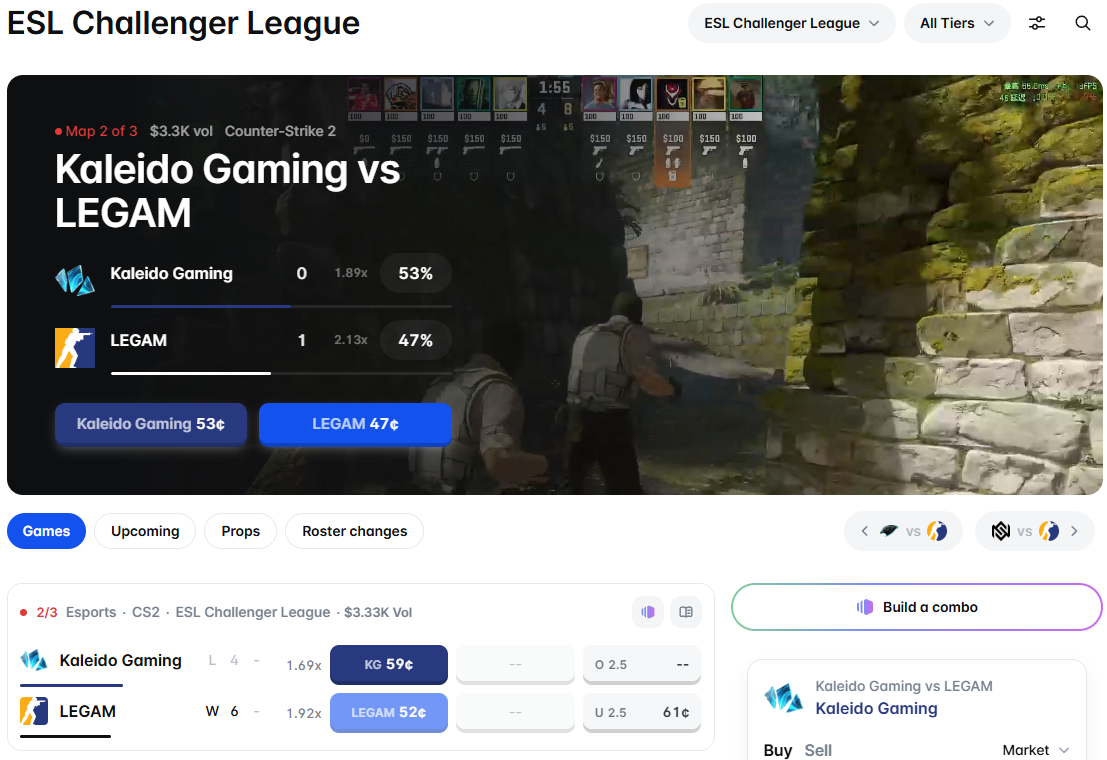
Prediction markets overlap with esports betting, but the underlying market structure can be different.
A sportsbook generally publishes odds and accepts bets based on those prices. Prediction markets instead allow participants to trade event contracts, with prices responding to supply and demand. Traders who believe the market is underestimating an outcome can buy it, while those who think the probability is too high can take the opposite side.
This creates something closer to a financial market for esports outcomes. The probability itself becomes the product being traded.
Consider a Counter-Strike 2 match where one team begins at a 60% implied probability of winning. A last-minute roster change, poor performance on the opening map, or unexpected tactical advantage could cause that probability to move sharply. Traders can respond to those developments as the market reprices the match.
For an esports audience already accustomed to live statistics, rankings, player performance data, and rapidly changing match conditions, the format is a natural extension of how many fans already follow competition.
Prediction Markets Create a New Esports Data Layer
One of the more interesting business implications is the data prediction markets generate.
A market price provides a continuously updated estimate of an outcome’s probability. Rather than asking analysts or fans who they expect to win, platforms can observe where participants are actually willing to commit capital.
That creates another source of information around professional matches. Broadcasters could display changing market probabilities alongside conventional match statistics, while analysts could use probability movements to identify moments when expectations shifted dramatically.
For example, a team might begin a series with a 70% probability of winning before falling to 40% after losing the opening map. A comeback could then push that probability back above 60%. The market effectively creates a financial record of how expectations changed throughout the competition.
This type of data can be valuable even to people who never trade the contracts themselves.
The Business Case Is About Engagement
Esports has long faced a monetization challenge. Large tournaments can attract millions of viewers, but converting those viewers into sustainable revenue is more complicated.
Prediction markets offer another engagement mechanism because they give audiences a financial reason to follow an event closely. A viewer holding a position on a tournament outcome has an incentive to monitor roster announcements, player form, map selections, injuries, and results across the competition.
That increased attention can potentially benefit broadcasters, tournament organizers, data providers, and other companies operating around esports. Prediction-market integrations could create new sponsorship inventory, data partnerships, and interactive broadcast features.
The important distinction is that the commercial opportunity does not necessarily depend on every viewer becoming a trader. Market probabilities themselves can become content, much like live odds, fantasy statistics, win-probability models, and player ratings already are.
The commercial stakes are becoming harder to ignore as the biggest tournaments grow in scale. The Esports World Cup now combines dozens of competitions with a $75 million prize pool, illustrating how much capital is being deployed to turn competitive gaming into a mainstream entertainment product.
Live Markets Could Be Particularly Powerful
Esports is especially compatible with live prediction markets because matches generate large amounts of structured data in real time.
In a League of Legends match, probabilities can respond to kills, gold differences, objectives, and map control. Counter-Strike markets can react to round scores, economy conditions, and map performance. Dota 2 provides similarly rich information through gold leads, objectives, hero compositions, and team fights.
That creates opportunities for markets extending beyond the final match winner. Contracts could theoretically revolve around individual maps, tournament qualification, series length, or other objectively measurable outcomes.
The faster and more granular the market becomes, however, the more important reliable data becomes. A delay of even several seconds can matter when participants are trading around rapidly changing events.
Esports Data Becomes More Valuable
Prediction markets could therefore increase the commercial importance of official esports data.
Markets need accurate information to price events and, ultimately, determine which contracts won. For live markets, they also need that information quickly. Tournament operators and game publishers often control the most reliable direct feeds.
That creates potential opportunities for licensing arrangements between prediction platforms, esports organizations, tournament organizers, and data companies. Official data feeds can help reduce latency and provide a trusted source for settlement.
The same dynamic has already made data an important part of traditional sports betting. If prediction markets become a larger part of esports, control over reliable match data could become an increasingly valuable business asset.
Crypto Makes Global Esports Markets Easier to Build
Blockchain-based prediction markets add another dimension. Smart contracts can manage collateral and settlement, while stablecoins can provide a common digital currency for participants across supported markets.
That model fits the international nature of esports particularly well. A major gaming tournament may feature teams from Europe, Asia, North America, and Latin America while attracting viewers from dozens of countries simultaneously.
Crypto infrastructure can theoretically allow a prediction market to serve that geographically distributed audience through the same settlement system. Blockchain transactions can also provide a public record of trading activity, making volumes and market movements more transparent.
That does not mean crypto prediction markets are universally accessible. Gambling, derivatives, and event-contract regulations vary substantially between jurisdictions, and blockchain infrastructure does not override local restrictions.
The Integrity Problem Is Bigger in Esports
The growth of prediction markets also creates risks, and esports has characteristics that make some of them particularly important.
Professional gaming has previously faced match-fixing allegations and integrity concerns, especially in lower-tier competitions where players may earn relatively modest salaries. Adding highly liquid markets to more esports events could increase the financial incentive for participants or people close to teams to exploit private information.
Inside information does not necessarily involve fixing a match. Someone could know that a player is ill, that a roster change is coming, or that a team is dealing with an undisclosed technical problem. Trading on that information before it becomes public could give the participant a substantial advantage.
Prediction markets may make some suspicious activity easier to identify, particularly when transactions occur on public blockchains. Unusual positions placed shortly before unexpected news can leave a permanent transaction trail. But transparency helps investigators after suspicious activity occurs, rather than eliminating the underlying incentive.
Market Liquidity Can Distort the Signal
Prediction markets are most informative when they attract enough independent participants to create meaningful price discovery.
A major esports final could generate sufficient interest for probabilities to be reasonably robust. A small regional match may not. In a thin market, one large trader can move prices substantially without possessing any special information.
That creates a problem if broadcasters or fans begin treating market probabilities as authoritative forecasts. A contract trading at 80 cents may suggest an 80% probability, but the quality of that estimate depends on how the market arrived there.
Professional market makers could improve liquidity and reduce some pricing inefficiencies. Their involvement would also push esports prediction markets further toward the structure of conventional financial exchanges rather than simple betting products.
Regulation Could Decide How Far the Model Goes
Prediction markets occupy an unusually complicated position between finance and gambling, and adding esports does not make that distinction easier.
A contract based on whether an esports team wins a match can look economically similar to a sports wager, even if it is structured as a tradable event contract. Regulators may therefore disagree over whether such products belong under gambling rules or derivatives regulation.
The answer affects licensing, age restrictions, consumer protections, taxation, market surveillance, and where platforms can legally operate.
For esports companies, this regulatory uncertainty matters commercially. Publishers and tournament organizers may be reluctant to form deep prediction-market partnerships until they know how regulators will treat the products in their largest markets.
Prediction Markets Could Change How Fans Follow Esports
The biggest impact of prediction markets may ultimately be on how esports audiences interpret competition.
Traditional broadcasts tell viewers what happened. Analysts attempt to explain why it happened. Prediction markets add another layer by continuously showing what participants collectively expect to happen next.
That can turn a tournament into a stream of changing probabilities. A favorite can move from 70% to 30% and back again during a series, creating a quantitative record of momentum, expectations, and surprise.
For esports businesses, those probabilities can become content, data, and a potential source of revenue. For fans, they provide another way to measure the state of a competition in real time.
Prediction markets are unlikely to replace esports betting, analyst forecasts, or traditional statistics. They could instead sit alongside them, creating a new market-driven layer around competitive gaming. If liquidity grows and regulatory frameworks become clearer, the result could be a closer connection between esports, financial-market mechanics, and the rapidly expanding prediction-market industry.
Related articles
- Cheapest Ways to Top Up Clash Royale Gems in 2026
- Gaming Industry Hits $263B, BCG Sees $353B by 2030 [2026]
- Sunshine + Moonlight Setup: 40K Stars, 12 Steps [2026]
- Sony Writes Down Bungie $765M as Destiny 2 Ends [2026]