
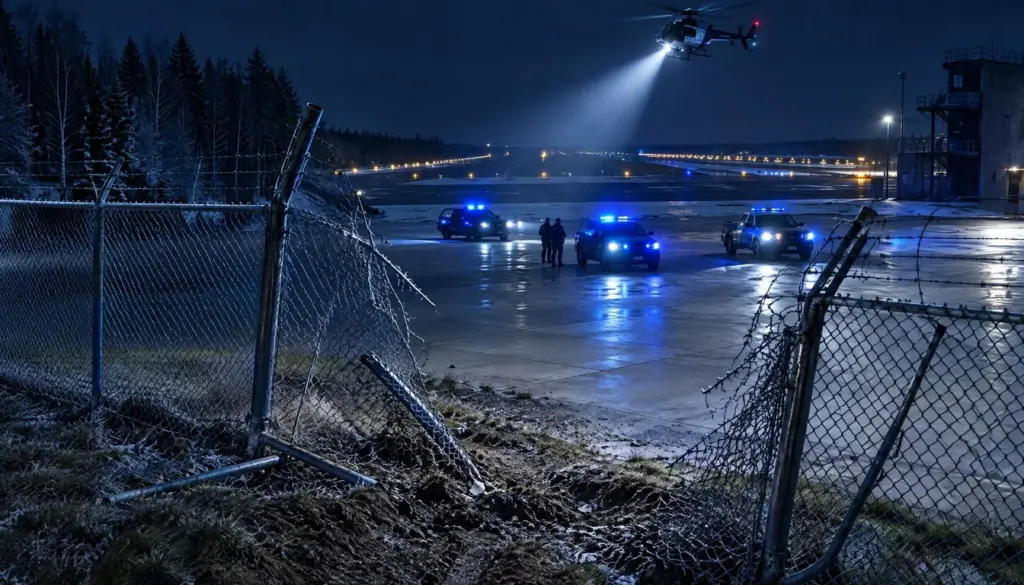
German police are investigating a security breach at Leipzig/Halle Airport after a section of the perimeter fence was found damaged late on Saturday, October 17, 2026. The discovery triggered an overnight search involving federal and state police, a helicopter, and drones, and forced the temporary closure of the airport’s northern runway. By Sunday morning, investigators had not located the vehicle they suspect caused the damage, and the circumstances of the Leipzig/Halle Airport security breach remained officially unresolved as of Monday, October 19.
The incident, confirmed by Leipzig police and reported by outlets including Aviation24.be, marks the second time this year that the perimeter of one of Germany’s busiest cargo hubs has come under scrutiny. For an airport that handles express freight for carriers operating around the clock, a breach in the fence line is not just a local policing matter. It raises questions about how airports verify and close gaps in physical perimeter security even as attention and budgets increasingly shift toward drone detection and cyber defense.

Don't miss new tech stories on Google
Add Shattered once in the Google app and our stories show up in your news suggestions.
What Happened at Leipzig/Halle Airport on Saturday Night
According to Leipzig police, airport security staff discovered the damaged fence section shortly before 23:00 local time on Saturday, October 17, 2026. The breach was located on the airport’s northern side, in the area between the visitor hill and the fire-service training center on Polygraphstraße, near the airport’s northern runway. Dirk Eidam, a Bundespolizei (Federal Police) spokesperson, said the airport security service came across the damage during a routine patrol, not in response to an alarm or a specific tip.
Police have formally classified the Leipzig/Halle Airport security breach as, in their own words, “a security-relevant incident,” a designation that triggers a mandatory joint response from federal and state police rather than a routine report filed by airport staff alone. That classification alone explains why the response scaled up overnight to include a helicopter and drone search rather than a single patrol car checking the fence line.
Timeline of the Fence Breach Investigation
The sequence of events, pieced together from Leipzig police statements and coverage from The Associated Press, shows a response that moved from discovery to a full ground-and-air search within about ten hours. The table below lays out what is confirmed so far.
| Date / Time (local) | Confirmed Event |
|---|---|
| Saturday, Oct. 17, ~22:45–23:00 | Airport security patrol discovers a damaged section of the perimeter fence near Polygraphstraße, close to the northern runway |
| Saturday night, Oct. 17 | Leipzig police notified; incident classified as “a security-relevant incident”; federal and state police mobilized |
| Sunday, Oct. 18, from 08:30 | Northern area of the airport grounds searched using police personnel, a police helicopter, and drones |
| Sunday, Oct. 18 (daytime) | Full ground search of airport property finds no unauthorized persons and no suspicious objects |
| Sunday, Oct. 18 | Northern runway closed during the search; southern runway stays operational, so flights continue |
| Sunday, Oct. 18 | Police say evidence indicates, with a high degree of probability, that a vehicle drove through the fence; no vehicle or driver identified |
| Monday, Oct. 19 (as of reporting) | Investigation ongoing; vehicle, driver, motive, and whether anyone entered a restricted zone remain unconfirmed |
Police Say a Vehicle Most Likely Caused the Breach
Leipzig police have not described the Leipzig/Halle Airport security breach as a confirmed intrusion by a person. Instead, their working theory centers on a vehicle. Leipzig police said: “The previous investigations have shown that, with a high degree of probability, a vehicle must have driven through the fence,” according to a report from Tagesschau. That assessment is based on physical evidence at the scene rather than camera footage or an eyewitness account, which is itself notable: reports indicate the breach point was not covered by functioning surveillance recording at the moment of impact.
Investigators have not released any description of the vehicle, its make, its owner, or the direction it was traveling when it struck the fence. Police have also not said whether they believe the vehicle entered the airport grounds, exited them, or both. That gap is significant for a story that is, at its core, about the strength of a boundary meant to separate public roads from an active runway environment.
The Search for a Vehicle That Was Never Found
From 08:30 on Sunday morning, police searched the northern section of the airport grounds using ground personnel, a helicopter, and drones, a combination of resources more typical of a missing-person search than routine fence-repair paperwork. Despite that effort, the vehicle police believe caused the damage was not located, and no unauthorized person or suspicious object was found anywhere on airport property.
That outcome leaves investigators in an unusual position: they are confident enough in the vehicle theory to state it publicly, but they have no vehicle, no driver, and no confirmed motive. It is a pattern that will be familiar to anyone who has followed recent intrusions at critical infrastructure sites, where the breach itself is detected quickly but the responsible party is not identified for days or weeks, if ever. Recent intrusions into US water utility systems followed a similar arc: fast detection of the breach, slow or incomplete identification of who was responsible.
Runway Closure Disrupts Operations, But Flights Continue
Leipzig/Halle Airport operates one of the largest cargo hubs in Europe, serving as a major base for overnight express freight. The northern runway closure during the search period was the most visible operational consequence of the breach, but it did not shut the airport down. The southern runway remained available throughout, and the airport did not report blanket flight restrictions, according to coverage from Deutsche Welle (DW).
That dual-runway redundancy is part of why the Leipzig/Halle Airport security breach, while alarming from a physical-security standpoint, did not produce the kind of cascading delays seen when a single-runway airport faces a similar closure. It is a reminder that operational resilience and perimeter security are two separate layers of defense, and a strong one in the first does not substitute for a weak one in the second.
A Second Security Incident for Leipzig/Halle in 2026
What makes the fence breach land harder than an isolated maintenance failure is timing. Multiple outlets, including The Associated Press and DW, reported that the incident came just over two months after an explosive-laden drone was discovered near the airport in August 2026. Germany later attributed that earlier drone incident to Russia, a claim Moscow denied, according to the same reporting. The fence breach has not been publicly linked to that earlier case, and police have given no indication the two are connected.
Still, the proximity in time is why this is being described in German reporting as the airport’s second security lapse of the year rather than a one-off. Reports also noted that the damaged fence section sat about two kilometers from three Russian Antonov An-124 cargo aircraft that have been grounded at the airport under European Union sanctions since 2022, a detail that has fueled speculation online even though investigators have not tied the fence damage to those aircraft in any official statement.
Comparing Leipzig/Halle’s Two 2026 Security Scares
Laid side by side, the August drone discovery and the October fence breach differ in almost every respect except the venue and the fact that both ended without a confirmed suspect.
| Detail | August 2026 Drone Discovery | October 17–19, 2026 Fence Breach |
|---|---|---|
| Nature of the threat | Explosive-laden drone found near the airport, per AP and DW reporting | Physical gap cut or driven through the perimeter fence |
| Suspected cause | Unconfirmed; later attributed by Germany to Russia, which denied involvement | Vehicle most likely drove through the fence, per Leipzig police |
| Location | Near airport grounds | Northern perimeter near Polygraphstraße, about two kilometers from grounded Antonov An-124 aircraft |
| Operational impact | Security response at the time, per reporting | Northern runway closed; southern runway kept flights moving |
| Status as of Oct. 19, 2026 | No publicly confirmed suspect or motive | Investigation ongoing; vehicle, driver, and motive unconfirmed |
What Officials Are Saying About the Breach
Leipzig police have been careful not to get ahead of the evidence. Beyond confirming that a vehicle most likely drove through the fence and calling it “a security-relevant incident,” according to a report from Tagesspiegel, officials have declined to speculate publicly on motive.
Uwe Schuhart, a spokesperson for the airport operator, addressed the broader question of fence standards after the incident, pointing out that the requirements for perimeter fencing at a commercial airport are set by law and that the fence in place meets national and international standards and is inspected regularly by the relevant authorities, according to German regional reporting. A Bundespolizei spokesperson separately said the investigation was proceeding in every direction, including the possibility that the breach was accidental rather than deliberate, according to German outlet reporting. Neither statement rules out any specific scenario, which is consistent with how little investigators have confirmed publicly so far.
Why a Perimeter Fence Alone Is Hard to Secure
Airport perimeters are long, run through mixed terrain, and sit next to public roads for much of their length, which is exactly why a vehicle strike can succeed even at a facility with legally mandated fencing. A chain-link or anti-climb fence is designed primarily to deter walking intruders and slow down anyone attempting to climb or cut through; it is not engineered as a vehicle barrier unless reinforced bollards, crash-rated gates, or ditches are added at specific points.
That distinction matters for how this incident should be read. A fence that meets regulatory standards for intrusion deterrence is not automatically a fence that stops a car, and nothing in the reporting so far suggests Leipzig/Halle’s perimeter was non-compliant. The open question investigators face is not whether the fence met the rules, but whether the rules themselves adequately anticipate vehicle-based breaches at points near active runways.
There is also a cost dimension that rarely makes it into breaking coverage. Retrofitting an existing perimeter with vehicle-rated barriers, such as hostile-vehicle-mitigation bollards or crash-rated gates, is far more expensive per linear meter than standard anti-climb fencing, which is why airports tend to concentrate that spending at vehicle access points and leave long stretches of open perimeter protected only by fencing and patrols. A breach in one of those stretches, like the one at Leipzig/Halle, is in some sense the predictable outcome of a cost-benefit calculation made years before the incident rather than evidence of negligence in the moment.
How European Airports Layer Perimeter Security
Modern airport perimeter protection is rarely a single fence. Operators typically combine anti-climb fencing with intrusion sensors, CCTV coverage, thermal imaging for low-light detection, controlled access points, scheduled and random patrols, lighting, and documented rapid-response procedures for when an alarm or a patrol flags a problem. Leipzig/Halle’s case shows the limits of that model when the trigger is a routine patrol discovering damage after the fact rather than a sensor catching the breach as it happens.
Counter-drone capability has become a parallel priority at European airports following a string of drone-related disruptions across the continent in 2025 and 2026, typically built around radio-frequency detection, radar, and electro-optical or infrared confirmation before any mitigation step is taken. The challenge Leipzig/Halle now illustrates is that a drone-detection investment does nothing for a ground-level vehicle breach, and a reinforced fence line does nothing for an airborne threat. Airports are increasingly expected to fund both categories at once, which raises the same budget-versus-coverage tension that shows up across critical infrastructure, from industrial control systems with aging firmware to municipal utilities defending against remote intrusion.
From Routine Patrols to AI-Assisted Detection: the Technology Gap
Video analytics and AI-assisted anomaly detection are increasingly marketed to airport operators as a way to catch fence tampering, loitering, or vehicles near restricted zones before damage occurs rather than discovering it on the next patrol. These systems are designed to complement human patrols rather than replace them, flagging anomalies for a human to verify rather than making an autonomous call.
Leipzig/Halle’s breach was found by a human patrol, not by an automated alert, which is likely to become a point of scrutiny as the investigation continues and as the airport operator responds to questions about its monitoring coverage at the specific section of fence near Polygraphstraße. The same detection-versus-discovery gap shows up in enterprise security generally: a known vulnerability that goes unpatched for even a short window, such as the issues addressed in this month’s Patch Tuesday release or the flaw fixed in Ivanti’s Connect Secure VPN, is often found only after exploitation rather than before it.
Market and Industry Impact: Perimeter Security Spending Pressure
Incidents like this one tend to move budgets even when no attacker is ever identified. Airport operators facing a publicized breach typically accelerate planned upgrades to sensor coverage, camera resolution, and access-control logging rather than waiting for a multi-year capital cycle, because the reputational and regulatory cost of a second incident outweighs the cost of moving faster. For vendors selling perimeter intrusion detection, counter-drone systems, and AI-assisted video analytics, a high-profile breach at a major European cargo hub functions as a sales trigger regardless of whether the eventual cause turns out to be a deliberate attack or an accident.
The same pressure is visible in cybersecurity budgets after major breaches elsewhere. Organizations that respond to an incident with a formal review process, similar in spirit to the frameworks covered in recent coverage of AWS’s security incident response tooling, tend to close gaps faster than those that treat an incident as a one-time anomaly. Whether Leipzig/Halle follows that pattern will depend on what the investigation ultimately attributes the breach to.
Insurance underwriters who cover aviation infrastructure also tend to react to publicized perimeter failures, even unresolved ones, by revisiting premiums or requiring documented remediation steps at the next policy renewal. That dynamic mirrors what has played out around other infrastructure incidents this year, where a breach that is never fully attributed to a specific actor still produces lasting changes to how a facility is insured and audited. For Leipzig/Halle, the practical effect may be felt less in headlines about an unidentified driver and more in quieter negotiations between the airport operator, its insurers, and German aviation regulators over the coming months.
The Open Questions Investigators Still Must Answer
As of this reporting, several central questions remain unresolved. Police have not identified the vehicle suspected of causing the damage, nor its owner or driver. They have not confirmed a motive, and they have explicitly left open the possibility that the breach was accidental. They have not said whether anyone entered a restricted area of the airport, and they have not linked the fence breach to August’s drone discovery or to the grounded Antonov aircraft nearby.
Until those questions are answered, any characterization of the Leipzig/Halle Airport security breach as a deliberate attack, an act of sabotage, or an accident is speculation. The facts publicly confirmed so far describe a damaged fence, a runway closure, an unsuccessful search, and a working theory about a vehicle, nothing more.
Predictions: Where Airport Perimeter Security Goes From Here
- Expect Leipzig/Halle’s operator to announce a review of fencing and sensor coverage at the specific section near Polygraphstraße, mirroring how airports typically respond publicly after a breach draws national attention.
- German federal and state police are likely to release periodic updates rather than a single conclusive report, given how many basic facts, including the vehicle’s identity, remain open.
- Other European cargo and passenger hubs will likely use this incident as a prompt to audit their own vehicle-barrier coverage at points where perimeter fencing runs close to public roads, separate from any drone-detection spending already underway.
- If investigators eventually tie the breach to the earlier drone incident or to the grounded Russian aircraft, expect renewed political attention in Berlin on protective measures for sanctioned foreign aircraft parked at German airports.
- If the breach is ultimately ruled accidental, expect the story to fade from headlines quickly, but the underlying debate about vehicle-rated perimeter barriers at runway-adjacent fence lines is likely to persist in aviation security circles regardless of the outcome.
Historical Context: Perimeter Breaches Are a Recurring Aviation Security Theme
Airport perimeter incidents are not new, but the mix of threats operators must plan for has expanded. A generation ago, perimeter security planning focused mainly on pedestrian intrusion and wildlife. Today it spans vehicles, drones, insider threats, and the possibility that an incident is simply an accident involving a confused driver rather than anything connected to aviation security at all. Leipzig/Halle’s own 2026 record, with a drone discovery in August and a fence breach in October, captures that range inside a single calendar year at one facility.
That broadening threat picture is similar to what has played out in other critical-infrastructure sectors this year. Ransomware operators have increasingly escalated beyond data encryption toward threats against individuals connected to a target, a shift documented in recent reporting on ransomware groups’ real-world tactics. In both aviation and cybersecurity, defenders are being asked to prepare for a wider range of scenarios with budgets that rarely grow as fast as the threat list.
Frequently Asked Questions
What exactly happened at Leipzig/Halle Airport?
Police found a section of the airport’s perimeter fence damaged shortly before 23:00 local time on Saturday, October 17, 2026. Investigators believe a vehicle most likely drove through the fence, though this has not been confirmed with a vehicle, driver, or motive identified.
Was anyone arrested in connection with the breach?
No arrests have been publicly reported. Police have not identified a suspect, a vehicle, or a driver as of this reporting.
Did the breach shut down the airport?
No. The northern runway was closed temporarily during the search, but the southern runway remained operational and the airport did not report blanket flight restrictions.
Is this connected to the drone incident at the same airport earlier in 2026?
Multiple outlets reported that an explosive-laden drone was found near the airport roughly two months earlier, in August 2026, and that Germany later attributed that case to Russia, which denied the claim. Police have not publicly linked the fence breach to that earlier incident.
Were the grounded Russian cargo planes at the airport involved?
Reports noted that the damaged fence section was located near three Russian Antonov An-124 cargo aircraft that have been grounded at the airport under EU sanctions since 2022. No official statement has tied the fence damage to those aircraft.
Could this have been an accident rather than a deliberate breach?
Yes. A Bundespolizei spokesperson said investigators were examining every possible explanation, including the possibility that the vehicle strike was accidental.
Does the airport’s perimeter fence meet legal standards?
The airport operator’s spokesperson said the fence meets national and international standards for a commercial airport and is regularly inspected by the relevant authorities. Nothing in current reporting suggests the fence was non-compliant.
What happens next in the investigation?
Leipzig police and federal police are continuing to investigate. Key unanswered questions include the identity of the vehicle and driver, whether the act was deliberate, and whether it has any connection to the airport’s earlier 2026 drone incident.