
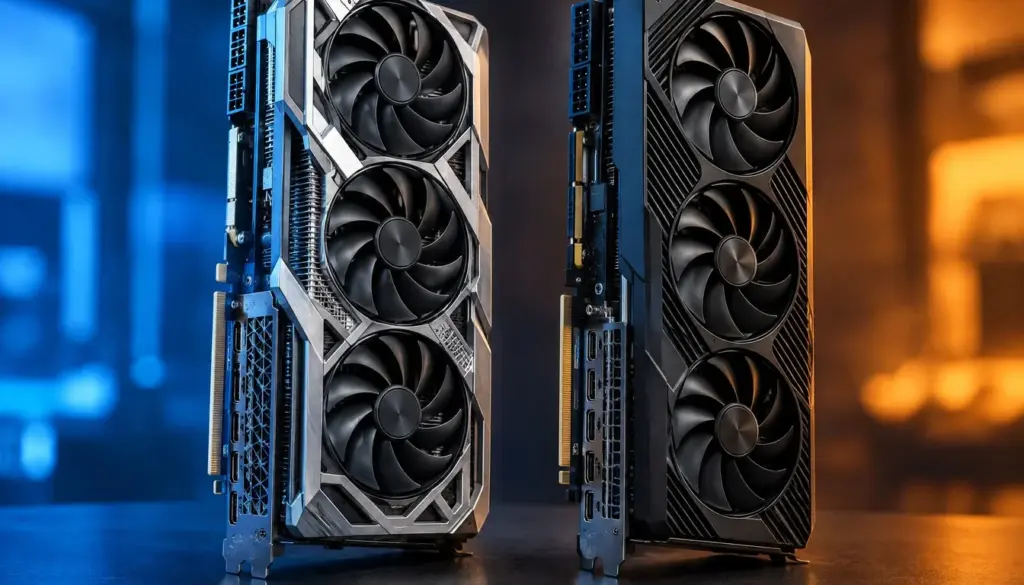
Every graphics card argument in 2026 eventually lands on the same two acronyms: DLSS and FSR. Nvidia’s DLSS 4 and AMD’s FSR 4 now decide more real-world frame rates than raw silicon does, since both companies lean on AI upscaling and frame generation to hit playable numbers at 4K. The gap between the two technologies has narrowed from “not close” to “close enough to argue about,” and that shift is reshaping which graphics card people actually buy, not just which one wins a spec sheet.
UL Benchmarks’ October 2026 rankings, pricing tracked by Tom’s Hardware, and buying guides from SpecPicks and Gaming PC Guru all point to the same conclusion: Nvidia still leads on upscaling polish and ray tracing, AMD still wins on price-per-frame, and the real decision now hinges on which tradeoff matters more at your budget.
What makes this comparison different from the usual spec-sheet shootout is timing. Both companies’ current-generation lineups are fully mature by this point in 2026, pricing has settled enough to compare directly rather than chasing a launch-week MSRP that nobody can actually find in stock, and both upscalers have been in the wild long enough for independent outlets to stress-test the marketing claims against real gameplay. That maturity is exactly why the data below carries more weight than it would have a year ago, when DLSS 4 and FSR 4 were still fresh enough that early reviews disagreed wildly on how close the two technologies really were.

Don't miss new tech stories on Google
Add Shattered once in the Google app and our stories show up in your news suggestions.
DLSS 4 vs FSR 4: what changed in 2026
DLSS 4 vs FSR 4 is now one of the most searched GPU comparison terms, and for good reason. Nvidia’s DLSS 4 runs on a transformer-based model rather than the older convolutional neural network architecture that powered DLSS 3, which is why Nvidia markets it as a generational leap rather than an incremental patch. The transformer model improves temporal stability, meaning less shimmering on thin objects like fences, power lines, and foliage, and it extends multi-frame generation, where the GPU inserts several AI-generated frames between every traditionally rendered frame.
AMD’s answer, FSR 4, moved the technology onto dedicated AI hardware blocks inside RDNA 4 for the first time, a departure from the more general-purpose shader-based approach FSR 3 used. According to Gaming PC Guru’s 2026 comparison, the upscaling battle has turned into “a full-blown AI arms race with DLSS 4 facing FSR 4 in nearly every modern title,” and the publication notes AMD has closed real ground rather than just matching Nvidia’s marketing claims. PC Game Check’s own breakdown of the two platforms frames FSR 4 as reaching near-parity with DLSS 4 in some games while Nvidia keeps an image-quality edge in others, particularly in fast-motion scenes and dense foliage.
The practical result for buyers: FSR 4 is no longer the soft, blurry upscaler that defined AMD’s reputation through 2023 and 2024. It still trails DLSS 4 in edge cases, but the gap that used to be a dealbreaker is now closer to a nitpick for most players, which matters because it removes the biggest reason shoppers used to default straight to Nvidia regardless of price. That shift alone explains why so much GPU shopping discussion in late 2026 has moved from “which brand” to “which price tier,” since the upscaler quality penalty for choosing AMD has shrunk considerably.
How DLSS 4 and FSR 4 actually work
Both technologies solve the same problem from different angles: render a game at a lower internal resolution, then use AI to reconstruct a sharper, higher-resolution image faster than native rendering would allow. DLSS 4 trains its transformer model on Nvidia’s own supercomputing infrastructure and ships model updates through driver releases, so image quality can improve on existing RTX 50 cards without new hardware. That’s the same distribution model Nvidia used for DLSS 3, and it’s part of why Nvidia has kept its upscaling lead for several GPU generations running, each driver cycle quietly sharpens the reconstruction without requiring buyers to purchase a new card.
FSR 4 breaks from AMD’s own history by requiring RDNA 4 hardware specifically, rather than running on any DirectX 12-class card the way FSR 1 through FSR 3.1 did. That’s a tradeoff: AMD sacrificed backward compatibility with RX 7000 and RX 6000 cards in exchange for dedicated AI acceleration that lets FSR 4 compete on image quality instead of just being the upscaler that works on more cards. It’s the same strategic bet Nvidia made years earlier when DLSS was locked to RTX hardware with tensor cores, and it suggests AMD concluded that broad compatibility was no longer worth the quality ceiling it imposed.
Frame generation is where the two diverge most. DLSS 4’s multi-frame generation can produce several interpolated frames per traditionally rendered frame, which is how Nvidia advertises large frame-rate multipliers in supported titles. AMD’s Fluid Motion Frames technology under the FSR 4 umbrella targets a more conservative single extra frame per rendered frame in most implementations, prioritizing lower input latency over raw frame-rate headline numbers. For competitive, latency-sensitive games, that conservatism can actually be the better choice, even though it produces a smaller number on a frame counter overlay.
There’s also a practical onboarding difference worth noting. Nvidia ships DLSS 4 settings as a near-universal toggle across its supported game library, with the “DLSS Override” feature in recent drivers letting players force newer DLSS versions into older titles that only shipped with DLSS 2 or 3. AMD doesn’t yet offer an equivalent driver-level override for FSR 4, so a game has to ship FSR 4 support directly from the developer to benefit from AMD’s AI hardware acceleration, which currently gives Nvidia a wider practical footprint even in games neither company specifically optimized for its newest technology.
DLSS 4 vs FSR 4 feature comparison
| Feature | DLSS 4 (Nvidia) | FSR 4 (AMD) |
|---|---|---|
| Core model architecture | Transformer-based neural network | AI model on dedicated RDNA 4 hardware blocks |
| Hardware requirement | RTX 40/50 series (tensor cores) | RDNA 4 (RX 9000 series) only |
| Backward compatibility | Driver-level “DLSS Override” can force newer versions into older titles | No equivalent override; needs native developer support |
| Frame generation approach | Multi-frame generation (several AI frames per rendered frame) | Fluid Motion Frames (typically one extra frame per rendered frame) |
| Input latency priority | Can rise with aggressive multi-frame generation settings | Generally lower, prioritized over raw frame-rate multiplier |
| Image quality in motion | Slight edge in fast motion and dense foliage per PC Game Check | Near-parity in many titles; narrowing gap |
| Update distribution | Via driver releases, no new hardware needed | Via driver and game patches on supported RDNA 4 cards |
RTX 50 vs RX 9000: the GPUs behind the upscalers
Upscaling tech doesn’t matter in isolation, so it’s worth looking at the hardware each company is shipping it on. Nvidia’s RTX 50 series, built on the Blackwell architecture, spans from the RTX 5090 flagship down through budget-tier cards, and the lineup is now fully deployed across every price bracket. AMD’s RX 9000 series, built on RDNA 4, has matured from launch-day scrutiny into what Gaming PC Guru calls “a legitimately compelling mid-tier value play,” particularly below the $600 mark.
UL Benchmarks’ October 2026 GPU rankings put hard numbers behind the rhetoric. The RTX 5090 tops the chart with a benchmark score of 14,636 at a listed price of $1,999, while the RTX 5080 sits further down the list with a score of 8,938 at $999. AMD’s RX 9070 XT scores 7,273 at $599, meaning the RTX 5090 roughly doubles the RX 9070 XT’s raw benchmark score but costs more than three times as much. The RTX 5080, meanwhile, scores noticeably higher than the RX 9070 XT but at nearly double the price, which is the crux of the value argument AMD leans on in its marketing.
SpecPicks’ buying guide sums up the three-way market split bluntly: Nvidia’s Blackwell-era cards dominate feature support with DLSS 4 and ray tracing, AMD’s RDNA cards lead on raw raster-per-dollar, and older RTX 30-series cards still linger as used-market value plays for shoppers who don’t need the newest upscaler at all. That three-way split is a change from a few years ago, when the used-GPU market mostly meant choosing between two generations of the same brand rather than weighing an entirely different upscaling ecosystem.
It’s worth noting that search interest itself still skews toward Nvidia. Market tracking from Accio’s trending graphics card analysis shows the RTX 4090 consistently leading overall search volume for graphics cards through 2026, even as RTX 5090 and RX 9070 XT dominate actual head-to-head buying comparisons. That gap between search interest and current-generation purchase comparisons suggests a lot of shoppers are still researching a flagship card from the previous generation, possibly because used and discounted RTX 4090 units remain attractive next to newer, pricier Blackwell cards.
Specs comparison table: RTX 50 vs RX 9000 lineup
| GPU | Architecture | UL benchmark score | Listed price | VRAM | Upscaler | Segment |
|---|---|---|---|---|---|---|
| RTX 5090 | Blackwell | 14,636 | $1,999 | 32GB GDDR7 | DLSS 4 | Flagship |
| RTX 4090 (prior-gen, still sold) | Ada Lovelace | 9,225 | $1,599 | 24GB GDDR6X | DLSS 3.5 | Flagship (legacy) |
| RTX 5080 | Blackwell | 8,938 | $999 | 16GB GDDR7 | DLSS 4 | High-end |
| RX 9070 XT | RDNA 4 | 7,273 | $599 | 16GB GDDR6 | FSR 4 | Upper mid-range |
| RX 9070 GRE | RDNA 4 | n/a (regional SKU) | $499 (recent low) | 12GB GDDR6 | FSR 4 | Mid-range |
| RX 9060 XT | RDNA 4 | n/a (budget tier) | Sub-$400 class | 8GB/16GB GDDR6 | FSR 4 | Budget-mid |
| RX 9050 (8GB) | RDNA 4 | 37% faster than 4GB variant (18-game avg.) | $279 | 8GB GDDR6 | FSR 4 | Entry-level |
| RX 9050 (4GB) | RDNA 4 | Baseline in 18-game test | Sub-$279 | 4GB GDDR6 | FSR 4 | Entry-level |
| RTX 3070 Ti (legacy, still ranked) | Ampere | 3,501 | $599 (original MSRP) | 8GB GDDR6 | DLSS 2/3 | Legacy mid-range |
| RTX Spark N1X (unified-memory platform) | Blackwell-derived | Not a discrete add-in card | Varies by OEM | Up to 128GB unified | DLSS 4 | Compact desktop/laptop platform |
Two things stand out in that table. First, the RTX 4090 still outperforms the RTX 5080 on UL’s October 2026 chart despite being a generation older, which tells you Nvidia’s Blackwell lineup didn’t simply replace Ada Lovelace card-for-card at every tier, it restructured pricing around it instead. Second, AMD’s RX 9050 listing shows the industry’s broader return to 4GB and 8GB VRAM configurations at entry-level price points, and the 37% performance gap between the two memory configurations in an 18-game average, as reported by VideoCardz, is a reminder that VRAM capacity alone can swing real-world results even within the same silicon.
The RTX Spark N1X entry deserves a caveat of its own. It’s not a conventional GeForce desktop card you slot into a PCIe x16 lane, it’s a unified-memory compact platform aimed at creators and small-footprint AI workloads, and treating it as a head-to-head RTX 50 versus RX 9000 gaming competitor would be misleading. It shows up here because it represents where Nvidia’s Blackwell architecture is heading outside traditional discrete graphics cards, and buyers researching “Nvidia vs AMD” should know it exists as a separate category rather than confuse it with a GeForce replacement.
Benchmark results from three sources
UL Benchmarks’ October 2026 “Best GPUs” ranking is the clearest head-to-head data point available right now. It places the RTX 5090 first overall at a score of 14,636, with the RTX 5080 ranked fifth at 8,938 and the RX 9070 XT ranked ninth at 7,273. Notably, a Mac Studio configured with a 2026 M5 Ultra 80-core GPU scored 8,023 on the same chart, landing between the RTX 5080 and RX 9070 XT, a sign that Apple Silicon‘s GPU throughput is now competitive enough to show up in conversations that used to be strictly Nvidia-versus-AMD.
SpecPicks’ buying guide, last updated in October 2026, backs the same general shape: Nvidia’s Blackwell cards win on feature depth, AMD’s RDNA 4 lineup wins on raster-per-dollar, and the used RTX 30-series market still offers value for buyers willing to skip the newest upscaler entirely. Gaming PC Guru’s comparison adds the price-tier framing directly, noting that the RX 9070 XT functions as a price-per-frame leader against Nvidia’s RTX 5070 Ti in its performance bracket, even though the RTX 5070 Ti pulls ahead in ray-traced titles where DLSS 4’s frame generation carries more of the workload.
None of the three sources disagree on the fundamental shape of the market. Nvidia wins the top end and the feature checklist. AMD wins the value argument in the $400 to $600 range. Where they diverge is in how much weight to put on DLSS 4’s remaining image-quality edge versus the RX 9070 XT’s roughly 40% lower price than the RTX 5080, a gap UL’s own pricing data confirms directly. Buyers comparing synthetic benchmark scores should also remember that UL’s methodology measures raw throughput under its own test workload, which doesn’t always map cleanly onto how a specific game engine handles upscaling and frame generation, so treat the benchmark score as a directional signal rather than a precise frame-rate prediction for any one title.
Pricing table: street prices and recent moves
| GPU | Listed/MSRP price | Recent price note | Price tier vs. rival |
|---|---|---|---|
| RTX 5090 | $1,999 | Nvidia denies discontinuation reports, but availability at MSRP is reportedly tight | No direct AMD rival |
| RTX 5080 | $999 | Holding steady through October 2026 | Roughly 67% above RX 9070 XT’s $599 listing |
| RX 9070 XT | $599 | Stable; sits ~40% below RTX 5080’s listed price | Closest value counter to RTX 5080/5070 Ti |
| RX 9070 GRE | $499 (recent low, per Tom’s Hardware) | Dropped below original launch MSRP | Undercuts most Nvidia 16GB-class cards |
| RX 9060 XT | Sub-$400 class | AMD’s steady mid-range value anchor | No direct same-tier RTX 50 equivalent at launch pricing |
| RX 9050 (8GB) | $279 | New entry-level SKU as 4GB/8GB split returns | Budget tier; no RTX 50 card at this price point |
| AMD lineup-wide | n/a | Reported ~10% price increase planned, driven by memory constraints (per hardware leaker Harukaze5719, via Ground News) | Could narrow AMD’s price advantage if confirmed |
| RTX 4090 (legacy) | $1,599 | Still sold and still outscoring RTX 5080 on UL’s chart | Sits between RTX 5080 and RTX 5090 in price and performance |
That reported 10% AMD price increase, described by hardware leaker Harukaze5719 and cited by Ground News, is worth flagging because it’s tied to the same memory-chip supply constraints that have pushed up DRAM and GDDR pricing across the industry through the second half of 2026. If it lands, AMD’s core argument, meaningfully cheaper than Nvidia at equivalent performance, gets squeezed, even if the RX 9000 lineup still undercuts RTX 50 cards in absolute terms. Buyers who are on the fence and comparing prices today should treat current listed prices as a snapshot rather than a guaranteed floor, since memory costs have already forced multiple price adjustments from both brands this year.
Ray tracing: still Nvidia’s strongest ground
Ray tracing remains the category where Nvidia’s lead is least contested. RTX 50’s dedicated ray-tracing cores, paired with DLSS 4’s frame generation, let Nvidia cards hold playable frame rates in fully path-traced titles that would otherwise bring any GPU to its knees. AMD’s RDNA 4 architecture closed real ground on ray-tracing throughput compared to RDNA 3, but PC Game Check’s comparison still lists ray tracing and AI-assisted rendering as Nvidia’s main gaming advantage heading into late 2026, a position that’s held steady even as FSR 4 narrowed the upscaling gap.
What’s changed is how much that matters to the average buyer. A few years ago, ray tracing was a checkbox feature in a handful of flagship titles. In 2026, it’s baked into enough major releases that the performance hit without a capable upscaler is no longer a minor inconvenience. That’s precisely why the DLSS 4 vs FSR 4 conversation has displaced the older, simpler “who has more raw teraflops” argument as the center of GPU shopping decisions. A GPU that renders ray tracing well but upscales poorly, or vice versa, now loses sales to a competitor that balances both better, which is exactly the dynamic playing out between the RTX 5080 and RX 9070 XT.
Power consumption and the software ecosystem
Raw performance numbers only tell part of the ownership story. Nvidia’s broader software ecosystem, built around CUDA, extends well beyond gaming into content creation, local AI inference, and professional rendering tools, and that ecosystem advantage shows up even for buyers who only care about games. Streaming software, video encoders, and AI-assisted creative tools frequently optimize for Nvidia hardware first, simply because CUDA has the larger installed developer base, which means an RTX card can feel like the safer default for anyone who dabbles in content creation alongside gaming.
AMD’s software stack has closed gaps here too, but it still trails in third-party tool support outside pure gaming workloads. Where AMD wins decisively is driver simplicity for straightforward gaming use: Radeon’s driver suite has a reputation for fewer forced background services and a lighter system footprint compared to Nvidia’s increasingly feature-dense app, which bundles overlay tools, recording software, and AI features that some users would rather not run at all. For a buyer whose GPU is doing one job, playing games, that simplicity is a real, if underrated, point in AMD’s favor.
Power efficiency comparisons are harder to generalize across the full lineup, since efficiency varies significantly by specific SKU and workload rather than by brand as a whole. What is consistent across 2026 reviews is that both companies’ flagship cards, the RTX 5090 and the RX 9070 XT’s higher-end sibling cards, draw enough power that case airflow and power-supply headroom matter more than they did two GPU generations ago, a practical consideration that belongs in any upgrade budget regardless of which brand you choose.
Which games actually support DLSS 4 and FSR 4 right now
A headline upscaler feature is only as useful as the games that implement it, and this is one area where the two ecosystems still diverge sharply. Nvidia’s DLSS 4 benefits from years of developer relationships built during the DLSS 2 and DLSS 3 eras, meaning most major 2025 and 2026 releases that ship any upscaler at all tend to ship DLSS first, with FSR and Intel’s XeSS following in a later patch if at all. Big-budget releases built around path tracing or heavy ray-traced lighting, the genre where upscaling matters most, have consistently prioritized DLSS integration at launch.
FSR 4 support is growing but still catching up on raw title count. Because FSR 4 requires RDNA 4 hardware specifically, developers can’t simply flip on FSR 4 for every PC that already supported FSR 3.1, they need to implement a genuinely new code path. That’s a meaningfully bigger engineering lift than a typical point-release upscaler update, which is part of why FSR 4 adoption has trailed DLSS 4 adoption by title count throughout 2026, even in games that already shipped FSR 3.1 at launch.
The practical advice for shoppers: don’t assume a game you care about supports both upscalers equally well just because it lists “AMD FSR” and “Nvidia DLSS” on the back of the box. Check whether it specifically supports FSR 4 and DLSS 4, not just a generic version of either technology, since a game running FSR 3.1 under an AMD card won’t get anywhere near the image quality this comparison describes for FSR 4. Community-maintained upscaler support trackers and individual game patch notes remain the most reliable way to confirm this ahead of a purchase, since neither Nvidia nor AMD publishes a single authoritative, continuously updated support list.
The used and budget GPU market: RTX 30-series and older Radeon cards
Not every buyer needs DLSS 4 or FSR 4 at all, and the used GPU market remains a legitimate third option alongside current-generation RTX 50 and RX 9000 cards. SpecPicks’ 2026 buying guide specifically calls out a handful of RTX 30-series cards as still compelling on the used market, since older DLSS 2 and DLSS 3 support is perfectly adequate for buyers targeting 1080p or 1440p without ray tracing. UL’s own October 2026 rankings still include the RTX 3070 Ti, scoring 3,501, as a reference point, confirming these cards remain in active circulation and relevant enough to track rather than being pure collector curiosities.
AMD’s older RX 6000-series cards occupy a similar niche, though with the caveat that they’re permanently locked out of FSR 4’s dedicated AI hardware path. That’s a meaningful long-term limitation: a used RX 6800 XT might still be a reasonable 1440p performer today, but it will never receive the upscaling quality jump FSR 4 brought to RDNA 4 cards, since the hardware itself can’t run it. Buyers shopping the used market should weigh that ceiling carefully if upscaling quality is likely to matter more as more titles lean on AI reconstruction over the next few years.
The practical takeaway is that the used market works best for buyers who have already decided image quality from the newest upscalers isn’t a priority, whether because they play mostly at native resolution, stick to older or less demanding titles, or simply want to spend as little as possible on a GPU upgrade. For everyone else, the price-to-performance math increasingly favors buying into a current RDNA 4 or Blackwell card new, even at the budget end, given how much of the 2026 upscaling conversation is now locked to current-generation hardware on both sides.
Real-world buying scenarios
Here’s how the DLSS 4 vs FSR 4 and RTX 50 vs RX 9000 decision plays out across six common buyer profiles, using the pricing and performance data above.
- The 1440p esports player: The RX 9070 XT at $599 delivers enough raster performance for high refresh-rate competitive play, and AMD’s more conservative Fluid Motion Frames approach keeps input latency lower than aggressive multi-frame generation, which matters more than headline frame-rate numbers in fast-paced shooters.
- The 4K single-player enthusiast: The RTX 5080 at $999 pairs DLSS 4’s transformer-based upscaling with strong ray-tracing hardware, making it the more comfortable pick for path-traced, story-driven titles where image fidelity outweighs a 40% price premium over the RX 9070 XT.
- The budget-conscious first-time builder: AMD’s RX 9060 XT or the newer RX 9050 (specifically the 8GB variant, given the 37% performance gap over the 4GB model in 18-game testing) offers the clearest entry point under $400, with no equivalent RTX 50 card at that price tier.
- The no-compromise flagship buyer: The RTX 5090 at $1,999 has no direct AMD competitor in raw benchmark score, roughly doubling the RX 9070 XT’s UL score, though buyers should expect tight availability at listed MSRP given ongoing supply reports.
- The value-focused mid-range upgrader: The RX 9070 GRE’s recent drop to $499, as tracked by Tom’s Hardware, undercuts most Nvidia 16GB-class alternatives while keeping 12GB of VRAM, making it a strong pick for buyers upgrading from older 8GB cards without stretching to flagship pricing.
- The creator or hybrid workstation user: Nvidia’s broader CUDA ecosystem and the emerging RTX Spark N1X platform, which pairs up to 128GB of unified memory with 5,120 or 6,144 CUDA cores, give Nvidia the edge for buyers who mix gaming with AI or content-creation workloads, though this platform should be treated as a separate category rather than a drop-in GeForce replacement.
Migration guide: switching from DLSS to FSR, or the reverse
Switching GPU brands used to mean relearning driver software and hoping your favorite games supported the new upscaler. In 2026, that friction has dropped, but it hasn’t disappeared. Here’s a practical path for making the switch in either direction without losing performance or running into driver conflicts.
- Step 1: Audit your current game library for upscaler support. Check which of your most-played titles support FSR 4 specifically, not just a generic “FSR” label, since older FSR 2/3 implementations don’t automatically gain FSR 4’s AI-driven image quality without a developer patch.
- Step 2: Confirm hardware compatibility before buying. FSR 4 requires RDNA 4 hardware (RX 9000 series); it doesn’t run on RX 7000 or RX 6000 cards the way earlier FSR versions did. Similarly, DLSS 4’s full feature set, including multi-frame generation, is tied to RTX 40 and RTX 50 tensor core generations.
- Step 3: Uninstall old GPU drivers cleanly. Use the manufacturer’s dedicated uninstall utility, Nvidia’s DDU-recommended process or AMD’s driver cleanup tool, before installing drivers for a different brand’s card to avoid conflicts between leftover driver components.
- Step 4: Reset in-game upscaler settings per title. Most games store upscaler preferences per GPU vendor, so switching hardware usually means manually re-selecting DLSS, FSR, or native resolution in each game’s graphics menu rather than relying on carried-over settings.
- Step 5: Check PSU and case clearance before physically swapping cards. Flagship cards in both lineups, particularly the RTX 5090, have higher power draw and larger coolers than older generations, so confirm your power supply’s wattage headroom and your case’s maximum card length before the physical install.
- Step 6: Benchmark your actual games, not synthetic scores. UL’s benchmark scores are useful for cross-GPU comparison, but real frame rates in your specific games, at your specific resolution and settings, are what determine whether the switch was worth it.
- Step 7: Reassess frame generation settings. If you’re moving from AMD to Nvidia, try DLSS 4’s multi-frame generation at a lower base setting first, since it can introduce visible artifacts at maximum multipliers in fast-motion scenes. If moving from Nvidia to AMD, expect FSR 4’s Fluid Motion Frames to produce a more modest frame-rate boost with typically lower input latency.
Pros and cons: Nvidia RTX 50 and DLSS 4
- Pro: Transformer-based DLSS 4 delivers the best overall upscaling image quality available on any consumer GPU today.
- Pro: Strongest ray-tracing hardware, making path-traced titles genuinely playable at high resolutions.
- Pro: Multi-frame generation produces the largest frame-rate multipliers in supported titles.
- Pro: Broader software ecosystem (CUDA, content-creation tools) benefits hybrid gaming and work setups.
- Pro: Driver-level DLSS Override extends newer upscaling versions into older games without waiting on developer patches.
- Con: Significant price premium at every comparable performance tier, roughly 40-67% above AMD’s equivalent cards per UL’s October 2026 pricing.
- Con: RTX 5090 availability at listed $1,999 MSRP is reportedly tight despite Nvidia’s denial of discontinuation.
- Con: Aggressive multi-frame generation can add input latency and visible artifacts at maximum settings.
Pros and cons: AMD RX 9000 and FSR 4
- Pro: Best price-per-frame value across the mid-range, with the RX 9070 XT undercutting the RTX 5080 by roughly 40% while remaining competitive in raster performance.
- Pro: FSR 4’s move to dedicated AI hardware closed most of the historical image-quality gap with DLSS.
- Pro: Fluid Motion Frames’ more conservative frame generation keeps input latency lower, a real advantage for competitive gaming.
- Pro: Broader budget-tier selection, including the new $279 RX 9050, with no direct RTX 50 equivalent at that price.
- Pro: Lighter, simpler driver software footprint for buyers who just want a gaming GPU without a bundle of extra apps.
- Con: FSR 4 requires RDNA 4 hardware specifically, breaking the backward compatibility earlier FSR versions offered.
- Con: Ray-tracing performance still trails Nvidia’s equivalent price tier in heavily path-traced titles.
- Con: A reported ~10% AMD price increase tied to memory constraints could narrow the value gap in coming months.
What’s next: RDNA 5 and Nvidia Rubin timelines
Anyone weighing whether to buy now or wait should know both companies’ next architectures are further out than a lot of forum speculation suggests. VideoCardz’s AMD graphics coverage reports that AMD’s RDNA 5 graphics cards are unlikely to be revealed before Computex 2027, and the same coverage notes that Nvidia’s next-generation GeForce Rubin architecture, along with most RDNA 5 GPUs, reportedly isn’t coming until 2028. That timeline matters directly for this comparison: buyers debating RTX 50 versus RX 9000 today are not choosing between a soon-to-be-outdated generation and an imminent replacement, they’re choosing the current generation for what is likely to be a multi-year window before the next real architectural shift arrives.
That longer runway changes the calculus on a few of the scenarios above. A flagship buyer picking up an RTX 5090 today isn’t skipping a near-term successor, Rubin’s reported 2028 timeline puts roughly two years between this purchase and Nvidia’s next ground-up architecture. The same logic applies to AMD’s RX 9000 lineup: with RDNA 5 not expected before Computex 2027 at the earliest, and likely later given the 2028 GPU timeline cited alongside it, an RX 9070 XT or RX 9070 GRE purchase today should hold up as AMD’s current-generation recommendation for a while yet, rather than being an interim stopgap before a quick refresh.
That said, both companies will keep shipping incremental updates inside the current generation. Nvidia has a track record of refreshing DLSS through driver updates without new hardware, and AMD is actively expanding FSR 4 support to more of its lineup and reportedly adjusting pricing in response to memory costs. Expect the software side of this comparison, upscaler quality, frame-generation tuning, and driver-level overrides, to keep shifting meaningfully even while the underlying silicon stays the same for the next year or two.
The verdict: which one should you actually buy
The data points to a split decision rather than a clean winner. If ray tracing and the sharpest possible upscaled image matter most to you, and budget is secondary, Nvidia’s RTX 50 lineup with DLSS 4 is still the stronger technical package; UL’s benchmark numbers back that up directly, with the RTX 5090 scoring nearly double the RX 9070 XT. But that lead comes at a real cost: the RTX 5080’s $999 listing is roughly 67% above the RX 9070 XT’s $599, and that gap hasn’t been closing.
If you’re buying anywhere below the $1,000 mark, which is where most GPU sales actually happen, AMD’s RX 9000 lineup and FSR 4 make a genuinely strong case. The image-quality gap that used to be the deciding factor has narrowed enough that Gaming PC Guru can credibly call RDNA 4 “a legitimately compelling mid-tier value play,” and the RX 9070 GRE’s recent drop to $499 only strengthens that case. The one wrinkle worth watching is AMD’s reported ~10% price increase tied to memory costs; if that lands broadly, recheck current street prices before assuming the numbers in this comparison still hold exactly.
The short version, and the real answer underneath every FSR vs DLSS search query: buy Nvidia if ray tracing, DLSS 4’s upscaling polish, or flagship-tier performance is non-negotiable for you. Buy AMD if you want the best frame rate per dollar in the $279 to $599 range and can live with a slightly smaller ray-tracing margin. Neither brand is making a bad GPU right now, which is itself the real story of the 2026 GPU market.
Frequently asked questions
Is DLSS 4 better than FSR 4?
DLSS 4 generally holds a small image-quality edge over FSR 4, particularly in fast-motion scenes and dense foliage, according to PC Game Check’s 2026 comparison. But FSR 4’s move to dedicated AI hardware on RDNA 4 has closed most of the historical gap, and in many titles the difference is difficult to spot without pausing and zooming in on individual frames.
Does FSR 4 work on older AMD graphics cards?
No. FSR 4 requires RDNA 4 hardware, meaning it only runs on RX 9000 series cards. Older RX 7000 and RX 6000 cards remain limited to FSR 3.1 or earlier versions, which use a shader-based approach rather than FSR 4’s dedicated AI acceleration.
Is the RTX 5090 actually discontinued?
Nvidia has denied discontinuing the RTX 5090, but reports tracked by VideoCardz indicate availability at the $1,999 listed price has been tight, with some supply reportedly reserved for Nvidia’s RTX Pro workstation lineup instead. The card still ranks first on UL Benchmarks’ October 2026 chart with a score of 14,636.
What is the best value GPU between RTX 50 and RX 9000?
Based on UL Benchmarks’ October 2026 pricing and scores, the AMD RX 9070 XT at $599 offers the strongest price-per-frame value against Nvidia’s comparable RTX 5070 Ti and RTX 5080 cards, undercutting the RTX 5080’s $999 listing by roughly 40% while remaining competitive in raster-heavy games.
Will AMD GPU prices go up soon?
Hardware leaker Harukaze5719 reportedly told AIB partners that AMD graphics card prices would rise by around 10%, driven by ongoing memory chip constraints, according to a report covered by Ground News. This hasn’t been officially confirmed by AMD, so treat it as a pricing trend to watch rather than a locked-in number.
What is the RTX Spark N1X, and is it a GeForce replacement?
The RTX Spark N1X is a unified-memory desktop and laptop platform launching in October 2026, pairing 18 or 20 CPU cores with 5,120 or 6,144 CUDA cores and up to 128GB of unified memory. It’s not a direct GeForce desktop add-in card replacement, it’s a separate compact platform aimed more at creators and AI workloads than traditional discrete-GPU gaming rigs.
Does the RX 9050’s 4GB vs 8GB memory configuration actually matter?
Yes, significantly. Testing cited by VideoCardz found the 8GB RX 9050 was 37% faster than the 4GB variant across an 18-game average, which is a larger gap than you’d expect from memory capacity alone and underscores why buyers should check VRAM configuration, not just the model name, before purchasing entry-level cards in 2026.
Which GPU has better ray tracing, RTX 50 or RX 9000?
Nvidia’s RTX 50 series retains a clear ray-tracing performance advantage over AMD’s RX 9000 lineup, a position multiple 2026 buying guides, including PC Game Check and SpecPicks, consistently confirm. AMD’s RDNA 4 architecture improved ray-tracing throughput over RDNA 3, but it hasn’t closed the gap the way FSR 4 closed the upscaling gap.
Should I wait for AMD’s reported price increase before buying?
If you’re set on an AMD card and the reported ~10% increase is accurate, buying sooner rather than later could lock in current pricing, particularly for value-tier cards like the RX 9070 GRE at its recent $499 low. That said, the increase hasn’t been officially confirmed by AMD, so it’s reasonable to check current retailer pricing before treating it as certain.