
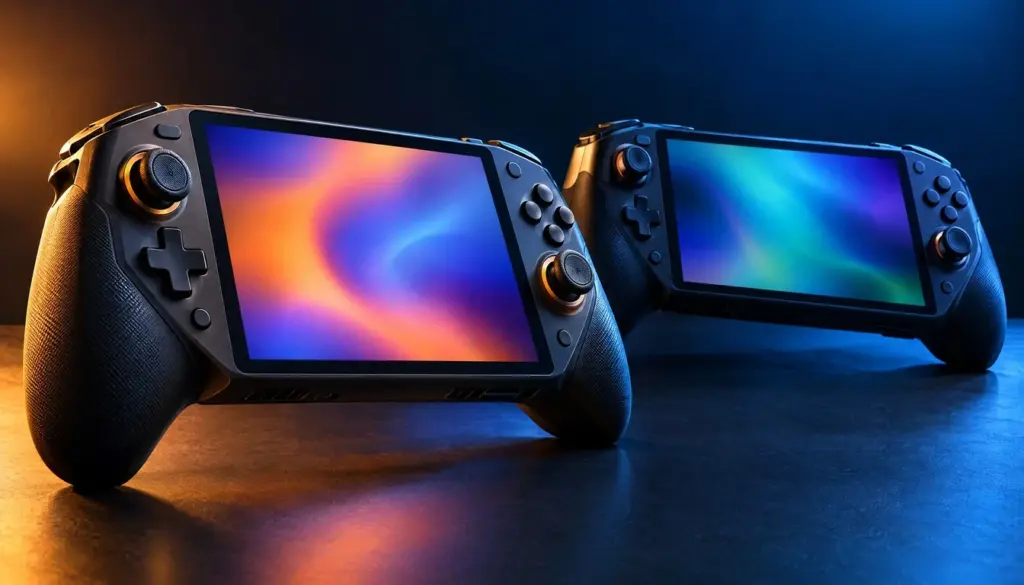
Intel is making its first real run at the gaming handheld market, and it is doing so with a number that is already drawing skepticism from hardware reviewers: a claimed 42% average performance advantage over AMD’s Ryzen Z2 Extreme chip, the silicon that powers most of the Windows handheld gaming PCs sold in 2026. The claim comes from Intel’s own 36-game test suite behind the Arc G-Series, the company’s new handheld-specific graphics brand, and it arrives embedded in products that are already shipping: MSI’s Claw 8 EX AI+ and Acer’s newly unveiled Predator Atlas 7.
For the past four years, AMD has effectively owned the x86 handheld gaming PC category. The Steam Deck, the ROG Ally and Ally X, the Lenovo Legion Go, and most of the MSI Claw lineup all shipped with AMD’s Ryzen Z-series APUs. Intel’s attempt to break that run, backed by aggressive upscaling claims and an “Endurance” battery mode that reportedly stretches some titles past 11 hours, is the most direct challenge AMD’s handheld business has faced since the category exploded in 2022. Whether the 42% figure survives contact with independent reviewers is a separate question, and one this piece digs into.

Don't miss new tech stories on Google
Add Shattered once in the Google app and our stories show up in your news suggestions.
What Is the Intel Arc G-Series for Handheld Gaming
Intel’s product page for the chip line is explicit about its target: it is branded “Arc G-Series Processors for Handheld Gaming,” a category Intel has not previously sold into with a dedicated product name, according to Intel’s own Arc G-Series handheld product page, which was last updated on October 3, 2026. The line sits alongside Intel’s existing Core Ultra mobile processors but pairs them with Arc graphics tuned for the thermal and battery constraints of a device you hold in two hands rather than plug into a wall.
The lineup spans at least two tiers so far. The base Arc G3 shows up in the standard MSI Claw 8 EX AI+ configuration, while a higher Arc G3 Extreme variant is positioned as the performance flagship. Intel’s benchmark materials, explained in detail by hardware outlet BTTR’s breakdown of the Arc G3 handheld chip, describe the underlying test methodology as a geometric mean across 36 games, run at 1080p on High settings, at a sustained 35-watt power limit, with 2x upscaling enabled wherever the game supports it. That is a specific, repeatable methodology, more rigorous than most vendor marketing decks, even if the headline comparisons still favor Intel’s own hardware by design.
Critically, Intel’s own published comparison was tested in May 2026, months before the October page refresh. That gap matters for anyone reading the current marketing page and assuming the numbers reflect October’s shipping drivers. Intel has also reported a more modest, driver-specific gain: up to 10% higher gaming performance on the Arc 140V configuration (the chip inside the original MSI Claw 8 AI+) after graphics driver version 32.0.101.6734, a reminder that a meaningful chunk of “new” handheld performance comes from software tuning rather than new silicon.
MSI Claw 8 EX AI+: Pricing and Specs Breakdown
MSI is Intel’s primary design-win partner for this push, and the company has three handheld SKUs on the market at once: the original Claw 8 AI+ (Arc 140V graphics, Core Ultra 7 258V, 32GB of LPDDR5X-8533 memory), the newer Claw 8 EX AI+ with base Arc G3 graphics, and the Claw 8 EX AI+ Extreme with the Arc G3 Extreme chip. MSI has priced the Arc G3 version of the Claw 8 EX AI+ at $1,499 for preorder, roughly $300 below the Arc G3 Extreme configuration, giving buyers a real choice between a value tier and a performance tier for the first time in the Claw lineup.
That $300 spread is itself a useful signal. It tells you Intel’s G3 Extreme silicon carries a real cost premium over the base G3 part, not just a marketing tier, and it puts the top Claw configuration in the same price neighborhood as high-end AMD-based handhelds like the GPD WIN 5, which ships with an AMD Ryzen AI Max+ 388 chip and a full Radeon 8060S GPU for $1,722 in its top configuration. For the first time since the Steam Deck popularized the category, a buyer shopping at the $1,500 to $1,800 price point is choosing between two different graphics architectures rather than just picking a case shape.
| Handheld | Graphics Silicon | CPU | Memory | Price (USD) |
|---|---|---|---|---|
| MSI Claw 8 AI+ (original) | Intel Arc 140V | Core Ultra 7 258V | 32GB LPDDR5X-8533 | Not newly disclosed |
| MSI Claw 8 EX AI+ (base) | Intel Arc G3 | Panther Lake-class Core Ultra | Not disclosed | $1,499 (preorder) |
| MSI Claw 8 EX AI+ Extreme | Intel Arc G3 Extreme | Panther Lake-class Core Ultra | Not disclosed | ~$1,799 (est. from $300 premium) |
| GPD WIN 5 (top config) | AMD Radeon 8060S | Ryzen AI Max+ 388 | Not disclosed | $1,722 |
| Acer Predator Atlas 7 | Intel Arc G-Series | Not disclosed | Not disclosed | Pricing TBA (Q4 2026 NA ship) |
Battery capacity, exact compute unit counts, and TOPS figures for the Claw 8 EX AI+ have not been independently confirmed in any of the specification sheets reviewed for this piece, and this article will not guess at numbers Intel and MSI have not published. That gap in public documentation is itself worth flagging: Intel’s marketing has led with frame-rate claims while leaving basic spec-sheet details, the kind buyers compare before purchase, unusually sparse for a shipping product.
Acer Predator Atlas 7: Intel’s Second Design Win
MSI is not alone. Acer introduced the Predator Atlas 7 at IFA 2026 as a smaller handheld built around Intel Arc G-Series graphics, confirmed by Philippines-focused outlet TechBeatph’s coverage of the Acer Predator Atlas 7 launch. The device pairs a 7-inch Full HD touchscreen running at 120Hz with 500-nit peak brightness and variable refresh rate support, specs that put it in the same display tier as AMD-based competitors like the ROG Ally X.
The headline spec is the battery: Acer is fitting the Atlas 7 with up to an 80Wh cell, unusually large for a 7-inch handheld and a figure that, if it holds up in independent testing, would outpace most AMD-based rivals on raw capacity alone. Acer has set North American availability for the fourth quarter of 2026, with EMEA markets following in November 2026. Pricing had not been announced as of the most recent coverage, which makes direct cost comparisons against the MSI lineup premature, but the timing puts Atlas 7 units in buyers’ hands within the same holiday shopping window as the Claw 8 EX AI+ Extreme.
Two OEMs committing to the same new graphics architecture inside a single quarter is a meaningfully different signal than one vendor experimenting. It suggests Intel secured more than a single favor from MSI, and that the Arc G-Series roadmap has enough supply and driver maturity behind it that a second major laptop and handheld brand was willing to design a flagship product around it rather than treat it as a side SKU.
Intel’s Benchmark Claims: 42% Faster Than AMD Ryzen Z2 Extreme
The number driving most of the current coverage is Intel’s claimed 42% average advantage for the Arc G3 Extreme over AMD’s Ryzen Z2 Extreme, the chip found in the ROG Ally X and several Legion Go configurations. That figure comes from Intel’s own internal testing, not an independent lab, and it should be read with that caveat attached every time it appears in a headline, including this one.
The most widely cited example is a Cyberpunk 2077 comparison: Intel’s materials show the Arc G3 Extreme reaching 199 frames per second with XeSS 3 Multi-Frame Generation enabled, against 89 frames per second for the competing AMD chip using its own frame-generation technology. Intel’s same comparison set shows 121fps with XeSS 2 Frame Generation and 73fps with XeSS Super Resolution alone, numbers that illustrate how much of the final headline figure comes from generated frames rather than the GPU rendering more of the scene natively.
| Upscaling Mode | Claimed Result | What It Measures |
|---|---|---|
| XeSS Super Resolution only | 73 fps | Closest to native-equivalent rendering |
| XeSS 2 Frame Generation | 121 fps | Resolution upscaling plus one generated frame per rendered frame |
| XeSS 3 Multi-Frame Generation | 199 fps | Resolution upscaling plus multiple generated frames per rendered frame |
| AMD Ryzen Z2 Extreme (rival chip, own frame-gen tech) | 89 fps | Intel’s comparison baseline; AMD’s own upscaling enabled |
That distinction is not a technicality. Frame generation inserts interpolated frames between rendered ones to boost the on-screen frame counter without a proportional increase in actual game logic processing or input responsiveness. A 199fps figure built substantially on generated frames is not directly comparable to a native 89fps render, even though both numbers will show up on a frame counter overlay. Reviewers who have covered the handheld space for years, including the team behind Tom’s Hardware’s ongoing handheld gaming coverage, have repeatedly warned that vendor-selected frame-gen comparisons tend to overstate real-world gains compared to side-by-side native testing.
None of this means Intel’s silicon is slow. The underlying 73fps Super Resolution figure, if it holds in independent Cyberpunk 2077 testing at the same settings, would already represent a strong result for a 35-watt handheld chip. It simply means the 42% topline number is a marketing composite built from Intel’s most favorable settings, run on Intel’s own test bench, and it has not yet been reproduced by a reviewer running the Claw 8 EX AI+ Extreme against a ROG Ally X side by side under identical conditions.
The Upscaling Arms Race: XeSS 3 vs AMD FSR 4
Intel’s push into handhelds is arriving at the exact moment AMD is trying to close its own upscaling gap. AMD senior vice president Jack Huynh has said FSR 4 support will expand to additional APUs, gaming laptops, and handheld gaming PCs by the end of 2026, according to reporting aggregated by Ground News’s coverage of AMD’s FSR 4 handheld rollout. That is a meaningful admission: FSR 4, AMD’s machine-learning-based upscaler that debuted on RDNA 4 desktop cards, has not yet reached most handheld silicon, which still relies on the older FSR 3.1.
The same reporting notes that existing RDNA 2 handheld hardware, the architecture inside the original Steam Deck and early Ally models, may not receive FSR 4 support until 2027 at the earliest. That creates an awkward two-tier situation for AMD: its newest Ryzen AI Max and upcoming Z3-class chips will get modern upscaling quickly, while millions of RDNA 2-era handhelds already in circulation wait another year or more. Intel, by contrast, is launching its handheld push with XeSS 3 already built in from day one, giving it a clean, unified upscaling story across its entire current handheld lineup rather than a staggered rollout.
This is the real competitive battle underneath the headline frame-rate numbers. Both companies know that raw rasterization gains are getting harder to extract from power-limited handheld silicon, so both are racing to make AI-generated frames carry more of the visible performance story. Whoever has the more mature, widely deployed upscaler earns an advantage in every benchmark chart for the next two years, regardless of the underlying GPU’s native throughput.
Battery Life and Endurance Mode: Trading Frames for Hours
Intel is not only competing on frame rate. The company has also published results from what it calls an Endurance mode, a capped-frame-rate, aggressive power-management configuration built into the Claw 8 EX AI+. In that mode, Team Fortress 2 reportedly ran for nearly 12 hours on a single charge. Forza Horizon 6 lasted 5 hours and 51 minutes in the endurance configuration, compared with just 2 hours and 47 minutes at full, uncapped power on the same hardware.
That more than doubling of battery life between full power and endurance mode is a software and power-curve achievement as much as a hardware one. It suggests Intel is betting that a meaningful slice of handheld buyers would rather play a lighter title for half a workday than chase maximum frame rates in a demanding game for under three hours, a trade-off that mirrors how Valve originally positioned the Steam Deck’s own frame-rate caps back in 2022. If Intel can make that trade-off nearly seamless through software toggles rather than manual settings tweaking, it becomes a genuine differentiator rather than just a marketing bullet point.
Why This Matters: AMD’s Near-Monopoly on Handheld Gaming PCs
To understand why a single chip comparison is generating this much attention, it helps to look at how total AMD’s grip on this category has been. Every mainstream Windows gaming handheld released since the Steam Deck’s February 2022 debut, the original ROG Ally, the ROG Ally X, the Lenovo Legion Go and Legion Go S, and every MSI Claw model before the AI+ generation, shipped with an AMD Ryzen Z-series or custom APU. Valve’s own Steam Deck uses a custom AMD chip. Even devices marketed as competitors to each other were, under the hood, competing variations on the same AMD silicon family.
That consolidation happened for understandable reasons. AMD’s combination of x86 compatibility, competitive integrated graphics, and willingness to supply semi-custom silicon to OEMs at handheld-friendly power budgets made it the only realistic option for several product generations. Intel’s integrated graphics lagged for years, and Qualcomm’s ARM-based chips, while power-efficient, cannot run the massive existing library of x86 Windows games natively without emulation overhead.
Intel’s Arc G-Series push is the first time since the category’s creation that a second x86 vendor has shipped flagship-tier handheld silicon with multiple OEM design wins in the same year. Whether or not the 42% claim survives independent scrutiny, the mere existence of real buying choice at the top of the handheld market, backed by two different OEMs and two different upscaling ecosystems, is the more durable story for the category’s long-term health.
Historical Context: Intel Arc’s Road From Alchemist to Handhelds
Intel’s credibility in gaming graphics has not been a straight line. The first Arc Alchemist desktop cards launched in 2022 to a rocky reception, plagued by immature drivers, inconsistent frame pacing, and weak performance in older DirectX 9 and 11 titles that make up a huge share of the PC gaming library. It took roughly two years of driver updates before Arc desktop cards became a genuinely recommendable budget option for most reviewers.
The second-generation Battlemage architecture, which arrived in the Arc B-series desktop cards in late 2024, marked a clear inflection point. Driver stability improved substantially, performance-per-dollar became competitive at the budget end of the market, and Intel began shipping Arc graphics inside laptop chips, the Core Ultra “Lunar Lake” and later “Panther Lake” generations, with enough consistency that OEMs started trusting the silicon for premium thin-and-light laptops rather than just budget machines.
The jump into handhelds is the natural next step in that trajectory, but it is also the highest-stakes one yet. A buggy driver on a desktop card is annoying; a buggy driver on a $1,500 handheld that a buyer is already comparing against a well-established AMD alternative is the kind of first impression that can poison a product category for years. Intel appears to understand the stakes, which may explain why its public marketing has leaned so heavily on favorable frame-generation comparisons rather than letting independent reviewers set the first narrative.
AMD’s Response: Ryzen Z3 and RDNA 4 Compute Units
AMD is not standing still. Leaked details point to a next-generation Ryzen Z3 handheld chip series built around 4 performance cores plus 2 efficiency cores and 12 RDNA 4 compute units, a meaningful architectural jump from the RDNA 3-based graphics in the current Ryzen Z2 Extreme. Pairing that with the promised FSR 4 rollout across handheld-class silicon by the end of 2026 would give AMD an answer to both halves of Intel’s pitch, raw rendering throughput and modern AI upscaling, within roughly the same calendar window Intel is using to establish its own footprint.
The timing suggests AMD was not blindsided by Intel’s entry so much as it is racing to make sure its next-generation silicon ships before Intel’s Arc G-Series accumulates enough design wins to become the new default recommendation. Handheld buying cycles run roughly 18 to 24 months per flagship generation, so the next six months of design-win announcements, not just benchmark charts, will likely decide which company shapes the category’s next cycle.
Competitive Landscape: How the Full Handheld Field Stacks Up
Beyond the Intel-versus-AMD framing, the broader handheld field now spans at least three distinct silicon strategies. AMD remains the volume leader with the Ryzen Z2 Extreme across the ROG Ally X and Legion Go lineup, and the upcoming Z3 generation is squarely aimed at defending that position. Intel’s Arc G-Series is the new challenger, currently limited to MSI’s Claw 8 EX AI+ family and Acer’s incoming Predator Atlas 7, but with real OEM commitment behind it rather than a one-off reference design.
A third tier sits below both, built on ARM-based or budget x86 silicon. Devices tracked by sites like VideoCardz’s gaming handheld coverage show a steady stream of sub-$300 devices, including retro-focused handhelds and Linux-first dual-screen designs, that compete on price and portability rather than raw frame rate. The GPD WIN 5’s $1,722 configuration occupies an interesting middle ground: it uses AMD’s higher-end Ryzen AI Max+ 388 and Radeon 8060S combination, a chip more commonly associated with compact AI workstations than gaming handhelds, which puts it closer to the Claw 8 EX AI+ Extreme in price than to AMD’s own Z-series handheld lineup.
That price convergence at the $1,500 to $1,800 tier is worth watching. It suggests the handheld market’s premium segment is settling into a predictable band regardless of which silicon vendor supplies the chip, which means the real competitive differentiation for 2027 buyers will come down to driver maturity, upscaling quality, and battery behavior, exactly the dimensions where Intel’s claims are least independently verified right now.
Market Impact: What This Means for Handheld PC Prices
Competition at the chip level tends to show up in buyer-facing prices within one to two product cycles, and there are early signs of that dynamic already. MSI’s decision to offer a $300 price spread between its base and Extreme Arc configurations, rather than a single flagship SKU, gives budget-conscious buyers a lower entry point than most AMD-based flagships currently offer at the top end. If Acer’s Predator Atlas 7 lands with aggressive pricing when it reaches North America in the fourth quarter of 2026, that would mark two OEMs using Intel silicon specifically to undercut AMD’s top-tier handheld pricing, rather than simply matching it.
There is a supply-chain angle here too. Intel has spare fabrication and packaging capacity it has been eager to fill as its foundry business works to attract external customers, and a successful handheld push gives Intel’s own Arc silicon a higher-margin outlet beyond thin-and-light laptops. AMD, by contrast, has spent recent quarters prioritizing data center and AI accelerator capacity, which could leave less manufacturing headroom for AMD to flood the handheld market with Z3 chips the moment Intel’s momentum builds. If that supply gap opens up even briefly, it would hand Intel a window to lock in additional OEM design wins before AMD’s answer ships in volume.
What Independent Reviewers Are Watching For
The gap between Intel’s marketing claims and what independent testing confirms is the single biggest open question hanging over this launch. Outlets that maintain ongoing handheld benchmark databases, including HandheldAtlas’s handheld gaming benchmark tracker, are the kind of resource that will ultimately settle whether the Arc G3 Extreme’s 42% claim holds up once reviewers run identical game builds, identical driver versions, and identical power limits across both the Claw 8 EX AI+ Extreme and a ROG Ally X side by side.
Three specific gaps stand out. First, native rasterization performance without any upscaling or frame generation enabled, the number least flattering to Intel’s current marketing and the most useful for apples-to-apples comparison. Second, real-world battery testing outside Intel’s curated Endurance-mode demos, since capped frame rates can be tuned to make almost any chip look efficient in a vendor-selected test. Third, driver stability across the actual back catalog of Windows PC games that handheld buyers care about, not just the curated 36-title suite Intel used for its own comparison, since Arc’s history of inconsistent older-title performance is the most direct reason skepticism toward these numbers is justified in the first place.
Predictions: Where the Handheld GPU Race Goes From Here
- Independent reviewers will publish head-to-head Claw 8 EX AI+ Extreme versus ROG Ally X benchmarks within weeks of broader retail availability, and the native-rendering gap will almost certainly be narrower than Intel’s 42% frame-gen-inclusive figure.
- AMD will accelerate its Ryzen Z3 and FSR 4 handheld rollout timeline into early 2027 rather than risk ceding an entire holiday shopping cycle to Intel’s new OEM partners.
- At least one additional major handheld OEM, beyond MSI and Acer, will announce an Intel Arc G-Series design win by the first half of 2027, following the pattern of MSI and Acer committing within the same quarter.
- Pricing pressure at the $1,500-to-$1,800 premium tier will intensify, with at least one vendor cutting list prices or bundling extras within six months of launch as Intel and AMD compete directly for the same shelf space.
- Marketing benchmarks leaning on multi-frame generation, from both Intel and AMD, will keep climbing in headline numbers even as reviewer skepticism toward frame-gen-inclusive comparisons grows across the hardware press.
The Bottom Line for Handheld Buyers
Intel’s entry into gaming handhelds is real, backed by shipping products and more than one OEM, which separates it from years of speculative rumors about Intel eventually competing in this space. But the specific number generating headlines, a 42% average advantage over AMD’s Ryzen Z2 Extreme, is a vendor-selected, frame-generation-heavy comparison that has not yet been reproduced independently. Buyers shopping in the $1,500-to-$1,800 handheld tier right now are choosing between a well-established AMD ecosystem with years of driver maturity and a new Intel ecosystem with aggressive pricing, a unified upscaling story from day one, and a genuinely larger battery option in the Predator Atlas 7’s 80Wh cell, but also a company whose graphics division is still rebuilding trust after a rough desktop GPU debut in 2022.
The honest advice for anyone shopping this holiday season is to wait for independent native-performance benchmarks before trusting either company’s own slides, and to weigh battery behavior and driver stability as heavily as peak frame rate, since those are the two areas where Intel’s handheld track record is thinnest and AMD’s is deepest.
Frequently Asked Questions
Is the Intel Arc G3 Extreme actually 42% faster than AMD’s Ryzen Z2 Extreme?
That is Intel’s own claimed average across a 36-game test suite, not an independently verified result. The headline example, 199fps versus 89fps in Cyberpunk 2077, relies heavily on Intel’s XeSS 3 Multi-Frame Generation, which inserts AI-generated frames rather than rendering every frame natively. Independent reviewers have not yet published matching side-by-side tests.
Which handhelds currently use Intel Arc G-Series graphics?
MSI’s Claw 8 EX AI+ family (available with base Arc G3 or Arc G3 Extreme graphics) and Acer’s newly announced Predator Atlas 7 are the two confirmed design wins as of October 2026. The earlier MSI Claw 8 AI+ uses the older Arc 140V integrated graphics rather than the new G-Series branding.
How much does the MSI Claw 8 EX AI+ cost?
The base Arc G3 configuration is listed for preorder at $1,499. The Arc G3 Extreme configuration costs roughly $300 more. Exact battery capacity, compute unit counts, and TOPS figures for either configuration have not been publicly disclosed.
When is the Acer Predator Atlas 7 coming out, and how much will it cost?
Acer has set North American availability for the fourth quarter of 2026, with EMEA markets following in November 2026. Pricing has not yet been announced.
Does AMD have an answer to Intel’s handheld push?
Leaked specifications point to a next-generation Ryzen Z3 handheld chip with 4 performance cores, 2 efficiency cores, and 12 RDNA 4 compute units. AMD has also said FSR 4 upscaling support will expand to additional handheld gaming PCs by the end of 2026, though older RDNA 2-based handhelds may not get FSR 4 until 2027.
What is Intel’s handheld Endurance mode?
It is a capped-frame-rate, aggressive power-management profile built into the Claw 8 EX AI+. Intel’s own figures show Team Fortress 2 running for nearly 12 hours in Endurance mode, and Forza Horizon 6 lasting 5 hours and 51 minutes, compared with 2 hours and 47 minutes at full, uncapped power.
Is XeSS 3 better than AMD’s FSR 4?
Both are AI-based upscaling and frame-generation technologies, and neither has been directly, independently compared on identical handheld hardware yet. XeSS 3 is already shipping across Intel’s current Arc G-Series handheld lineup, while FSR 4 is only beginning its rollout to handheld-class AMD silicon, with full coverage not expected until the end of 2026 at the earliest.
Should I buy an Intel Arc handheld or wait for AMD’s Ryzen Z3?
If driver maturity and a large existing game-compatibility track record matter most, AMD’s current Ryzen Z2 Extreme handhelds remain the safer bet today. If a lower entry price, a unified upscaling story, and a larger battery option appeal more, Intel’s Arc G-Series handhelds are shipping now, but buyers should wait for independent native-performance reviews before treating Intel’s 42% claim as a purchasing decision.