
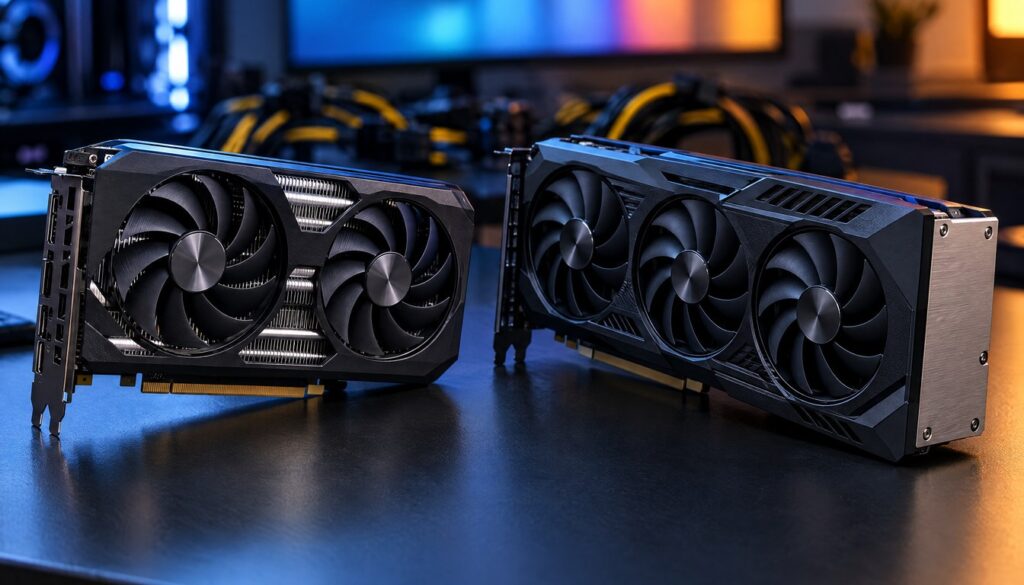
The GPU market flipped a script nobody expected in October 2026. AMD’s Radeon RX 9070 XT keeps winning head-to-head benchmark tests against Nvidia’s GeForce RTX 5070, yet the RTX 5070 just became the single most popular graphics card on Steam, climbing from 3.77% to 6.15% of surveyed systems in one month. Shoppers are picking the slower card in raw performance terms, and the reasons behind that split say a lot about where the GPU market actually stands right now. Street prices have drifted far from launch MSRPs, AMD shipped a new ROCm 10.1 driver mid-month to chase Nvidia’s AI workload lead, and Nvidia’s own flagship, the RTX 5090, is functionally unavailable near its list price.
RTX 5070 vs RX 9070 XT at a Glance
Both cards sit in the same roughly $550 to $600 launch bracket, and both target 1440p gaming with some ambition toward 4K. The RTX 5070 vs RX 9070 XT debate boils down to a tradeoff familiar to anyone who has shopped these two brands before: Nvidia sells software features and AI throughput, AMD sells raw frame rate and VRAM headroom for the same money. In October 2026 that tradeoff got sharper. AMD’s RX 9070 XT carries a $599 MSRP against the RTX 5070’s $549, a $50 gap, but independent testing from PCWorld, Gamers Nexus, and PCGuide all found the AMD card pulling ahead in rasterized performance by double digits in most titles. Meanwhile Nvidia’s DLSS 4 multi-frame generation and its CUDA ecosystem keep pulling buyers toward the green team regardless.
Neither card is the newest thing Nvidia or AMD has shipped this generation. The RTX 5070 Ti sits above the RTX 5070 at a $750 launch price, and the RTX 5090 sits at the very top, though it has been nearly impossible to buy near its $1,999 MSRP for most of 2026. On the AMD side, the plain Radeon RX 9070 (without the XT suffix) undercuts both AMD and Nvidia on price while reportedly beating the RTX 5070 outright in several benchmarks, based on PCWorld’s test results. That makes the RTX 5070 vs RX 9070 XT comparison really a proxy for a wider question: in a GPU market where prices keep climbing well past launch numbers, which brand gives you more card for the money you will actually have to pay.
Full Specs Comparison: Architecture, Cores, and Clocks
On paper, AMD’s RDNA 4-based RX 9070 XT and Nvidia’s Blackwell-based RTX 5070 look evenly matched at first glance, but the details diverge once you get past the headline clock speeds. AMD leans on more compute units and a higher boost clock, while Nvidia leans on a narrower but more AI-accelerator-dense design, reflected in the RTX 5070’s much higher peak TOPS figure for machine learning workloads. The table below lays out the published specs for both cards side by side.
| Specification | AMD Radeon RX 9070 XT | Nvidia GeForce RTX 5070 |
|---|---|---|
| Architecture | RDNA 4 | Blackwell |
| Compute units / streaming multiprocessors | 64 | 48 (6,144 CUDA cores) |
| RT accelerators | 64 | 48 |
| AI accelerators | 128 | 192 |
| Peak AI throughput | 1,557 TOPS | 988 TOPS |
| Boost clock | 2.97 GHz | 2.5 GHz |
| Memory | 16GB GDDR6 | 12GB GDDR7 |
| Typical board power (TDP) | 304W | 250W |
| Bus interface | PCIe 5.0 x16 | PCIe 5.0 x16 |
| Display outputs | DisplayPort 2.1a, HDMI 2.1b | DisplayPort 2.1b, HDMI 2.1b |
| Launch MSRP | $599 | $549 |
| Street price, October 2026 | Rising, but closer to MSRP than Nvidia’s card | Elevated over MSRP, per retailer listings |
That peak AI throughput gap matters more than it looks on a spec sheet. Nvidia’s 192 AI accelerators generate 988 TOPS against AMD’s 128 accelerators and 1,557 TOPS figure, a reminder that raw TOPS counts and accelerator counts do not move in lockstep across architectures, since clock speed, precision mode, and accelerator design all factor into the final number. The real-world effect shows up later in this comparison when we get to AI and content creation workloads, where Nvidia’s CUDA software stack still carries more weight than either card’s raw TOPS rating.
Pricing in October 2026: MSRP vs Street Reality
Launch MSRP has become close to meaningless for this GPU generation. Component shortages, tariffs on certain import categories, and a surge in AI buyers competing for the same silicon have pushed street prices well above what either company originally advertised. According to TechTimes reporting published October 12, 2026, “AMD Radeon Loses Its Last Affordability Buffer” describes a market where even AMD’s traditionally cheaper lineup has started losing ground on price, while Nvidia’s RTX 5070 has also drifted up in price at retail, though the report does not give a specific dollar figure for the card.
The pricing picture gets more extreme at the top of Nvidia’s stack. The RTX 5090 launched at $1,999 but has reportedly traded hands for $6,500 to $9,500 in 2026, according to the same TechTimes report, as AI buyers snap up available units for local inference work rather than gaming. That scarcity has pushed a lot of shoppers who would normally stretch for a flagship card down into the RTX 5070 and RX 9070 XT price bracket instead, which is part of why this particular matchup has become so searched this month.
| Card | Launch MSRP | October 2026 Street Price | Notes |
|---|---|---|---|
| Nvidia RTX 5090 | $1,999 | $6,500 – $9,500 | Severely supply-constrained, per TechTimes |
| Nvidia RTX 5070 Ti | $750 | Elevated, premium over RX 9070 XT holds | 3-6% faster than RX 9070 XT for 25% more money, per PCWorld |
| Nvidia RTX 5070 | Elevated over MSRP | Most popular GPU on Steam despite the price jump | |
| Nvidia RTX 5060 Ti (8GB) | Near original MSRP | Near original MSRP | One of the most consistently available Nvidia cards |
| Nvidia RTX 5060 (8GB) | Near original MSRP | Near original MSRP | Second most popular GPU on Steam at 4.40% |
| AMD RX 9070 XT | $599 | Climbing, but affordability edge narrowing | 16GB VRAM, wins most rasterized benchmarks |
| AMD RX 9070 | Below RX 9070 XT | Below RX 9070 XT | Reportedly beats RTX 5070 outright per PCWorld |
| AMD RX 7700 XT (prior gen) | $449 | $449 reference | 3,322 Steel Nomad score, per UL Benchmarks |
| Nvidia RTX 4060 Ti 8GB (prior gen) | $399 | $399 reference | 2,907 Steel Nomad score, per UL Benchmarks |
The takeaway from the pricing table is not subtle. If you can find an RX 9070 XT anywhere close to its $599 MSRP, it is objectively the better dollar-for-performance buy against an RTX 5070 selling for $850 at retail. The problem, and this is where AMD’s “affordability buffer” language from TechTimes becomes relevant, is that finding either card at MSRP has gotten harder as 2026 has worn on.
Gaming Benchmarks: Who Wins at 1440p and 4K
Three independent outlets tested these cards against each other this generation, and all three landed on the same broad conclusion even though their exact numbers differ by test suite and settings. AMD’s RX 9070 XT wins more often than it loses in pure rasterized frame rate, and the margin ranges from single digits to high teens depending on the game.
PCWorld’s Full-Suite Numbers
PCWorld ran both cards across its full game test suite and published a clear average. Michael Kan, who reviewed the cards for PCWorld, wrote that “Across our suite, the Radeon 9070 XT runs 15 percent faster than the RTX 5070 on average, and 7 percent faster than the vanilla Radeon 9070.” That 15% average gap is the single most quoted number in this entire comparison, and it lines up with what the other two outlets found independently.
PCWorld’s testing also flagged where Nvidia’s higher-tier card fits into the picture. The RTX 5070 Ti, priced $150 above the RX 9070 XT at $750, delivers only 3 to 6 percent more performance for a 25 percent price jump, a value proposition PCWorld called weak unless a buyer specifically wants DLSS 4 or stronger AI and content creation tools.
Gamers Nexus 4K Rasterization Breakdown
Gamers Nexus ran its own 4K-focused pass and found a wider, game-dependent spread. Steve Burke, editor-in-chief at Gamers Nexus, summarized the result plainly: “As for the RTX 5070, it’s not looking good for NVIDIA’s card you shouldn’t buy: At 4K and rasterized, the 9070 leads the 5070 by 0% to 18%, depending on game.” Note that Burke’s comment there references the plain RX 9070, not the XT variant, which underscores just how competitive AMD’s entire 9000-series stack has become against Nvidia’s equivalent price tier.
PCGuide’s own testing matched the overall direction. Technology writer Edgardo D. C. Cruz concluded that “The short answer is that the RX 9070 XT wins out in most gaming scenarios, making it definitely worth the additional $50 asking price, though it still lags behind the Nvidia cards when you factor in the latest DLSS 4 multi-frame generation performance gains,” a line from his PCGuide comparison that captures the nuance most reviewers landed on this cycle. Cruz went further on native rendering specifically, writing that “it is clear that the RTX 5070 can’t compete with the RX 9070 XT head-on as it lacks the raw power to deliver similar native results,” a point that applies when frame generation and upscaling features are turned off on both sides.
| Source | Test Scope | Result |
|---|---|---|
| PCWorld (Michael Kan) | Full game suite, average rasterized FPS | RX 9070 XT 15% faster than RTX 5070 on average |
| Gamers Nexus (Steve Burke) | 4K rasterized, per-game spread | AMD 9070-series leads RTX 5070 by 0% to 18%, game dependent |
| PCGuide (Edgardo D. C. Cruz) | Native rendering without upscaling or frame generation | RTX 5070 cannot match RX 9070 XT’s raw native performance |
| UL Benchmarks (Steel Nomad, budget tier) | Synthetic 3DMark score, prior-gen reference cards | RX 7700 XT scores 3,322 vs RTX 4060 Ti 8GB’s 2,907 |
Put all four sources side by side and the pattern holds across every single one of them. AMD’s current-generation cards consistently out-rasterize their Nvidia equivalents at the same or a lower price point, a trend that also shows up a tier down, where UL Benchmarks’ October 2026 database has the older RX 7700 XT beating the older RTX 4060 Ti 8GB on its Steel Nomad synthetic test despite a $50 higher MSRP. That is not a one-generation fluke. It is a pattern that has held across multiple AMD and Nvidia product cycles now.
Ray Tracing and Upscaling: DLSS 4 vs FSR 4 and Hypr-RX
Rasterized frame rate is only half the story in 2026. Ray tracing and AI upscaling now decide whether a card feels fast in the games that matter most to a given buyer, and this is where Nvidia’s advantage has traditionally been largest. That gap narrowed considerably with the RX 9000 series. PCWorld’s review noted that ray tracing, long described as an AMD weakness, “improved dramatically” on the new Radeon cards, closing a performance gap that used to be a clear and easy reason to pick Nvidia almost automatically.
AMD’s AI accelerators now also power FSR 4, a genuine AI-upscaling technology rather than the older hand-tuned FSR versions, and a feature called Hypr-RX that can boost frame rates across what PCWorld described as thousands of supported games, albeit with some visual compromises in certain titles. The catch, and PCWorld was specific about this in its review, is that FSR 4 support has been inconsistent and occasionally frustrating to enable depending on the game and driver version in use.
Nvidia’s counter is DLSS 4 with multi-frame generation, which PCGuide’s Cruz flagged as the one area where the RTX 5070 still pulls ahead of the RX 9070 XT in overall experienced frame rate, even while losing on raw native rendering power. DLSS 4’s multi-frame generation can insert several AI-generated frames between each rendered frame in supported titles, which can make a slower native GPU feel faster in practice than its rasterization numbers alone would suggest. Whether that tradeoff matters to a given buyer depends heavily on whether their favorite games actually support DLSS 4, since the feature is not universal across every release.
VRAM and 4K Headroom: Why 16GB Matters
The RX 9070 XT ships with 16GB of GDDR6 memory. The RTX 5070 ships with 12GB of faster GDDR7. That 4GB gap, roughly 33% more total VRAM on the AMD card, has become one of the most cited reasons reviewers recommend the Radeon card for anyone planning to game at 4K resolution or run texture-heavy modded games for more than a year or two. PCWorld specifically called out the RX 9000 series’ “16GB of memory and 256-bit bus” as being built for 4K gaming and the kind of strenuous modern games that keep pushing VRAM requirements upward release after release.
Memory bandwidth and raw capacity are not the same thing, and GDDR7’s higher per-pin speed does give the RTX 5070 some compensation for its smaller frame buffer. But capacity tends to matter more than bandwidth once a game’s texture and asset data simply does not fit in the available memory pool, at which point frame rate collapses regardless of how fast the remaining memory bandwidth is. For buyers planning to keep a card for three or more years, which covers most people who are not constantly upgrading, 12GB looks increasingly tight as 2026-era games and their texture packs grow larger.
Power Draw, Heat, and Efficiency
Performance per watt tells a different story than raw performance alone. The RX 9070 XT draws up to 304W of typical board power against the RTX 5070’s 250W, a 54W gap that shows up directly on your electricity bill and in how much case airflow you need to keep temperatures in check. A reviewer on a benchmark-focused YouTube channel summed up the tradeoff concisely in a side-by-side test: in raw performance, the 9070 XT comes out ahead, but it consumes more power to get there.
That efficiency gap is not surprising given the architectural differences covered earlier. AMD’s RDNA 4 design uses more compute units running at a higher boost clock to hit its performance numbers, which is a more power-hungry way to get there than Nvidia’s narrower but more specialized Blackwell design. For small form factor builds, laptops are a separate conversation entirely since neither of these specific desktop chips ships in mobile form, but for a standard desktop tower the 54W gap is manageable with a decent case fan setup and a power supply rated with reasonable headroom above either card’s rated draw.
AI and Content Creation Workloads: CUDA vs ROCm 10.1
This is the category where Nvidia’s lead stays largest and least contested. PCWorld’s review found the RX 9070 series “much slower than RTX 5070 in AI text generation and Premiere Pro,” a gap that comes down to software maturity as much as raw silicon. Nvidia’s CUDA ecosystem has a decade-plus head start, and most popular AI frameworks, video editing accelerations, and machine learning libraries are written and optimized against CUDA first, with AMD support arriving later if at all.
AMD is actively working to close that gap. The company shipped a dedicated ROCm 10.1 driver for both the Radeon RX 9000 and the older RX 7000 series in mid-October 2026, a move that signals AMD is treating AI and workstation compatibility as a priority rather than an afterthought for this hardware generation. Whether ROCm 10.1 meaningfully closes the practical gap for everyday users running local large language models or AI image generators remains to be seen, since driver support and library compatibility tend to lag hardware announcements by months rather than days. For now, anyone whose primary use case leans toward AI inference, fine-tuning, or professional content creation software with GPU acceleration should treat the RTX 5070’s CUDA advantage as the deciding factor over AMD’s raw gaming frame rate lead.
Steam Hardware Survey: Market Share Reality Check
Here is the number that makes this whole comparison newsworthy right now. According to the September 2026 Steam Hardware Survey reported by Digital Foundry, the RTX 5070 became the single most popular individual GPU among surveyed Windows systems, reaching 6.15% of the user base, up from 3.77% the month before, a jump of roughly 2.38 percentage points in a single reporting cycle. That is an unusually fast climb for any individual GPU model on the Steam survey, which usually moves in much smaller increments month to month.
The rest of the Nvidia lineup followed the same pattern. The RTX 5060 held second place at 4.40% share, and the RTX 5060 Ti rounded out the podium at roughly 4.06%. Collectively, Nvidia’s entire current RTX 50 series, spanning the RTX 5050 through the RTX 5090, accounted for about 18.21% of all surveyed Steam systems in September 2026. Nvidia’s overall discrete GPU market share across the whole survey, covering every generation still in active use, rose from 72.9% to approximately 76%, a 3.1 percentage point gain that came mostly at AMD and Intel’s expense.
AMD’s showing looks starkly different by comparison. No Radeon model appeared in the Steam survey’s top ten GPUs for September 2026, and the RX 9070 XT, AMD’s own highest-ranked current card, held only around 1.42% of the surveyed base, a tiny fraction of the RTX 5070’s 6.15%. That is a genuinely strange outcome given that the RX 9070 XT wins most of the benchmark comparisons covered earlier in this article. It points to brand loyalty, retailer stocking patterns, laptop OEM partnerships that skew heavily toward Nvidia, and simple name recognition carrying more weight with the average buyer than per-dollar frame rate numbers from enthusiast review sites.
The Rest of the Lineup: RTX 5090 Scarcity and Budget Options
No RTX 5070 vs RX 9070 XT comparison happens in a vacuum, since both cards sit inside much larger product stacks with their own pricing quirks. On Nvidia’s side, the RTX 5090 remains the headline problem. Functionally absent from retail at anywhere close to its $1,999 launch MSRP for most of 2026, the TechTimes report from October 12, 2026 put street prices as high as $6,500 to $9,500, driven largely by AI buyers purchasing available units for local inference rather than gaming. That scarcity has a knock-on effect: buyers who would normally save up for a flagship card are getting pushed down into the exact price bracket this article covers.
At the budget end, the picture is calmer. The RTX 5060 and RTX 5060 Ti, both in their 8GB configurations, were reported as the most consistently available Nvidia options near their original pricing as of October 2026, according to TechTimes. For buyers unwilling to spend $550 to $850 on either the RTX 5070 or RX 9070 XT, UL Benchmarks’ October 2026 comparison database offers a useful older-generation reference point: the AMD RX 7700 XT at a $449 MSRP posted a 3DMark Steel Nomad score of 3,322, outscoring the $399 RTX 4060 Ti 8GB’s 2,907 despite the $50 price premium, continuing the same AMD-wins-on-raw-performance pattern seen at every price tier this generation.
Real-World Buying Scenarios
Specs and benchmark averages only go so far. Here is how the RTX 5070 vs RX 9070 XT decision actually plays out for specific types of buyers shopping in October 2026.
- The competitive shooter player on a 1440p 240Hz monitor. Raw rasterized frame rate matters more than any upscaling feature here, since competitive titles like Valorant or Counter-Strike run light enough that native frame rate rules. The RX 9070 XT’s 15% average lead, per PCWorld’s testing, translates directly into a smoother experience at the same settings, and the $50 MSRP premium pays for itself the first week.
- The single-player story gamer chasing ray tracing visuals. This buyer benefits most from Nvidia’s DLSS 4 multi-frame generation in supported titles, since ray-traced lighting at native resolution is still demanding on both cards. The RTX 5070 can feel smoother in exactly the games where DLSS 4 is implemented well, even though it loses the native rendering race according to PCGuide’s testing.
- The content creator editing 4K footage in Premiere Pro. PCWorld’s own testing flagged the RX 9000 series as much slower than the RTX 5070 in Premiere Pro acceleration and AI text generation tasks. Anyone whose income depends on render times should stick with Nvidia’s CUDA ecosystem here regardless of the gaming benchmark gap.
- The 4K gamer running texture-heavy modded titles. The RX 9070 XT’s 16GB of VRAM, 33% more than the RTX 5070’s 12GB, becomes the deciding factor once a game’s asset pool exceeds Nvidia’s smaller frame buffer, at which point frame rate collapses regardless of GPU horsepower.
- The budget rebuild using a previous-generation card. Someone unwilling to spend $550 or more should look at the RX 7700 XT’s $449 MSRP and its 3,322 Steel Nomad score against the RTX 4060 Ti 8GB’s $399 price and 2,907 score, per UL Benchmarks’ October 2026 database, rather than stretching into current-gen pricing at all.
- The small-business buyer locally running AI models. With the RTX 5090 trading for $6,500 to $9,500 and effectively off the table, and AMD’s ROCm 10.1 driver still maturing, the RTX 5070’s CUDA compatibility remains the safer bet for anyone running local large language models or AI image generation tools on a mid-range budget.
Who Should Buy Which Card: Use-Case Recommendations
Pulling the scenarios above into direct recommendations, here is the short version for anyone deciding between these two cards in October 2026.
- Buy the RX 9070 XT if: you play mostly rasterized or lightly ray-traced games, you want the most VRAM headroom for future-proofing at 4K, and you can find the card anywhere near its $599 MSRP rather than inflated street pricing.
- Buy the RTX 5070 if: your favorite games support DLSS 4 multi-frame generation, you do any serious AI, machine learning, or Premiere Pro work, and you are willing to pay the current roughly $850 street price for that software ecosystem advantage.
- Buy the plain RX 9070 (non-XT) if: you want the best value in the entire comparison, since PCWorld’s testing found it beating the RTX 5070 outright in several benchmarks while usually selling for less than either flagship card discussed here.
- Buy the RTX 5070 Ti instead if: you specifically need the extra 3 to 6 percent performance headroom over the RX 9070 XT and have no price sensitivity, though PCWorld called this a weak value proposition given the 25% price premium for that small gain.
- Wait and buy a prior-generation card if: your budget caps out around $400 to $450, in which case the RX 7700 XT’s UL Benchmarks score beats the similarly priced RTX 4060 Ti 8GB and both are far more available than current-gen stock.
- Avoid the RTX 5090 entirely right now unless: you specifically need the AI inference throughput and have a budget north of $6,500, since gaming-only buyers get essentially no practical benefit over an RTX 5070 Ti at a fraction of the current street price.
Migrating Between Nvidia and AMD: What Changes
Switching GPU brands is not as simple as pulling one card out and dropping another in, even though the physical installation process is identical on both sides. A handful of software and configuration steps change depending on which direction you are moving.
Start by fully uninstalling your old GPU’s driver stack before installing the new one, rather than simply installing over the top of it, since leftover driver files from the opposite vendor are a common source of stuttering and crashes after a GPU swap. Most dedicated driver-cleanup utilities support a clean uninstall in safe mode. After the old driver is gone, check your monitor’s adaptive sync certification. Nvidia’s G-Sync and AMD’s FreeSync are not interchangeable on older monitors, though most displays sold since 2022 support the generic VESA Adaptive-Sync standard that both brands can use through DisplayPort or HDMI 2.1.
If you are moving from Nvidia to AMD, re-check any game-specific settings tied to DLSS, since those menus will simply disappear and need to be replaced with FSR 4 equivalents where available, keeping in mind PCWorld’s note that FSR 4 support has been inconsistent across titles. If you are running any AI or machine learning workloads, budget time to reinstall your toolchain against ROCm rather than CUDA, and verify your specific framework version actually supports ROCm 10.1 before assuming compatibility, since AMD’s AI software support still trails Nvidia’s CUDA ecosystem by PCWorld’s own testing. A simple command-line check on Linux can confirm your new card and driver are both recognized correctly before you move on to reinstalling game launchers and benchmarking tools.
# Linux: confirm the GPU and driver are detected after a swap
lspci | grep -i vga
rocm-smi --showproductname    # AMD cards running ROCm
nvidia-smi                    # Nvidia cards running the proprietary driver

# Windows PowerShell: list the active GPU and driver version
Get-WmiObject win32_VideoController | Select-Object Name, DriverVersion
Finally, sell or recycle your old card rather than letting it sit in a drawer. With RTX 5090 units trading for multiples of their MSRP due to AI demand, even older mid-range cards have held resale value better than usual this generation, which can meaningfully offset the cost of your upgrade.
Pros and Cons: RTX 5070 vs RX 9070 XT
RTX 5070 Pros and Cons
- Pro: DLSS 4 multi-frame generation gives smoother experienced frame rates in supported titles, even without leading in native rendering.
- Pro: CUDA ecosystem maturity makes it the clear choice for AI inference, machine learning, and Premiere Pro acceleration work.
- Pro: Became the single most popular GPU on Steam in September 2026, which means wider driver testing coverage and community support resources.
- Pro: Lower typical board power draw at 250W against the RX 9070 XT’s 304W.
- Con: Street price has climbed to roughly $850, a nearly $300 jump over its $549 MSRP.
- Con: Loses most rasterized and native rendering benchmarks against the RX 9070 XT, by as much as 18% in some titles per Gamers Nexus.
- Con: Only 12GB of VRAM, which could become a bottleneck in texture-heavy games within the card’s useful lifespan.
RX 9070 XT Pros and Cons
- Pro: Wins most rasterized benchmarks against the RTX 5070, averaging 15% faster across PCWorld’s test suite.
- Pro: 16GB of VRAM gives meaningfully more headroom for 4K gaming and large texture mods.
- Pro: Ray tracing performance improved dramatically this generation, closing what used to be a clear Nvidia advantage.
- Pro: Street pricing has stayed closer to its $599 MSRP than the RTX 5070 has to its own MSRP.
- Con: FSR 4 upscaling support has been inconsistent and occasionally frustrating to enable across different titles.
- Con: Much slower than the RTX 5070 in AI text generation and Premiere Pro acceleration, per PCWorld’s testing.
- Con: Higher power draw at 304W typical board power, and PCWorld noted occasional driver crashes and weak 1% low frame times in specific titles like Returnal.
- Con: Holds only about 1.42% share on the Steam Hardware Survey, far below the RTX 5070’s 6.15%, which may mean less driver optimization priority from some game studios.
Expert Verdict: Which GPU Wins in October 2026
Every independent benchmark cited in this comparison points the same direction on pure performance. The RX 9070 XT beats the RTX 5070 by an average of 15% across PCWorld’s full game suite, and by as much as 18% in specific 4K rasterized tests from Gamers Nexus. AMD’s card also carries 33% more VRAM and, as of October 2026, has held its street price closer to its original MSRP than Nvidia’s card has. On a pure price-to-performance basis, the RX 9070 XT is the better buy for anyone whose use case is primarily gaming.
Yet the market is not behaving that way. The RTX 5070 outsold or at least out-adopted the RX 9070 XT by a factor of more than four to one on Steam’s own survey data, climbing to 6.15% share against the Radeon card’s roughly 1.42%. That gap is not explained by the benchmark numbers. It is explained by DLSS 4’s pull in supported titles, by Nvidia’s deep lead in AI and content creation software, and by a decade of brand mindshare that AMD’s genuinely competitive hardware has not yet overcome. If your workload includes any serious AI or video editing work, the RTX 5070 remains the safer, if pricier, choice. If you are buying purely to play games at the best frame rate your money can buy, the data says the RX 9070 XT is the smarter purchase, provided you can actually find one near its $599 MSRP rather than paying the kind of markup currently attached to Nvidia’s lineup.
Frequently Asked Questions
Is the RX 9070 XT actually faster than the RTX 5070?
Yes, in rasterized and native rendering performance. PCWorld measured a 15% average lead for the RX 9070 XT across its test suite, and Gamers Nexus found the AMD card leading by 0% to 18% depending on the specific game tested at 4K.
Why is the RTX 5070 more popular than the RX 9070 XT if it loses most benchmarks?
The September 2026 Steam Hardware Survey showed the RTX 5070 at 6.15% share against the RX 9070 XT’s roughly 1.42%. The gap likely comes down to DLSS 4’s multi-frame generation feature, Nvidia’s stronger position in AI and content creation software, and general brand recognition rather than raw gaming frame rate.
How much VRAM do I actually need in 2026?
For 1440p gaming, 12GB is generally still adequate for most titles. For 4K gaming or heavily modded games with large texture packs, the RX 9070 XT’s 16GB offers noticeably more headroom than the RTX 5070’s 12GB, and that gap tends to matter more as a card ages.
Is the RTX 5070 Ti worth the extra $150 over the RX 9070 XT?
PCWorld’s testing found the RTX 5070 Ti delivers only 3 to 6 percent more performance than the RX 9070 XT for a 25 percent higher price, calling it a weak value proposition unless you specifically want DLSS 4 or stronger AI and content creation performance.
Should I buy an RTX 5090 instead of either of these cards?
Probably not right now. The RTX 5090 has reportedly traded for $6,500 to $9,500 in 2026 against its $1,999 launch MSRP, driven largely by AI buyers rather than gamers, which makes it a poor value for anyone shopping purely for gaming performance.
Does AMD’s ROCm 10.1 driver fix its AI software gap against Nvidia?
Not immediately. AMD released ROCm 10.1 for the RX 9000 and RX 7000 series in mid-October 2026, signaling an active push into AI workload compatibility, but PCWorld’s testing of the RX 9070 series found it still much slower than the RTX 5070 in AI text generation and Premiere Pro acceleration as of this review cycle.
Is FSR 4 as good as DLSS 4 yet?
Not consistently. PCWorld’s review noted that FSR 4 support has been inconsistent and occasionally frustrating to enable depending on the title, while PCGuide found that DLSS 4’s multi-frame generation still gives the RTX 5070 an edge in supported games despite losing the native rendering race to the RX 9070 XT.
What is the single biggest factor in choosing between these two cards?
Your workload mix. If you only game and your favorite titles are not DLSS 4 showcases, the RX 9070 XT’s benchmark lead and extra VRAM make it the better buy. If you do any AI, machine learning, or professional video editing work alongside gaming, the RTX 5070’s CUDA ecosystem advantage likely outweighs its benchmark losses.