
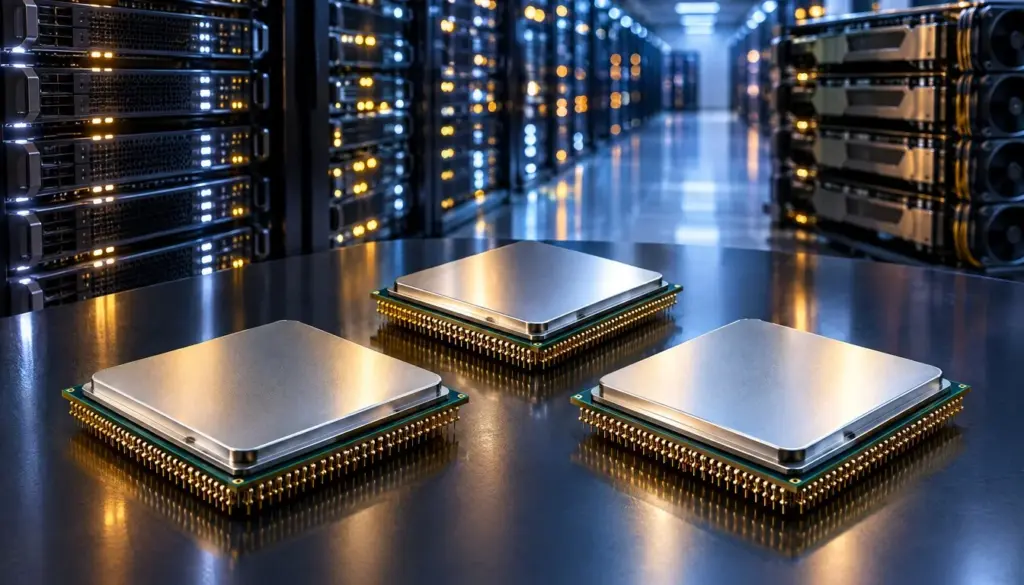
Korea Investment Management Co., Ltd. is set to list a new exchange-traded fund on the Korea Exchange on October 20, 2026, and its pitch is simple: GPUs have had their moment, now it is the CPU’s turn. The firm announced the ACE U.S. CPU Semiconductor TOP3+ ETF on October 19, 2026, a product that packages 10 U.S.-listed CPU-related companies into a single ticker, with roughly three-quarters of the fund riding on just three names: Intel, AMD, and Arm.
The announcement, confirmed by multiple South Korean financial outlets including The Asia Business Daily and Seoul Economic Daily, lands at a moment when investors are openly debating whether the AI trade’s next leg belongs to the chips that do the heavy lifting inside servers, rather than the GPUs that have dominated headlines since 2023. Korea’s financial press, including eToday and Naver News, framed the listing with a version of the same question: after GPUs, is it CPUs’ turn?

Don't miss new tech stories on Google
Add Shattered once in the Google app and our stories show up in your news suggestions.
What the ACE U.S. CPU Semiconductor TOP3+ ETF Actually Holds
The fund’s Korean-language name is 미국CPU반도체TOP3+ ETF, and its mandate is narrower than most semiconductor funds on the market. Rather than tracking the broad chip sector, Korea Investment Management built a portfolio specifically around central processing units, the general-purpose chips that still run the bulk of enterprise software, databases, and the orchestration layer sitting on top of every AI workload. The ETF holds 10 U.S.-listed companies tied to CPU production and the surrounding supply chain.
Three names anchor the fund: Intel, AMD, and Arm. Each is planned at approximately 25% of the portfolio, which puts the trio at roughly 75% of total assets combined. That is an unusually concentrated structure for an ETF, closer to a thematic basket than a diversified sector tracker, and it signals how confident the fund manager is that these three companies will define the CPU story for U.S.-listed chipmakers over the next several years.
The remaining roughly 25% is spread across seven additional companies involved in server CPU production, memory, networking, and server manufacturing, according to the fund’s disclosed structure. That tail allocation gives the ETF exposure to the hardware ecosystem that physically ships CPUs into data centers, rather than just the chip designers themselves.
Why Intel, AMD, and Arm Get Equal 25% Weighting
An equal-weight approach across Intel, AMD, and Arm is a deliberate design choice, not an accident of market-cap math. A pure market-cap-weighted fund tracking these three names would look very different today given how far their valuations have diverged over the past two years. By pinning all three to roughly a quarter of the portfolio each, Korea Investment Management is effectively betting that no single company has a lock on the CPU market’s next phase, and that investors want balanced exposure to the restructuring under way among the three largest players in general-purpose computing silicon.
That framing lines up with public comments from the fund’s own team. Nam Yong-soo, Head of the ETF Division at Korea Investment Management, said the ETF’s strength is that it offers exposure in a single investment to leading companies in the CPU market as well as companies that manufacture server racks, according to The Asia Business Daily. Nam also tied the product’s thesis directly to the AI agent boom, telling reporters that as the public’s use of agentic AI grows, CPUs will become increasingly important for handling multiple tasks at once.
That is a notable argument. Most of the AI infrastructure narrative over the past three years has centered on GPUs and the parallel-processing muscle needed to train and run large models. Korea Investment Management’s pitch flips that emphasis: agentic AI systems, which chain together many smaller tasks, tool calls, and decision steps rather than running one giant inference pass, lean more heavily on CPU orchestration than raw matrix-multiplication throughput. If that thesis holds, it would explain why a Korean asset manager is willing to build a fund that treats CPUs as the next leg of the AI hardware trade rather than an afterthought behind GPUs.
The Other 25%: Server, Memory, and Networking Stocks
The seven companies outside the core Intel-AMD-Arm block are not named individually in the disclosed fact pattern, but their categories are: server CPU production, memory, networking, and server manufacturing. That is a meaningful detail because it means the fund is not purely a bet on chip design. It is also a bet on the companies that physically assemble servers and the memory makers that supply the DRAM and HBM those servers need to run.
Memory has been one of the tightest corners of the semiconductor market through 2026, with shortages pushing PC and server costs higher across the industry, a dynamic shattered.io covered in detail when memory shortages pushed PC prices up 17%. Folding memory and networking exposure into a CPU-themed ETF gives investors a way to capture that broader supply-chain squeeze without having to pick individual memory stocks separately.
The fund’s structure also includes a mechanism for staying current: a newly listed major related company can be added to the portfolio after a review by the index committee, beginning three business days after that company’s own listing date. That rule matters because the CPU and server-hardware sector has seen a wave of new listings and spinoffs over the past year, and a static index would risk falling out of date quickly in a market moving this fast.
From GPU Mania to CPU Rotation: Why Now
The timing of this listing is not incidental. GPU-themed ETFs and GPU-heavy chip funds have dominated South Korea’s retail investing conversation for most of 2025 and 2026, riding the same wave that pushed Nvidia’s data-center business to record quarters and sent chip stocks on a wild ride that included sharp pullbacks. Shattered.io reported on one such swing when chip stocks slumped and erased roughly $1 trillion in combined value earlier in the AI hardware cycle.
Launching a CPU-focused product now reads as an attempt to find the next rotation before it becomes obvious. GPU valuations have already priced in years of AI infrastructure spending. CPU makers, by contrast, have spent the past few years losing share and mindshare to the GPU narrative, even as they remain indispensable to every data center that also houses GPU racks. A server cannot run without a CPU managing its I/O, networking, and orchestration layer, no matter how many GPUs sit alongside it.
That dynamic has already shown up in stock-specific stories on this site. Intel shares dropped 2.6% at one point this year even as Nvidia’s RTX Spark line grabbed headlines that briefly eclipsed Intel’s own Xeon 6 server chips, a reminder of how much the GPU narrative has crowded out CPU coverage, as shattered.io detailed when Intel fell 2.6% around the RTX Spark launch. A fund built around the idea that CPUs are undervalued relative to that attention gap is, in effect, a contrarian trade dressed up as a diversified basket.
Server-CPU Market Share: Intel’s Slide, AMD’s Climb, Arm’s Surge
The case for treating Intel, AMD, and Arm as a single, balanced basket gets stronger when you look at how fast server-CPU share has moved between the three companies. Industry data cited in a UBS-sourced report shows a genuine three-way redistribution of server-CPU market share over the past year, not just a slow bleed from one incumbent to a single challenger.
| Company | Current Server-CPU Share | Share One Year Earlier | Year-over-Year Change |
|---|---|---|---|
| Intel | 54.9% | 64.4% | -9.5 percentage points |
| AMD | 27.4% | 24.1% | +3.3 percentage points |
| Arm | 17.7% | 11.5% | +6.2 percentage points |
Arm posted the largest proportional gain of the three in that dataset, which helps explain why Korea Investment Management treats it as a peer to Intel and AMD rather than a minor satellite holding. Separately, the same UBS-cited reporting included an alternate share snapshot putting Intel at 53.8% and AMD at 46.2% in a narrower measurement window, a reminder that server-CPU share estimates vary meaningfully depending on the product segment, time frame, and methodology a given analyst uses. Shattered.io’s own coverage of the broader PC and desktop CPU market reached a similar conclusion when AMD’s CPU share hit a record 30.7% as Intel sank to a 1995-level low in a different slice of the market.
Either way you slice it, Intel is still the single largest server-CPU supplier by a wide margin. But the direction of travel over the past 12 months has clearly favored AMD and, even more so, Arm-based designs, which have moved from a niche curiosity in hyperscaler data centers to a double-digit share of a market Intel used to treat as its own backyard.
Historical Context: How Intel Lost Its Server Lock
Intel’s server dominance was close to absolute for most of the 2010s, when its Xeon line faced no serious commercial rival in volume data-center deployments. That changed gradually after AMD’s EPYC server chips began shipping in meaningful volume, giving hyperscalers and enterprise buyers a credible second source for x86 server silicon for the first time in years. AMD used that opening to keep shipping higher core counts and better price-to-performance ratios generation after generation, chipping away at Intel’s share one data-center refresh cycle at a time.
Arm’s rise followed a different path. Rather than competing head-on with x86 chips on their own terms, Arm-based server designs took hold first inside hyperscaler-built custom silicon, where cloud providers designed their own Arm-based chips to run portions of their own infrastructure more efficiently and cheaply than buying off-the-shelf x86 parts. That self-designed Arm silicon gradually expanded from internal workloads into broader commercial offerings, and third-party Arm server chip vendors followed the same trail. The result, visible in the current share numbers, is a server-CPU market that has gone from effectively a one-company show to a genuine three-way contest in under a decade.
That history is exactly why an equal-weight ETF makes more sense now than it would have five years ago. A fund built in 2018 that split its CPU exposure evenly across Intel, AMD, and Arm would have badly underweighted the company that actually mattered at the time. Building that same structure in 2026, after years of share erosion and two credible rivals gaining real volume, looks less like an arbitrary allocation and more like an attempt to track a market that has already become genuinely tripolar.
Competitive Landscape: Comparing the Three Core Holdings
Each of the ETF’s three anchor holdings is pursuing a distinct strategy, which is part of what makes an equal-weight structure a genuine diversification play rather than three bets on the same outcome.
| Company | Core Business Model | Primary Competitive Angle | Server-CPU Share Trend |
|---|---|---|---|
| Intel | Designs and manufactures its own x86 CPUs | Full in-house fabrication plus legacy enterprise install base | Declining, still largest single share |
| AMD | Designs x86 CPUs, outsources manufacturing | Chiplet design and core-count leadership on EPYC server line | Rising steadily year over year |
| Arm | Licenses CPU architecture and designs, does not manufacture | Power efficiency and licensing model adopted by hyperscalers | Fastest percentage-point gain of the three |
Intel’s model still rests on doing more in-house than either rival: it designs its own chips and, unlike AMD and Arm, still manufactures a large share of them in its own fabs rather than relying entirely on outside foundries. That gives Intel supply-chain control that AMD and Arm’s licensees don’t have, but it also means Intel carries the capital cost and execution risk of running its own fabrication lines, a burden neither AMD nor Arm’s business model requires. AMD, by contrast, designs chips and leases out the manufacturing to third-party foundries, letting it focus its capital on design work and move faster between process-node generations. Arm does not manufacture or even fully design finished chips in the way Intel and AMD do. It licenses CPU architecture and reference designs to other companies, including the hyperscalers that have built their own Arm-based server silicon, which is part of why Arm’s server-CPU footprint has grown so quickly without Arm itself needing to build a single fab or assembly line.
What Korea Investment Management Is Saying
The fund’s public comments so far have focused on two themes: breadth of exposure and the agentic AI angle. Nam Yong-soo, Head of the ETF Division at Korea Investment Management, told reporters that the ETF’s strength is that it lets investors buy everything from leading CPU companies to server rack makers in one product, according to Seoul Economic Daily.
Nam also made the case that CPU demand is set to rise specifically because of how AI usage is evolving, saying that as mainstream use of agentic AI increases, CPUs will become even more important in handling multiple tasks at the same time, per the same Seoul Economic Daily report. That comment is worth sitting with, because it is a direct challenge to the assumption that AI infrastructure spending flows almost entirely toward GPUs. If agentic workloads really do shift more compute demand back toward general-purpose CPU orchestration, that would be a meaningful tailwind for exactly the three companies this ETF is built around.
Market Impact: What the Listing Signals for Investors
For South Korean retail investors, the ACE U.S. CPU Semiconductor TOP3+ ETF offers a way to take a position on the CPU side of the AI infrastructure trade without having to open a U.S. brokerage account or manage three separate individual stock positions plus a basket of smaller server and memory names. That packaging matters in a market where retail participation in U.S. tech stocks, often called “seohak gaemi” investing in South Korea, has become a significant force in how quickly thematic products get built and listed.
The listing also arrives against a backdrop where chip-sector volatility has been unusually high. Shattered.io has tracked repeated swings in chip-stock sentiment throughout 2026, including moments when the broader sector shed roughly a trillion dollars in value in a single stretch, as covered in the chip stocks slump piece, and other moments when AMD alone crossed symbolic valuation milestones, as covered when AMD hit a $1 trillion market cap after a 9.6% single-day surge. A fund that spreads exposure across three companies with different risk profiles, rather than concentrating in one name, is partly an answer to that volatility: if one holding has a bad quarter, the equal-weight structure limits how much that single stock can drag down the whole product.
There is also a signaling effect that goes beyond the fund itself. When an asset manager builds and lists a thematic product this specific, it is making a public statement that it believes there is enough investor appetite, and enough of an investment thesis, to justify a standalone CPU basket. That is a different bet than simply adding Intel, AMD, and Arm to an existing broad semiconductor fund, and it puts Korea Investment Management’s name behind the idea that CPU stocks deserve their own spotlight going into 2027.
Risks and Fund Structure: What Investors Should Know
The ACE U.S. CPU Semiconductor TOP3+ ETF is structured as a performance-distribution type product. That structure means principal loss is possible, and it means the fund’s underlying holdings may change after listing and during ongoing operation, rather than staying fixed to the three core names forever. Investors should treat the 25%-25%-25%-25% split described at launch as the fund’s starting allocation, not a permanent guarantee, since weightings can shift as the index committee reviews the portfolio over time.
The index committee’s ability to add newly listed major related companies beginning three business days after their own listing date is a double-edged feature. It keeps the fund responsive to a fast-moving sector, where a spinoff or a major new IPO in the CPU or server-hardware space could otherwise sit outside the index for months. But it also means the fund’s composition is not fully static, and investors buying in expecting a fixed Intel-AMD-Arm-plus-seven-others basket should understand that the list of “seven others” is explicitly designed to evolve.
Concentration risk is the other obvious factor. With roughly three-quarters of assets in just three stocks, this fund will move far more sharply on company-specific news, like an earnings miss at Intel or a guidance cut at AMD, than a broadly diversified semiconductor ETF would. That is the trade-off investors are accepting in exchange for more concentrated exposure to the specific CPU rotation thesis Korea Investment Management is pitching.
South Korea’s Broader Appetite for Thematic Tech ETFs
This listing fits a pattern that has been building across South Korea’s ETF market for the past two years: asset managers slicing the U.S. tech and AI infrastructure trade into increasingly specific, narrow themes rather than offering one broad fund that covers the whole sector. Korean investors have shown a consistent appetite for products that let them express a precise view, whether that is AI chip exposure, memory-specific baskets, or now a CPU-only fund that deliberately treats server and networking suppliers as a secondary layer around three anchor names.
That appetite has been fed in part by how volatile and headline-driven the broader AI hardware trade has become. With GPU-centric names swinging on every new model release, export-control headline, and supply announcement, a CPU-themed product gives Korean retail investors a way to stay in the AI infrastructure story while stepping slightly to the side of the most crowded part of the trade. Whether that turns out to be a smart rotation or simply a later entry into a less-hyped corner of the same overall semiconductor cycle will depend heavily on how the agentic AI compute-demand thesis plays out over the next few quarters.
What Comes Next for the Fund and the Sector
The immediate next step is mechanical: the ETF lists on the Korea Exchange’s main board on October 20, 2026, one day after the October 19 announcement. From there, the real test begins. The index committee’s review process for adding newly listed major related companies will be the first thing to watch, since any high-profile CPU, server, or memory IPO in the following months could become a candidate for inclusion starting three business days after its own listing.
The bigger question is whether the underlying thesis, that agentic AI adoption will push incremental compute demand back toward CPUs rather than exclusively toward GPUs, actually shows up in the companies’ earnings and in continued server-CPU share shifts over the next several quarters. If Arm’s share gains and AMD’s steady climb continue at anything close to the pace seen over the past year, the fund’s equal-weight structure will look prescient. If Intel manages to stabilize or claw back share with new server chip generations, the equal-weight approach will have correctly hedged against betting too heavily on any single outcome.
Predictions: Where This CPU Rotation Trade Heads From Here
- Expect more CPU-specific or CPU-weighted thematic ETFs to follow from other Korean and Asian asset managers within the next two to three quarters, as competitors try to capture the same “after GPUs, CPUs” narrative before it becomes fully priced in.
- Watch for the index committee to add at least one new constituent to the fund’s non-core 25% allocation within its first year, given how active the server-hardware and memory IPO pipeline has been through 2026.
- If agentic AI adoption keeps accelerating as Nam Yong-soo’s comments suggest, expect server-CPU share data to keep drifting away from Intel and toward AMD and Arm-based designs over the next two to four quarterly reporting cycles, extending the trend already visible in the year-over-year numbers.
- Expect continued volatility in the fund’s underlying holdings tied to broader AI capital-expenditure headlines, since all three core companies remain highly sensitive to hyperscaler spending announcements regardless of their individual CPU-share trajectories.
- Longer term, watch whether Arm’s licensing-based gains translate into Arm itself capturing more direct economic value, or whether the bulk of the benefit continues flowing to the hyperscalers and server makers that design their own Arm-based chips using Arm’s architecture.
How This ETF Compares to a Direct Three-Stock Portfolio
An investor could, in theory, replicate roughly three-quarters of this ETF’s exposure simply by buying Intel, AMD, and Arm shares directly in equal amounts. What the ETF adds on top of that is the remaining 25% spread across seven server, memory, and networking companies, automatic rebalancing, and the index committee’s ability to add newly listed companies without the investor needing to track every CPU-adjacent IPO themselves. For a South Korean investor without an existing U.S. brokerage setup, the ETF also removes the friction of currency conversion and direct U.S. equity settlement on each of the three core names separately.
The trade-off is the usual one that applies to any thematic ETF versus a self-built equivalent: management fees eat into returns over time, and the investor gives up some control over exact weighting as the fund’s holdings evolve. For someone who already has a U.S. brokerage account and is comfortable managing a small basket of individual positions, buying Intel, AMD, and Arm directly and adding a server-hardware name or two of their own choosing would replicate most of the fund’s core thesis without the ongoing fee drag.
Frequently Asked Questions
What is the ACE U.S. CPU Semiconductor TOP3+ ETF?
It is a new exchange-traded fund from Korea Investment Management Co., Ltd. that invests in 10 U.S.-listed CPU-related companies, with Intel, AMD, and Arm each planned at roughly 25% of the portfolio and the remaining roughly 25% spread across seven server, memory, and networking companies.
When does the ETF list on the Korea Exchange?
The fund is scheduled to list on the Korea Exchange’s main board on October 20, 2026, one day after Korea Investment Management announced the product on October 19, 2026.
Why does the fund weight Intel, AMD, and Arm equally instead of by market cap?
Korea Investment Management designed the fund around roughly equal exposure to all three companies rather than letting market capitalization dictate the weighting, reflecting a view that no single company currently dominates the CPU market’s next growth phase.
Can the fund lose money?
Yes. The fund is structured as a performance-distribution type product, meaning principal loss is possible, and its holdings may change after listing and during ongoing operation.
What are the seven other companies in the ETF besides Intel, AMD, and Arm?
The fund’s disclosed structure describes the remaining roughly 25% as spread across seven companies involved in server CPU production, memory, networking, and server manufacturing. Specific names for that portion of the portfolio were not disclosed in the fund’s initial announcement.
Why is a CPU-focused ETF getting attention now, after years of GPU-focused investing?
Korea Investment Management’s ETF Division head, Nam Yong-soo, has argued that growing mainstream use of agentic AI will make CPUs more important for handling multiple simultaneous tasks, shifting some investor attention away from GPU-exclusive AI infrastructure plays.
How has server-CPU market share shifted between Intel, AMD, and Arm?
According to a UBS-cited industry report, Intel’s server-CPU share fell to 54.9% from 64.4% a year earlier, AMD’s share rose to 27.4% from 24.1%, and Arm’s share climbed to 17.7% from 11.5%, making Arm the fastest-growing of the three over that period.
Can the fund add new companies after it lists?
Yes. A newly listed major related company can be added to the fund after a review by the index committee, with eligibility beginning three business days after that company’s own listing date.