
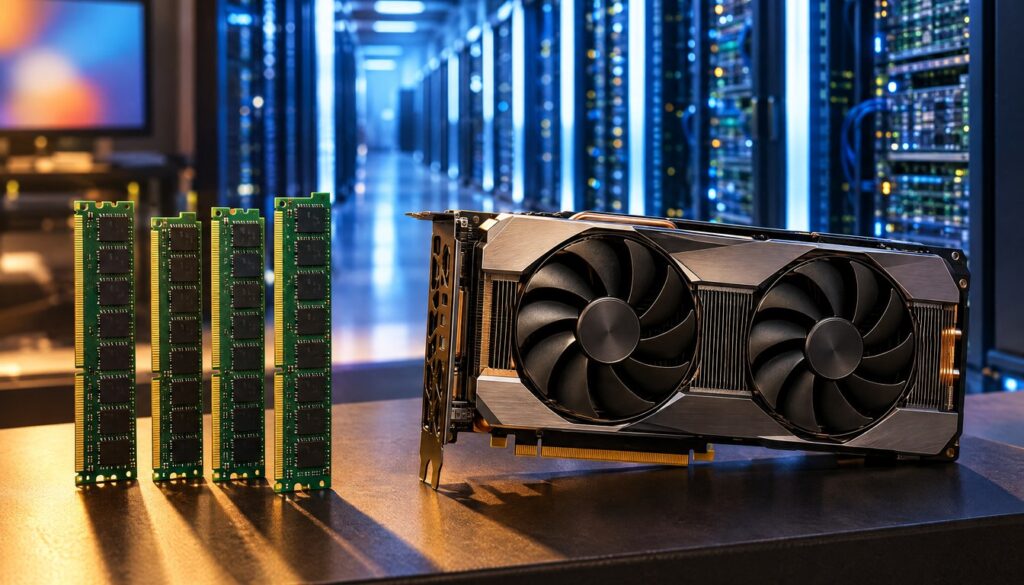
Memory chip prices climbed nearly 20% quarter over quarter in Q3 2026, according to research firm Bernstein, and the firm expects another increase in Q4. The jump is not a short-term blip. It is reshaping what a laptop, graphics card, or gaming desktop costs heading into 2027, and the root cause is not a factory fire or a trade dispute. It is artificial intelligence data centers buying up nearly every spare wafer of DRAM and NAND flash the industry can produce.
For the first time in years, memory, not logic chips, is the bottleneck squeezing PC and GPU pricing. Bernstein’s October analysis found that both conventional DRAM and NAND flash contract prices rose sharply in the third quarter, and the firm does not expect the shortage to ease until 2027 at the earliest. Samsung, SK hynix, and Micron have reportedly sold out their 2026 high-bandwidth memory (HBM) production capacity to AI data center customers months in advance, leaving consumer electronics makers fighting over what is left.
What’s Driving the 2026 Memory Chip Shortage
The memory chip shortage traces back to a simple supply and demand mismatch. AI accelerators built by Nvidia, AMD, and a handful of hyperscalers need enormous volumes of HBM to feed their processors, and HBM is manufactured on the same production lines, using the same wafer capacity, as the DRAM that goes into consumer PCs and GPUs. When memory makers reallocate capacity toward higher-margin HBM for data centers, the leftover supply for consumer-grade DDR5 and GDDR memory shrinks.
Research firm IDC projects 2026 DRAM supply growth of only around 16% year over year, with NAND supply growth landing near 17%. Both figures fall below the levels the memory industry has historically delivered during a demand spike, largely because building new fabrication capacity takes years, not quarters. That mismatch between slow-to-build supply and fast-growing AI demand is why analysts increasingly describe this cycle as structural rather than seasonal.
TrendForce data cited in recent coverage puts DRAM lead times at roughly 20 weeks, and the research firm has forecast that SLC NAND prices specifically could climb between 120% and 170% in the second half of 2026 as manufacturers continue shifting output toward higher-margin server and AI products. Those are not modest adjustments. They represent the kind of supply reallocation that normally takes a geopolitical shock to trigger, not a single product category’s boom.
Nvidia’s own finance chief has acknowledged the scale of the problem. CFO Colette Kress said memory-price increases had already exceeded the company’s initial expectations and could climb further next year, tying the shortage directly to the pace of AI data center construction. When the company selling the GPUs that create AI demand is also warning that memory costs are squeezing its own supply chain, it is a signal the shortage runs deeper than a single vendor’s forecasting miss.
Gartner’s Numbers: PC Prices Up, Shipments Down
Gartner has put the clearest numbers yet on how this shortage reaches ordinary buyers. The research firm projects that combined DRAM and SSD prices will rise by 130% by the end of 2026, pushing average PC prices up 17% compared with 2025. “Gartner projects combined DRAM and SSD prices to rise by 130% by the end of 2026, increasing average PC prices by 17% compared with 2025,” the firm said in its February 2026 press release, Gartner, cited research.
The shipment impact is just as stark. “Gartner forecasts that global PC shipments will decline by 10.4% in 2026 because of surging memory costs,” according to the same release from Gartner, cited research. A double-digit drop in PC shipments driven purely by component costs, rather than weak consumer demand, is unusual, and it underscores how much leverage memory suppliers currently hold over the rest of the hardware industry.
Gartner also quantified how much of a finished PC’s bill of materials now goes toward memory. “Gartner estimates that memory costs will reach 23% of the total PC bill of materials in 2026, up from 16% in 2025,” Gartner, cited research, said. That seven-point swing in under a year means manufacturers have far less room to absorb the increase internally, which is one reason retail prices are moving instead of staying flat while margins shrink.
IDC’s supply-growth estimates reinforce why Gartner’s shipment forecast looks grim rather than overly cautious. “IDC projects that DRAM supply will grow by approximately 16% and NAND supply by approximately 17% in 2026, below the level required to meet AI-driven demand,” according to IDC, cited research, in analysis published by Zacks. When supply growth trails demand growth by a wide margin for an entire calendar year, price relief simply has nowhere to come from until new fabrication capacity comes online, typically a multi-year process.
GPU and CPU Pricing Already Moving
The shortage has already reached graphics cards and processors, not just RAM sticks and SSDs. Reports indicate AMD notified partners of roughly 10% price increases for consumer GPUs and motherboard chipsets heading into Q4 2026, a move that mirrors what shattered.io covered when AMD raised GDDR6 pricing on October 1 while Nvidia held the line on GDDR7. Consumer and prosumer graphics cards are reportedly becoming scarcer across the board as memory allocation increasingly favors AI and server customers over gaming hardware.
That allocation shift is also reshaping Nvidia’s own product lineup. shattered.io previously reported that Nvidia has been shifting GB202 silicon toward RTX Pro cards and away from the RTX 5090, a pattern consistent with chasing higher margins on professional and data center-adjacent products while consumer flagship supply tightens. Separate reporting has gone further, suggesting the RTX 5090 could be discontinued entirely while the RTX 5080 jumps to 24GB of memory, a change that would itself require more of the very DRAM supply already in short supply.
Billionaire Elon Musk has also weighed in publicly on the pricing dynamics. According to Tom’s Hardware’s reporting, Musk called out Samsung and SK hynix over what he described as extortionate memory pricing, while noting that Micron is reportedly pulling in margins near 90% on consumer RAM even as it frames its pricing as protecting long-term customer loyalty. Market analysts separately expect the supply shortage to persist through at least 2028, a timeline that gives the three dominant memory manufacturers considerable leverage in contract negotiations with PC and GPU makers for years, not quarters.
Wall Street has noticed the ripple effects beyond component pricing. Chip stocks broadly wobbled in mid-October as investors reassessed how durable AI-driven demand really is, a theme shattered.io tracked when chip stocks collectively erased roughly $1 trillion in value during a sharp slump. Memory and GPU supply tightness cuts both ways for investors: it can mean fatter margins for suppliers holding scarce inventory, but it also raises the risk that downstream demand erodes if PCs and graphics cards get too expensive for mainstream buyers.
Memory Price Increases: Q3 2026 vs Prior Forecasts
The table below lines up the key figures from this round of research and analyst commentary, showing how far current forecasts have moved from where the industry expected pricing to land just months ago.
| Metric | Figure | Source |
|---|---|---|
| Memory contract price increase, Q3 2026 (quarter over quarter) | Nearly 20% | Bernstein |
| Combined DRAM and SSD price increase forecast, full-year 2026 | 130% | Gartner |
| Average PC price increase, 2026 vs 2025 | 17% | Gartner |
| Global PC shipment decline forecast, 2026 | 10.4% | Gartner |
| Memory share of total PC bill of materials, 2026 | 23% (up from 16% in 2025) | Gartner |
| 2026 DRAM supply growth (year over year) | ~16% | IDC |
| 2026 NAND supply growth (year over year) | ~17% | IDC |
| SLC NAND price increase forecast, H2 2026 | 120% to 170% | TrendForce (cited reports) |
| Reported AMD consumer GPU and chipset price increase, Q4 2026 | ~10% | Industry reports |
| Average DRAM lead time | ~20 weeks | TrendForce (cited reports) |
Historical Context: How This Shortage Differs From Past Cycles
Memory has gone through boom-and-bust pricing cycles for decades, and anyone who bought RAM during the 2017-2018 DRAM spike or the 2021 chip shortage that hit everything from GPUs to cars has seen prices move sharply before. Those earlier cycles were largely driven by fab capacity decisions made years in advance colliding with demand spikes tied to smartphones, cryptocurrency mining, or pandemic-driven device purchases. Prices eventually fell once new capacity came online or demand cooled.
What makes the 2026 cycle different is the nature of the buyer driving demand. AI data center operators are not a seasonal or speculative customer base the way crypto miners were in 2021. They are signing multi-year supply agreements for HBM tied to AI infrastructure buildouts that companies like Nvidia, AMD, and the major cloud providers have committed tens of billions of dollars toward. That changes the incentive structure for Samsung, SK hynix, and Micron: locking in high-margin, long-term HBM contracts is more attractive than chasing lower-margin consumer DRAM and NAND volume, even if it means consumer prices spike as a side effect.
It also explains why this shortage has proven harder to forecast an end date for. Past memory cycles typically had a visible catalyst, a new fab ramping, a demand category cooling, that let analysts pencil in a rough recovery quarter. With AI infrastructure spending still accelerating rather than plateauing, and IDC projecting supply growth that already trails demand for all of 2026, there is no obvious near-term event that resets the balance. That is a meaningful break from the pattern buyers have come to expect from memory pricing.
Competitive Landscape: Who Gains, Who Gets Squeezed
Samsung, SK hynix, and Micron sit at the top of the winner’s list in this cycle. All three control the HBM and DRAM capacity that AI accelerator makers depend on, and reports of them selling out 2026 HBM production months ahead of schedule suggest they are capturing premium pricing on both the AI-facing and consumer-facing sides of their business simultaneously. Micron’s reported margins near 90% on consumer RAM, as cited in Tom’s Hardware’s coverage of Musk’s comments, illustrate just how much pricing power memory makers currently hold.
Nvidia occupies a more complicated position. The company benefits enormously from AI accelerator demand, but its own CFO has acknowledged that rising memory costs are eating into the economics of building AI infrastructure, and the company has reportedly been reallocating GB202 silicon toward RTX Pro cards rather than consumer RTX 5090 units to chase better margins. That is a company managing scarcity on both the input side, memory, and output side, finished GPU allocation, at the same time.
AMD faces similar pressure from the consumer side. Reports of a roughly 10% price increase on consumer GPUs and motherboard chipsets heading into Q4 2026 suggest AMD is passing rising memory costs through to buyers rather than absorbing them, a choice that keeps margins intact but risks further dampening PC upgrade demand that Gartner already expects to fall 10.4% this year. Intel, meanwhile, faces the same input cost pressure without the AI accelerator upside that partially offsets it for Nvidia, leaving the company’s client and server CPU lines more exposed to margin compression if memory prices keep climbing into 2027.
PC makers and consumers sit at the bottom of this chain with the least leverage. Gartner’s bill-of-materials data shows memory jumping from 16% to 23% of a finished PC’s cost in a single year, a shift manufacturers cannot easily hide from buyers without eating into already-thin margins. That dynamic is already visible in gaming hardware pricing more broadly, a pattern shattered.io has tracked closely, including when AMD CEO Lisa Su said AI chip demand would outpace supply into 2028, a timeline that lines up uncomfortably well with current memory shortage forecasts.
Market Impact: PC Shipments, GPU Availability, and Build Costs
The most immediate market impact is on PC shipment volume. Gartner’s 10.4% shipment decline forecast for 2026 is a direct consequence of pricing, not weak demand for computing in general. When a laptop that cost $800 a year ago now carries a meaningfully higher price tag purely because of a $40 to $60 memory module price swing, a share of buyers simply delay their purchase or shift toward lower-spec configurations, which further distorts which products manufacturers prioritize building.
Graphics card availability is the second major pressure point. Between AMD’s reported 10% price increase on consumer GPUs and chipsets, Nvidia’s reported silicon reallocation away from the RTX 5090, and broader reports that prosumer graphics cards are becoming scarcer as memory supply shifts toward AI and server products, builders shopping for a new gaming PC in late 2026 face a market where both price and availability are moving against them at the same time. That compounds the pressure already visible in GPU-adjacent pricing stories shattered.io has covered, including the push toward 24GB configurations on cards like the RTX 5080 that themselves require more of the scarce memory supply.
Enterprise and data center buyers face a different flavor of the same squeeze. Server memory modules draw on the same DRAM production lines as consumer parts, so the 20-week lead times TrendForce has cited for DRAM broadly apply to enterprise procurement too. Companies planning hardware refreshes or data center expansions in 2027 are increasingly locking in orders further ahead of schedule simply to avoid getting squeezed out by AI infrastructure customers with larger standing orders and longer-term contracts already in place with Samsung, SK hynix, and Micron.
Projected Price Trajectory Into 2027
The table below summarizes how key forecasts for this shortage compare across the research firms currently tracking it, to show where there is broad agreement and where estimates diverge.
| Forecast area | Bernstein | Gartner | IDC / TrendForce (cited) |
|---|---|---|---|
| Near-term price direction | Up again in Q4 2026 | Up 130% (DRAM+SSD) for full-year 2026 | Up, with SLC NAND up 120%-170% in H2 2026 |
| Expected shortage duration | Into 2027 | Not specified beyond 2026 shipment impact | Supply growth (16%-17%) trailing demand through 2026 |
| Consumer impact measured | Contract pricing only | Average PC price up 17%, shipments down 10.4% | Lead times near 20 weeks (DRAM) |
| Primary demand driver cited | AI applications | Surging memory costs broadly | AI-driven demand outpacing supply |
What This Means for PC Builders and Gamers Right Now
For anyone planning a new PC build or GPU upgrade heading into the holiday season, the practical takeaway is that waiting rarely helps in this kind of cycle. With Bernstein projecting another round of contract price increases in Q4 2026 and analysts broadly expecting the shortage to persist into 2027, memory and GPU prices are more likely to climb further than to retreat in the next two quarters. Builders with flexibility on timing may want to lock in RAM and storage purchases sooner rather than later, particularly for DDR5 kits and NVMe SSDs that draw on the same constrained NAND supply as enterprise products.
Graphics card shoppers face a trickier calculation. Reports of Nvidia reallocating GB202 silicon toward RTX Pro cards and away from the RTX 5090, combined with AMD’s reported price increases on consumer GPUs, suggest the sweet spot of the market, mid-range to high-end gaming cards, could see both tighter availability and higher prices through early 2027. Shoppers who have tracked coverage of the RTX 5080’s reported jump to 24GB of memory should also expect that change, if it materializes, to add further pressure on already-scarce GDDR supply rather than ease it.
Pre-built PC and laptop buyers are somewhat better insulated in the short term, since manufacturers often lock in component pricing for a given model cycle in advance. But Gartner’s bill-of-materials data suggests that insulation will not last through 2027 model refreshes, when memory representing 23% of a PC’s cost rather than 16% will need to show up in sticker prices one way or another.
Predictions: Where Memory Pricing Goes From Here
- Memory contract prices will likely rise again in Q4 2026, consistent with Bernstein’s forecast, with consumer-facing DRAM and NAND price tags following within one to two quarters.
- PC shipment volumes will likely land closer to Gartner’s 10.4% decline forecast than prior, more optimistic 2026 projections, as buyers delay purchases or downgrade specs to manage cost.
- Expect more GPU vendors to follow AMD’s reported Q4 2026 price increase pattern, with Nvidia’s own partner board makers under similar pressure to adjust pricing on memory-heavy SKUs.
- Silicon reallocation toward higher-margin products, such as Nvidia’s reported shift of GB202 chips toward RTX Pro cards, will likely continue as long as HBM and professional GPU demand outpaces consumer GPU demand in profitability per wafer.
- Relief is unlikely before 2027 at the earliest, and even then it depends on new fab capacity from Samsung, SK hynix, and Micron coming online faster than currently projected, something IDC’s below-trend 2026 supply growth estimates suggest is not guaranteed.
Frequently Asked Questions
Why is there a memory chip shortage in 2026?
AI data center operators are buying up most of the world’s high-bandwidth memory production for AI accelerators, and that memory is built on the same wafer capacity as consumer DRAM and NAND flash. Samsung, SK hynix, and Micron have reportedly sold out their 2026 HBM capacity to AI customers, leaving less supply for consumer PCs and GPUs.
How much have memory prices increased in 2026?
Bernstein found memory contract prices rose nearly 20% quarter over quarter in Q3 2026. Gartner projects combined DRAM and SSD prices will climb 130% for the full year, pushing average PC prices up 17% versus 2025.
When will the memory chip shortage end?
Bernstein and other analysts expect the shortage to continue into 2027 at the earliest. Some market commentary suggests supply constraints could persist through 2028, since new fabrication capacity takes years to build and AI demand is still accelerating.
Will GPU prices keep rising because of the memory shortage?
Reports indicate AMD has already notified partners of roughly 10% price increases on consumer GPUs and motherboard chipsets for Q4 2026. Nvidia has reportedly been reallocating GB202 silicon toward higher-margin RTX Pro cards, which could further tighten consumer RTX 5090 and RTX 5080 availability.
How much does memory add to the cost of a PC now?
Gartner estimates memory will make up 23% of a PC’s total bill of materials in 2026, up from 16% in 2025, a seven-point jump in a single year that manufacturers have limited room to absorb without raising retail prices.
Is this memory shortage different from past chip shortages?
Yes. Earlier cycles, including 2021’s broad chip shortage, were driven by demand spikes tied to specific consumer categories that eventually cooled. The 2026 shortage is tied to multi-year AI infrastructure contracts, which gives memory makers less incentive to prioritize consumer supply even as prices rise.
Should I buy RAM, an SSD, or a new PC now or wait?
With Bernstein projecting further price increases in Q4 2026 and most analysts expecting the shortage to persist into 2027, buying sooner rather than later is generally the safer bet for anyone who needs to upgrade in the near term, particularly for DDR5 memory and NVMe storage.
Which companies benefit most from the memory shortage?
Samsung, SK hynix, and Micron currently hold the most leverage, since they control the HBM and DRAM capacity AI accelerator makers depend on. Reports cited by Tom’s Hardware suggest Micron is earning margins near 90% on consumer RAM during this cycle.