
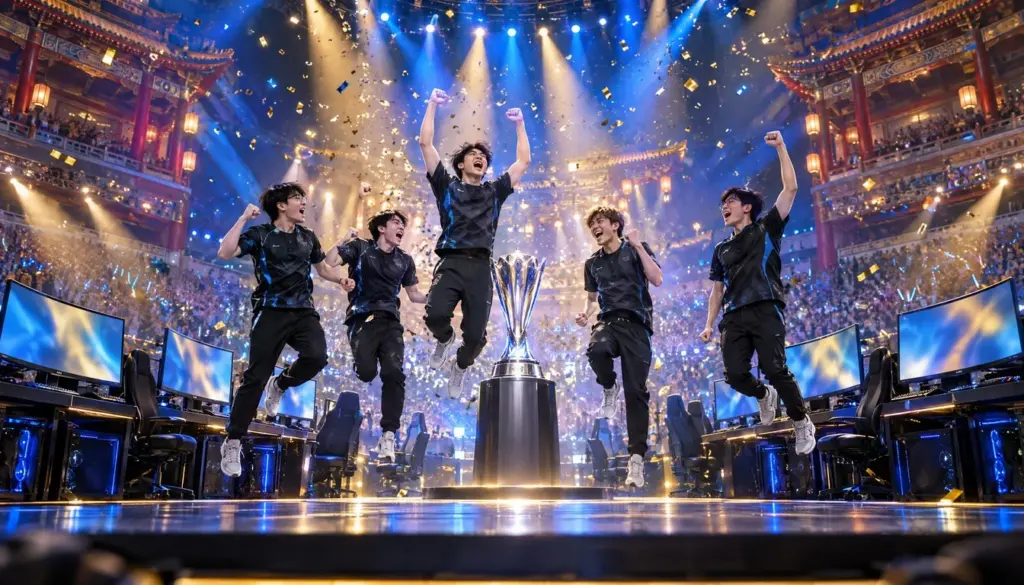
South Korea’s FEARX swept to the first-ever Demacia Cup Global Invitational title on October 17, 2026, beating China’s Team WE 3-1 in a best-of-five final staged at JD Gaming’s home venue in Beijing. The result closes out a tournament that China’s TJ Sports and streaming partner Huya Inc. had quietly transformed from a domestic, League of Legends Pro League (LPL) offseason filler into a 12-team, six-region international fixture, according to Insider Gaming and RFT.gg. Field Level Media, whose report was carried by outlets including the Miami Herald, put FEARX’s winning share at roughly $89,760 from a total prize pool of about $224,400.
The scoreline matters less than who delivered it. FEARX plays in the League of Legends Champions Korea (LCK), not the LPL, and its run through the bracket means Korean teams took three of the tournament’s top four places on Chinese soil, at a Chinese-organized event, with a Chinese team eliminated in the final. For a competitive scene still parsing what Worlds 2026 revealed about regional strength, that detail has become the real story behind the scoreline.

Don't miss new tech stories on Google
Add Shattered once in the Google app and our stories show up in your news suggestions.
What Happened: FEARX Sweeps to the Demacia Cup Title
FEARX closed out Team WE 3-1 in the Demacia Cup Global Invitational grand final on October 17, 2026, a result confirmed by Field Level Media and picked up by the Miami Herald. The win capped a knockout stage held entirely on LAN in Beijing, at the venue JD Gaming uses as its home arena, after an online group stage had trimmed the 12-team field. KT Rolster and BRION, both LCK sides, shared third and fourth place, while JD Gaming, Team Vitality, FlyQuest, and LGD Gaming filled out the fifth-through-eighth bracket, per the same report.
FEARX itself carries a notable backstory for anyone who has not followed Korean League of Legends closely. The organization competed for years as Liiv SANDBOX, and before that SANDBOX Gaming, before its rebrand to FEARX, according to Liiv Sandbox’s own tournament history pages indexed by esports wikis. Lifting an international trophy on Chinese soil, against a Chinese finalist, gives the rebranded org its highest-profile result since the name change.
Inside the New Format: How the Demacia Cup Became a Global Invitational
The Demacia Cup Global Invitational did not spring up overnight. Insider Gaming and RFT.gg both report that TJ Sports and Huya Inc. restructured the long-running, LPL-only Demacia Cup into a 12-team, six-region invitational for 2026, running October 3 through October 17. Esports News UK adds that Riot Games is also credited as an organizing partner in its coverage of the announcement, which first surfaced in late August.
The format split the event in two. An online Swiss-system group stage ran October 3-8, with the opening round played as single-game matches and every subsequent round decided over best-of-three series, according to RFT.gg. The top eight finishers then advanced to a single-elimination, best-of-five knockout bracket played on LAN in Beijing from October 12-17. RFT.gg also reports a specific rules wrinkle for the offline stage: coaches were allowed three in-game communication windows per match, capped at 45 seconds each, a format tweak aimed at making the LAN portion more spectator-friendly.
Slot allocation followed competitive results rather than invitation by reputation. Teams were seeded using each region’s placement at MSI 2026, with the top two regions receiving three slots apiece, the third- and fourth-ranked regions receiving two each, and the remaining two regions receiving one slot each, per both Insider Gaming and RFT.gg. Crucially, the invitations targeted each region’s highest-finishing teams that had not already qualified for the League of Legends World Championship, turning the event into a showcase for mid-table talent rather than a rerun of Worlds qualifiers.
The Numbers: Prize Pool, Payouts and Final Standings
The total purse for the Demacia Cup Global Invitational came in at roughly 1.5 million Chinese yuan, which outlets converted differently depending on the exchange rate and date used: Field Level Media listed it at approximately $224,400, Insider Gaming at approximately $223,000, and Esports News UK at roughly €191,000. The payout structure rewarded the top eight finishers, with a steep drop-off between the final four and the rest of the field.
| Placement | Team | Region | Approx. Payout (USD) |
|---|---|---|---|
| 1st | FEARX | LCK (South Korea) | $89,760 |
| 2nd | Team WE | LPL (China) | $59,840 |
| 3rd-4th | KT Rolster / BRION | LCK (South Korea) | $26,180 each |
| 5th-8th | JD Gaming / Team Vitality / FlyQuest / LGD Gaming | LPL / LEC / LCS / LPL | $5,610 each |
Those figures are small next to the sport’s marquee events, and that gap is part of the point: this was never positioned as a Worlds-tier payday. It was built as a competitive proving ground for teams that had already missed out on the one tournament that does carry Worlds-sized money and attention.
Why TJ Sports and Huya Opened the Gates
RFT.gg’s reporting frames the expansion plainly: the new format offers Chinese teams the chance to sharpen their skills against global opposition and provides high-level League of Legends competition in the run-up to Worlds 2026. Esports News UK frames the same move from the other direction, describing it as an alternative international opportunity for teams, particularly fourth- and fifth-place finishers in regions like the LEC, that would otherwise have no further official competition once their domestic playoffs ended.
That dual framing points to a business logic as much as a competitive one. The Demacia Cup has existed in some form since at least 2015 as a Chinese-only event organized by TJ Sports, according to tournament archives maintained by esports wikis. Turning it into an international broadcast product gives Huya, the Chinese livestreaming platform that operates alongside TJ Sports, a reason to court viewers from five additional regions during a slow stretch of the global League of Legends calendar, between MSI and the start of the following competitive year.
LCK’s Quiet Domination: Three Teams, Three Trophies in the Final Four
The headline result obscures a more pointed storyline buried in the standings. Of the four teams that reached the Demacia Cup Global Invitational’s final four, three were from the LCK: champion FEARX, and third-fourth finishers KT Rolster and BRION. Team WE, the lone LPL team to reach that stage, was also the only non-LCK side in the top four. The LPL sent three teams into the 12-team field under the slot-allocation rules, yet only one advanced past the semifinal stage, based on the standings reported by Field Level Media.
That pattern lands at an awkward moment for Chinese League of Legends. This was an event explicitly built, per RFT.gg’s own framing, to let Chinese teams sharpen their skills against global opposition on home soil. Instead, mid-table LCK sides outperformed mid-table LPL sides on a Beijing stage designed to showcase the host region. It’s one result from one new tournament, not a verdict on either region’s depth, but it arrives in a league already sensitive to comparisons after a broader pullback in gaming spending this year sharpened scrutiny of every corner of the industry’s numbers.
Historical Context: From Regional Offseason Filler to International Fixture
The Demacia Cup’s recent history helps explain why this year’s expansion is a genuine departure rather than a rebrand in name only. The 2023 edition, held primarily within China, ended with Bilibili Gaming defeating JD Gaming 3-0. The 2024 edition saw Anyone’s Legend beat Top Esports 3-1. The most recent purely domestic edition, held from December 2025 into January 2026 with 16 participating teams, ended with Invictus Gaming defeating JD Gaming 3-0, according to tournament records indexed by esports wikis and tracking sites.
Every one of those finals was an all-LPL affair, because the tournament had no foreign entrants to invite. The 2026 Global Invitational broke that pattern entirely by design, and the fact that its very first international final produced a non-Chinese champion is the kind of outcome organizers plan for competitively but rarely plan for from a promotional standpoint. China’s domestic League of Legends scene, the LPL, fields 16 teams in its 2026 season, per league records tracked by Wikipedia, making it one of the largest and best-funded regional leagues in the sport.
Competitive Comparison: Demacia Cup Global Invitational vs. Worlds
Measured against the League of Legends World Championship, the Demacia Cup Global Invitational is a different order of event entirely, and the gap illustrates how far down the competitive and commercial ladder it sits even in its new global form. Worlds 2025 drew a peak concurrent audience of 6,752,585 viewers and averaged 1,494,960 viewers across 89 hours of airtime, for a total of 132,926,815 hours watched, according to tracking site Esports Charts. That tournament carried a $5 million prize pool, with $1 million going to champion T1 after its 3-2 final win over KT Rolster.
| Metric | Demacia Cup Global Invitational 2026 | Worlds 2025 (Esports Charts) |
|---|---|---|
| Teams | 12, from 6 regions | Regional qualifiers, global field |
| Format | Online Swiss + offline Bo5 knockout | Multi-stage group and bracket play |
| Total prize pool | ~$224,400 (1.5M RMB) | $5,000,000 |
| Champion payout | ~$89,760 | $1,000,000 |
| Peak viewership | Not yet published | 6,752,585 |
| 2026 champion | FEARX (LCK) | T1 (LCK), Worlds 2025 |
One pattern survives the comparison regardless of scale: Korean teams won both events. T1 beat fellow LCK side KT Rolster for the 2025 World Championship, and FEARX beat an LPL side for the first Demacia Cup Global Invitational. Whether that is coincidence, a reflection of current competitive form, or a reminder that KT Rolster keeps finishing one spot short of a trophy is a question the 2027 competitive calendar will have more chances to answer.
Regional Breakdown: How Each of the Six Regions Fared
The slot-allocation formula rewarded regional strength at MSI 2026 with more invitations, and the final standings offer an early read on whether that strength carried over. The LPL and LCK each sent three teams, the maximum allowed; the LEC and LCS sent two apiece; and the LCP and CBLOL sent one team each, per Insider Gaming’s breakdown of the format. Team Vitality represented the LEC, FlyQuest represented the LCS, and both finished in the fifth-through-eighth group alongside two LPL sides, JD Gaming and LGD Gaming.
Esports News UK’s preview coverage had flagged Fnatic, Natus Vincere, Team Vitality, and GiantX as plausible LEC representatives before rosters were finalized, underscoring how fluid the invitation process was even weeks before the event began. In the end, Vitality was the region’s representative that advanced furthest, and the result still left the LEC and LCS both outside the top four, consistent with where those regions have generally landed relative to LCK and LPL at other international events in recent seasons. For fans tracking how regional balance shifts from one international bracket to the next, the Demacia Cup Global Invitational becomes one more data point sitting alongside results from events like the Esports World Cup, which drew its own massive global audience earlier in the year.
Market Impact: What a New Global Fixture Means for Sponsors and Streaming
The business case for internationalizing the Demacia Cup lines up with where the broader esports industry is spending its growth money: live, cross-regional content that can be sold to broadcasters and sponsors in more than one market at once. The worldwide esports market is projected to generate $4.91 billion in revenue in 2026, according to Statista Market Insights, a figure that reflects steady growth in sponsorship, media rights, and advertising spend across the sector rather than any single tournament.
Against that backdrop, a 12-team invitational that pulls in LEC and LCS organizations gives Huya a reason to court international rights buyers and gives TJ Sports a second flagship event, alongside the LPL season itself, to sell against. It also gives mid-table Western organizations like Team Vitality and FlyQuest a sanctioned reason to travel and compete during a part of the calendar that would otherwise be dead air for their rosters, sponsors, and content teams. None of the reporting reviewed for this story includes confirmed viewership figures for the 2026 edition, so any claim about how big an audience watched the FEARX-Team WE final should be treated as unconfirmed until a tracking outlet like Esports Charts publishes numbers.
FEARX’s Rebrand Story Gets Its Signature Win
For FEARX specifically, the title is the biggest result since the organization shed its previous identities as SANDBOX Gaming and later Liiv SANDBOX. Korean esports organizations rebrand periodically as sponsorship deals shift, and a new name without a marquee result can sit in limbo for seasons before it means anything to casual fans. An international trophy, even one from a newly created, mid-table-focused invitational, gives FEARX a concrete highlight to point to while it builds its identity under the new name.
It also complicates any easy narrative about the invitational being a showcase purely for second-tier competition. FEARX qualified by virtue of finishing outside Worlds contention in the LCK, by definition a mid-table result domestically, yet it played well enough across a Swiss group stage and a best-of-five Beijing bracket to beat every other invited team, including two of its own LCK peers along the way.
What’s Next: Predictions for the Format and the Regional Balance
None of the following is confirmed by TJ Sports, Huya, or Riot Games; these are reasoned expectations based on how the first edition played out and how similar expansions have gone elsewhere in esports.
- Expect TJ Sports and Huya to run the Demacia Cup Global Invitational again in 2027 if viewership and sponsorship numbers for this edition hold up, given the calendar gap it fills between MSI and the following season.
- Watch for LPL organizations to scrutinize why their three invited teams, including two LPL sides that finished fifth through eighth, underperformed against LCK opposition on home soil, especially with Worlds-season roster planning already underway.
- Expect LEC and LCS clubs like Team Vitality and FlyQuest to treat the event as a recurring offseason tune-up rather than a title priority, given the modest payout gap between a semifinal exit and a title run.
- If Huya’s numbers for this edition are strong, other regions could explore their own cross-regional, mid-table invitationals rather than leaving non-Worlds teams idle for months.
- FEARX’s run is likely to get cited in Korean esports coverage as evidence the org’s post-rebrand roster and coaching staff are trending upward heading into the 2027 LCK season.
Whether any of that plays out will depend on numbers nobody has published yet, chiefly viewership, which is exactly the kind of gap that tends to close once tracking outlets catch up with a tournament’s first run. For readers following the broader shape of competitive gaming news, this result sits alongside other recent storylines, including the end of the VCT franchise era at Valorant Champions 2026 and the record prize money paired with a player-count decline in CS2, as further evidence that 2026 has been a year of structural change across esports formats, not just a string of isolated tournament results.
The Bigger Picture: A Test Case for Cross-Regional Esports
Strip away the trophy and the Demacia Cup Global Invitational reads as a test case other tournament organizers will be watching closely. Mid-table teams that miss marquee events like Worlds or MSI rarely get a second, sanctioned shot at international competition in the same calendar year. Building one, with a modest but real prize pool and a LAN finals slot at an existing venue, cost TJ Sports and Huya relatively little compared to standing up a new tournament from scratch, since the Demacia Cup brand and infrastructure already existed.
If the format sticks, it could become a template other regions borrow for their own domestic cups, turning what used to be single-region offseason filler, like China’s old Demacia Cup or Korea’s own domestic cup events, into cross-regional events with their own sponsorship packages and broadcast rights. That would mark a meaningful shift in how the League of Legends competitive calendar is structured outside of Riot Games’ own flagship events, and it is one of the more interesting structural stories to come out of League of Legends esports this October, alongside continued attention on tournaments like PUBG’s own global championship format in a different title entirely.
Frequently Asked Questions
What is the Demacia Cup Global Invitational?
It is the 2026 expansion of China’s long-running Demacia Cup, previously an LPL-only offseason tournament, into a 12-team event spanning six League of Legends regions: LPL, LCK, LEC, LCS, LCP, and CBLOL. It ran October 3-17, 2026, and was organized by TJ Sports and Huya Inc.
Who won the 2026 Demacia Cup Global Invitational?
FEARX, a South Korean team competing in the LCK, won the tournament by defeating China’s Team WE 3-1 in the grand final on October 17, 2026, according to Field Level Media.
What was the prize pool?
The total prize pool was approximately 1.5 million Chinese yuan, converted by various outlets to roughly $223,000 to $224,400 or about €191,000. FEARX’s winning share was reported at approximately $89,760.
Which teams reached the top four?
FEARX (LCK) won the title, Team WE (LPL) finished second, and KT Rolster and BRION, both LCK teams, shared third and fourth place.
How were teams selected for the invitational?
Slots were allocated by each region’s performance at MSI 2026. The top two regions, LPL and LCK, each received three slots; the third- and fourth-ranked regions, LEC and LCS, received two slots each; and the remaining regions, LCP and CBLOL, received one slot each. Invitations went to each region’s highest-finishing teams that had not already qualified for Worlds 2026.
Is FEARX a Chinese team?
No. FEARX competes in South Korea’s LCK. The organization previously competed under the names SANDBOX Gaming and Liiv SANDBOX before its rebrand.
How does this compare to the League of Legends World Championship?
It is far smaller. Worlds 2025 carried a $5 million prize pool with a $1 million champion payout and drew a peak audience of 6,752,585 viewers, according to Esports Charts, dwarfing the Demacia Cup Global Invitational’s roughly $224,400 purse.
Will the Demacia Cup Global Invitational return in 2027?
That has not been confirmed by TJ Sports, Huya, or Riot Games. Based on how the first edition filled a gap in the competitive calendar between MSI and the following season, a repeat edition is a reasonable expectation rather than a confirmed plan.