
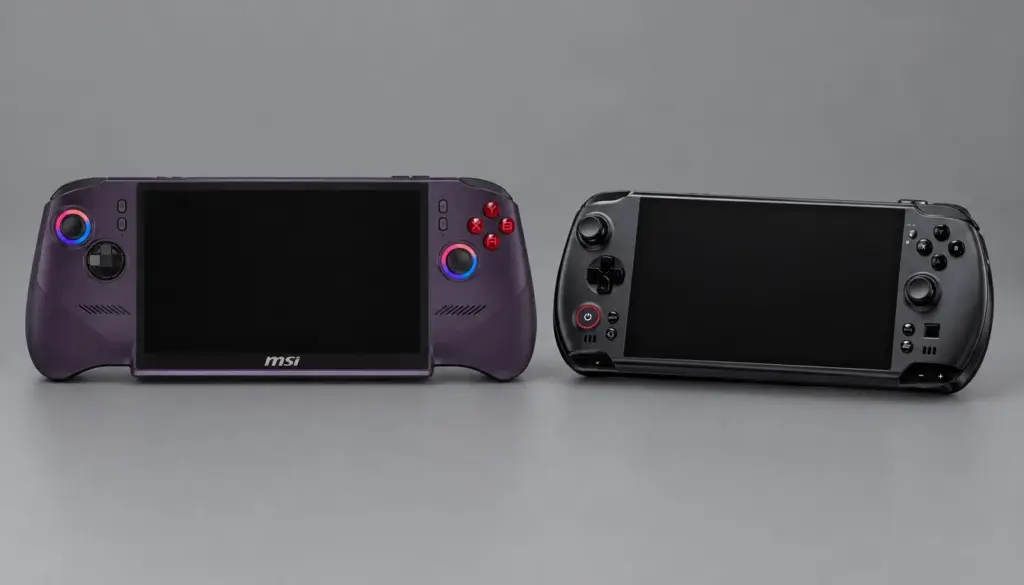
Two flagship handheld gaming PCs landed within weeks of each other this fall, and neither one is chasing the budget crowd. The MSI Claw 8 EX AI+ showed up carrying Intel’s brand-new Arc G3 Extreme platform, while the GPD WIN 5 arrived running AMD’s Ryzen AI Max+ 395 silicon with a 40-compute-unit Radeon 8060S GPU onboard. Both machines cost more than $1,600. Both ship with 32GB of memory as a baseline. And both are explicitly built to challenge the idea that a handheld gaming PC has to be a compromise next to a desktop tower.
That makes this a genuinely useful comparison rather than a spec-sheet exercise. Shoppers searching for the GPD WIN 5 right now are overwhelmingly comparing it against one rival: the MSI Claw 8 EX AI+. The two take almost opposite engineering paths to reach similar price points, and the differences show up fast once you look past the marketing slides.

Don't miss new tech stories on Google
Add Shattered once in the Google app and our stories show up in your news suggestions.
Why Two New Handhelds Are Splitting the Enthusiast Market
The handheld gaming PC category spent its first few years, from the Steam Deck’s 2022 debut through 2024, as an almost entirely AMD affair. That changed hard in 2026. Intel pushed its Arc G3 Extreme platform into premium handhelds, Qualcomm dropped a Snapdragon-based entry at the low end, and AMD answered by pushing its desktop-class Strix Halo silicon, marketed as Ryzen AI Max, down into pocket-sized hardware. The MSI Claw 8 EX AI+ and the GPD WIN 5 sit at the top of that reshuffled field, and they represent two very different bets about what a $1,700 handheld should prioritize.
MSI’s bet is efficiency and polish: a 14-core hybrid chip with a modest 12-core integrated GPU, tuned for battery runtime and a refined cooling stack. GPD’s bet is raw horsepower: a 40-compute-unit GPU borrowed from AMD’s workstation-class Strix Halo platform, paired with memory configurations that scale all the way to 128GB, which is unheard of in a handheld. Neither approach is objectively correct. They’re built for different buyers, and the rest of this comparison exists to help you figure out which buyer you are.
It’s also worth noting that this chip rivalry is broader than just these two devices. Intel’s Arc G3 Extreme platform also powers the Acer Predator Atlas 8, and outlets covering the wider handheld chip war have already pitted Arc G3 Extreme against AMD’s own Ryzen AI Max-class silicon across multiple vendors, not just GPD. The MSI Claw 8 EX AI+ vs GPD WIN 5 matchup is simply the clearest one-to-one read on that fight at the premium end of the market right now.
MSI Claw 8 EX AI+ at a Glance
The MSI Claw 8 EX AI+ is built around Intel’s Arc G3 Extreme platform, a 14-core hybrid design combining 2 Cougar Cove performance cores, 8 Darkmont efficiency cores, and 4 Darkmont low-power efficiency cores, with boost clocks reaching up to 4.7GHz. The chip runs on a configurable thermal envelope between 8W and 35W, which is what lets MSI offer both a battery-stretching low-power mode and a plugged-in performance mode from the same silicon.
Graphics duties fall to the integrated Intel Arc B390, built on the Xe3 architecture with 12 Xe-cores, 96 XMX matrix engines for AI-accelerated upscaling, and 12 dedicated ray-tracing units. That’s a meaningful jump from the previous-generation Lunar Lake-based MSI Claw 8 AI+, which shipped with the older Arc 140V graphics block. Reviewers who tested both machines back to back reported up to 47% higher 3DMark Time Spy scores and up to 54% higher Cyberpunk 2077 frame rates on the EX AI+ compared with its Lunar Lake predecessor, which tells you how large a generational leap Arc G3 Extreme represents for MSI’s handheld line.
The rest of the spec sheet is tuned for a travel-friendly, all-day device: an 8-inch, 1920×1200 IPS touchscreen with a 48-120Hz variable refresh range, 32GB of LPDDR5x memory, a 1TB PCIe Gen 4 SSD, two Thunderbolt 4 ports with DisplayPort and Power Delivery support, Wi-Fi 7, and Bluetooth. At 785 grams and 11.6 x 5.1 x 1.9 inches, it’s a dense but manageable device to hold for long sessions.
GPD WIN 5 at a Glance
The GPD WIN 5 takes the opposite philosophy: start with a desktop-grade APU and shrink the chassis around it. GPD offers the WIN 5 in two silicon tiers. The entry configuration runs AMD’s Ryzen AI Max 385 paired with a 32-compute-unit Radeon 8050S GPU. The flagship configuration steps up to the Ryzen AI Max+ 395, which pairs with the 40-compute-unit Radeon 8060S, the same RDNA 3.5 graphics block AMD uses in its Strix Halo workstation and mini-PC platforms, clocked up to 2.9GHz.
That GPU choice is the single biggest differentiator in this comparison. Where MSI’s Arc B390 tops out at 12 Xe-cores, GPD’s Radeon 8060S brings more than three times the compute unit count, and reviewers covering the device have pointed to comparisons placing the WIN 5’s flagship configuration at roughly 70-90% of base PlayStation 5 graphics performance in some workloads, a figure that would have been unthinkable in a handheld form factor even a year ago.
The screen is smaller than the Claw’s at 7 inches, running 1920×1080 at 120Hz with AMD FreeSync Premium and a quoted 6ms response time. Memory scales from 32GB up to a genuinely unusual 128GB of LPDDR5X-8000, and storage runs from 1TB to 4TB across an M.2 2280 PCIe 4.0 slot, with an additional Mini SSD slot for BIWIN modules between 512GB and 2TB. GPD lists the handheld’s own weight at roughly 590 grams, with retailer listings for bundled configurations, which include the external battery pack, running closer to 915 grams. Dimensions come in at 267 x 111.6 x 24.2mm, noticeably narrower but thinner than the Claw.
Full Spec Comparison: MSI Claw 8 EX AI+ vs GPD WIN 5
Here is how the two handhelds stack up across every major spec category, drawn from manufacturer listings and reviewer-reported figures.
| Spec | MSI Claw 8 EX AI+ | GPD WIN 5 |
|---|---|---|
| CPU | Intel Arc G3 Extreme, 14 cores (2P+8E+4LPE), up to 4.7GHz | AMD Ryzen AI Max 385 or Ryzen AI Max+ 395 |
| GPU | Intel Arc B390, Xe3, 12 Xe-cores, 96 XMX engines, 12 RT units | Radeon 8050S (32 CU) or Radeon 8060S (40 CU, up to 2.9GHz), RDNA 3.5 |
| Display | 8-inch, 1920×1200 IPS touchscreen, 48-120Hz VRR | 7-inch, 1920×1080, 120Hz, FreeSync Premium, 6ms response |
| RAM | 32GB LPDDR5x | 32GB / 64GB / 128GB LPDDR5X-8000 |
| Storage | 1TB PCIe Gen 4 NVMe SSD | 1TB / 2TB / 4TB PCIe 4.0 NVMe SSD, plus a Mini SSD slot for a 512GB-2TB BIWIN module |
| Battery | Internal battery, exact Wh not disclosed in current listings | Removable design, reported as either an 80Wh pack or a 35Wh internal plus 80Wh detachable external pack; 180W, 20V/9A charger |
| Weight | 785g (1.73 lb) | ~590g handheld alone; ~915g in bundled listings with external battery |
| Dimensions | 294.6 x 129.5 x 48.3mm | 267 x 111.6 x 24.2mm |
| Ports | 2x Thunderbolt 4 (DisplayPort, Power Delivery), microSD, 3.5mm jack | USB4 (40Gbps, DP 2.1, 100W PD), USB-C 3.2 Gen 2 (10Gbps, DP 2.1, no charging), USB-A 3.2 Gen 2, microSD, 3.5mm jack |
| Wireless | Wi-Fi 7, Bluetooth | Not fully disclosed in available listings |
| Cooling | MSI Cooler Boost HyperFlow, interflow layout, up to 25% higher static pressure vs prior design | Dual-fan, four-heat-pipe design, up to 85W sustained TDP |
| Launch price (base) | Reported at $1,799 by one outlet, $2,200 by another, with an earlier preorder tier at $1,499 | $1,448 crowdfunding price for Max 385/32GB/1TB; est. retail from $1,600 |
| Launch price (flagship) | Same 32GB/1TB configuration as base; no separate flagship SKU confirmed | $1,650 crowdfunding price for Max+ 395/32GB/2TB; est. retail from $1,850; one retailer lists Max+ 395/32GB/1TB at $1,722 |
| Availability window | Q4 2026 | Shipping tied to a crowdfunding campaign, with the flagship Ryzen AI Max+ 395 tier reaching buyers through September and October 2026 |
Two things jump out immediately. First, GPD’s pricing is murkier than MSI’s because the WIN 5 launched through a crowdfunding campaign with tiered backer pricing before settling into retail listings, so “the price” genuinely depends on when and where you buy. Second, the battery capacity discrepancy on the WIN 5, where some listings describe a single 80Wh removable pack and others describe a 35Wh internal cell plus an 80Wh detachable external pack, is not yet fully resolved across retailer documentation. Buyers comparing these two machines on battery life alone should treat GPD’s own spec sheet as the authoritative source at the point of purchase.
Chip Architecture: Arc G3 Extreme vs Ryzen AI Max+ 395
The architectural split here is the whole story. Intel’s Arc G3 Extreme platform, the chip at the heart of the MSI Claw 8 EX AI+, pairs a modest 14-core hybrid CPU with a comparatively small 12 Xe-core GPU, but it runs within an 8-35W configurable envelope. That narrow power window is a deliberate trade: Intel is optimizing for sustained battery runtime and lower heat output rather than peak throughput, and it leans on 96 XMX matrix engines to do AI-upscaling work like XeSS, which lets the chip punch above its raw compute numbers in supported titles.
AMD’s approach with the Ryzen AI Max+ 395 is almost the inverse. This is the same silicon family AMD ships in Strix Halo mini-PCs and workstation-class laptops, repurposed for a handheld chassis. The Radeon 8060S graphics block carries 40 RDNA 3.5 compute units, more than triple the Xe-core count in Intel’s chip, and GPD’s cooling system is built to sustain up to 85W, more than double the Claw’s upper limit. That’s the trade-off in plain terms: GPD is chasing raw frame rates and is willing to spend more battery and generate more heat to get there, while MSI is chasing efficiency and battery life at a lower performance ceiling.
Neither chip is objectively “better” in the way a single benchmark number implies. A 40-compute-unit GPU running at 85W will out-render a 12-core GPU running at 35W in almost any demanding title, full stop. The real question for a buyer is whether they want that extra performance enough to accept shorter battery life, a louder fan, and, in GPD’s case, a battery and weight situation that’s still shaking out across retail listings.
Display, Build Quality, and Ergonomics
MSI’s 8-inch, 1920×1200 IPS touchscreen gives up some pixel density compared with GPD’s 7-inch 1920×1080 panel, but the larger canvas and taller 16:10 aspect ratio make a real difference for anyone who alternates between gaming and productivity work, since more vertical space shows more of a spreadsheet or code editor without scrolling. Both panels support a 120Hz refresh ceiling, which matters more for competitive shooters and fast-paced action titles than for story-driven games, where even 60Hz is plenty.
Weight and dimensions tell a more complicated story than the raw numbers suggest. The Claw’s 785 grams is heavier than GPD’s quoted 590-gram figure for the handheld alone, but that GPD number appears to exclude the external battery pack that some configurations rely on, and bundled retailer listings put the WIN 5 closer to 915 grams once that pack is attached. In practice, a GPD WIN 5 running in its highest-performance mode with the external battery connected will likely feel heavier and more front-loaded in the hands than the Claw, even though GPD’s spec sheet implies the opposite.
Port layout favors GPD for anyone running an external monitor or dock setup. The WIN 5’s USB4 port carries 40Gbps of bandwidth, DisplayPort 2.1, and 100W of Power Delivery, while a second USB-C port adds DisplayPort without charging and a USB-A port rounds things out. MSI’s dual Thunderbolt 4 ports are themselves fast and flexible, carrying both DisplayPort and Power Delivery on either port, which is arguably a cleaner setup since either port can charge or output video. Both machines include microSD slots and standard 3.5mm headphone jacks, so neither one forces you into wireless-only audio.
Controls, Input, and Handling Comparison
Neither MSI nor GPD has published a radically different control layout from what’s become the standard handheld formula: dual analog sticks, a D-pad, four face buttons, shoulder triggers, and a handful of back or extra function buttons. Where the two diverge is in how that layout sits relative to the chassis size. The Claw’s wider 785-gram body and 8-inch screen push the control sticks further apart than on a 7-inch device, which tends to feel more natural for players with larger hands but can require more of a reach for smaller ones during fast thumbstick movements.
GPD’s handheld lineage goes back further than MSI’s in this specific niche, and the company has historically packed extra input options into its devices, including back paddles and, on some past models, a built-in trackball or mini-keyboard. Whether the WIN 5 carries forward any of those extras beyond the standard stick-and-button layout isn’t fully detailed in current retail listings, so buyers who specifically want GPD’s signature extra-input tricks should confirm the exact control layout before ordering rather than assuming it matches an older WIN-series model.
Grip comfort during long sessions is where the weight distribution difference matters more than the raw gram count. Because GPD’s battery setup may rely on an external pack connected to the bottom or rear of the chassis, the WIN 5’s center of gravity can shift once that pack is attached, which some handheld reviewers have flagged as a factor that makes bare-spec weight comparisons less useful than they first appear. The Claw’s single internal battery, by contrast, keeps its weight distribution consistent no matter how you’re using it, which is a small but real ergonomic advantage for marathon sessions.
Benchmark Results: 3DMark, Cyberpunk 2077, and Black Myth: Wukong
Independent benchmark coverage of the MSI Claw 8 EX AI+ is further along than coverage of the GPD WIN 5, which is still working through early retail and crowdfunding shipments. Here’s what reviewers have published for each machine so far.
| Benchmark | MSI Claw 8 EX AI+ | GPD WIN 5 (Max+ 395 tier) |
|---|---|---|
| 3DMark Fire Strike | 12,358 | Not yet independently published |
| 3DMark Time Spy | 6,534 | Not yet independently published |
| 3DMark Steel Nomad | 1,425 | Not yet independently published |
| 3DMark Port Royal | 3,544 | Not yet independently published |
| Geekbench single/multi-core | 2,256 / 14,661 | Not yet independently published |
| Cyberpunk 2077 | 54 fps at 1080p, High preset, with XeSS Performance upscaling | No verified frame rate figure yet published |
| Black Myth: Wukong | Not yet independently published | Reported above 80 fps at 1080p, High preset, by a buying-guide source; not yet confirmed by a lab-style test with full settings disclosed |
| Shadow of the Tomb Raider | 98 fps at 800p on battery, 112 fps plugged in; 67 fps at 1200p on battery | Not yet independently published |
| General comparison point | Up to 47% faster Time Spy and 54% faster Cyberpunk 2077 vs. the previous-generation Lunar Lake Claw 8 AI+ | Positioned by reviewers at roughly 70-90% of base PlayStation 5 graphics performance in select comparisons |
The gap in published GPD WIN 5 benchmarks is a real limitation of this comparison, and it’s worth being upfront about it rather than filling in numbers that haven’t actually been measured. What’s available suggests the Radeon 8060S’s 40-compute-unit advantage should translate into a meaningful frame-rate edge over the Claw’s 12-core Arc B390 in GPU-bound titles, and the PS5-adjacent performance claim points in that direction. But until more outlets run the WIN 5 through the same 3DMark and Cyberpunk 2077 tests MSI’s device has already been through, a precise, apples-to-apples frame-rate gap between these two specific machines isn’t something you should trust from any single source, including this one.
Battery Life Under Real Workloads
Battery testing on both devices shows the familiar handheld pattern: shorter runtime at full power, longer runtime once you cap the wattage. For the MSI Claw 8 EX AI+, reviewers have reported around 2 hours of demanding AAA gaming at the chip’s highest power state, stretching to roughly 3.5 hours when the system is capped at 15W. In lighter productivity-style use, like a Microsoft Office battery loop, one test recorded about 13 hours, and a separate, less gaming-representative test recorded over 18 hours.
The GPD WIN 5’s battery figures swing even more dramatically depending on power draw, which tracks with its higher 85W TDP ceiling. At maximum power, a sustained Cinebench loop drained the battery in about 42 minutes. Dial the chip down to 13W and one longevity test ran past 9 hours. At a middle-ground 55W TDP with 50% screen brightness and the system idling on the desktop, testers clocked roughly 10 hours. In a more direct gaming comparison at 30W and 60Hz, the WIN 5 lasted about 1.4 hours against a Steam Deck OLED’s 2.8 hours in the same test, though attaching GPD’s external battery pack reportedly extended total runtime to around 2.5 hours.
The takeaway is straightforward: if you plan to game at anything close to each chip’s peak wattage, expect roughly 1.5 to 2 hours from either device, with the Claw holding a modest edge thanks to its lower power ceiling. If you’re willing to cap performance and lean on battery-saver profiles, both machines can stretch well past the 9-hour mark, though at that point you’re trading away most of the reason to buy either one over a cheaper, lower-power handheld.
Cooling and Thermal Design
MSI’s cooling solution for the Claw 8 EX AI+ is branded Cooler Boost HyperFlow, and the company describes an interflow thermal layout with a fan height increased by roughly half a millimeter over its prior design, which it says adds about 5W of additional cooling capacity along with 25% higher static pressure and 9% more airflow. Combined with the chip’s 8-35W configurable envelope, that’s a cooling system built to run quiet and cool rather than to chase every last frame per second.
GPD’s dual-fan, four-heat-pipe setup is built for a different job: dissipating heat from a chip that can sustain up to 85W, more than double what the Claw’s cooler needs to handle. That’s a substantially bigger thermal load for a smaller 7-inch chassis to manage, and it’s one reason the WIN 5’s short-duration battery figures at maximum power look so aggressive compared with the Claw’s. Whether GPD’s dual-fan design can hold that line quietly over a long gaming session is the kind of question that only shows up in sustained, hour-plus review sessions, and broader third-party thermal testing on the WIN 5 is still catching up to the device’s retail availability.
Pricing and Configurations Compared
Pricing on these two handhelds is harder to pin down than usual, and for different reasons. MSI’s listings have been inconsistent across outlets: Tom’s Guide reported the EX AI+ at $1,799, while MobileSyrup listed it at $2,200, and an earlier preorder tier had briefly priced the device at $1,499. Until MSI publishes one unified global price sheet, treat $1,799 as the more conservative, better-supported figure for the 32GB/1TB configuration.
GPD’s pricing is complicated by its crowdfunding launch model. The WIN 5 debuted through a campaign offering backer pricing well below the eventual estimated retail price, and later retail listings have landed somewhere in between.
| Configuration | Crowdfunding price | Estimated retail price |
|---|---|---|
| GPD WIN 5, Ryzen AI Max 385, 32GB/1TB | $1,448 | From $1,600 |
| GPD WIN 5, Ryzen AI Max+ 395, 32GB/2TB | $1,650 | From $1,850 |
| GPD WIN 5, Ryzen AI Max+ 395, 32GB/1TB (later retail listing) | N/A | $1,722 |
| MSI Claw 8 EX AI+, 32GB/1TB | N/A | $1,799 (one outlet reports $2,200) |
Read across the table, the practical price gap between the entry-level GPD WIN 5 and the MSI Claw 8 EX AI+ runs anywhere from roughly $80 to nearly $350, depending entirely on which GPD configuration and which MSI price report you’re comparing. The clearest conclusion is that stepping up to GPD’s flagship Ryzen AI Max+ 395 tier with 2TB of storage lands very close to MSI’s asking price, while the entry Ryzen AI Max 385 tier undercuts it by a meaningful margin if you don’t need the extra compute units.
Real-World Use Cases: 5 Scenarios Where Each Handheld Wins
Spec sheets only go so far. Here’s how the trade-offs in this comparison actually play out across common buyer scenarios.
- Long-haul travel gaming: The MSI Claw 8 EX AI+’s 8-35W envelope and reported 3.5-hour runtime in capped gaming modes make it the better pick for a cross-country flight or a long train ride where you won’t have a wall outlet. Its 8-inch screen is also easier on the eyes during extended sessions.
- Pushing the newest AAA titles at native settings: The GPD WIN 5’s Ryzen AI Max+ 395 and 40-compute-unit Radeon 8060S give it a real performance ceiling advantage for demanding, GPU-bound games, assuming you’re near a power outlet and comfortable with shorter unplugged runtime.
- Doubling as a portable workstation: GPD’s 128GB memory ceiling and up to 4TB of onboard storage, plus a separate Mini SSD slot, make the WIN 5 a credible option for creators running local AI models, video editing, or memory-heavy development work between gaming sessions. No handheld at MSI’s price point offers anywhere near that memory headroom.
- Docked, TV-connected play: Both machines handle dock duty well thanks to DisplayPort-capable USB-C ports, but MSI’s dual Thunderbolt 4 ports mean either port can drive an external display and charge simultaneously, which is a small but real convenience advantage when cable routing is tight near a TV stand.
- Budget-conscious buyers who still want Strix Halo-class graphics: The entry-level GPD WIN 5 configuration with the Ryzen AI Max 385 and 32-compute-unit Radeon 8050S undercuts the MSI Claw 8 EX AI+ by as much as a few hundred dollars at crowdfunding pricing, while still offering a meaningfully larger GPU than Intel’s Arc B390.
Migrating From a Steam Deck, ROG Ally, or Legion Go
Both of these handhelds run full Windows, not SteamOS, so switching from a Steam Deck means a genuinely different setup process than swapping between two Windows-based handhelds like a ROG Ally or Legion Go. Here’s a practical path to get either machine configured for gaming without losing your existing library.
- Sign into your existing Steam, Xbox, Epic Games Store, and Battle.net accounts on the new device first, before installing anything else, so cloud saves start syncing in the background while you set everything else up.
- Update Windows fully before installing any games. Both MSI and GPD ship chipset and GPU drivers through their own control-panel apps, and running Windows Update first avoids driver conflicts that are common on brand-new handheld SKUs.
- Install MSI’s or GPD’s dedicated handheld control software (MSI Center M on the Claw, GPD’s control app on the WIN 5) before touching power profiles. These apps gate access to TDP sliders, fan curves, and button remapping.
- If you’re coming from a Steam Deck, remap your Steam Input profile manually. Valve’s community-shared controller configs don’t transfer to Windows-based handhelds, so you’ll need to rebuild or download a Windows-compatible layout for each game.
- Set a conservative TDP profile first (15W on the Claw, 30-45W on the WIN 5) and benchmark your most-played game before cranking the power limit. Both chips can run hotter than their default profiles, but doing so burns through battery life fast, as the testing above shows.
- Reinstall games rather than copying save folders wholesale from an old handheld’s SSD. Windows handhelds handle driver-specific shader caches differently than SteamOS, and a clean install avoids stutter on first launch.
- If storage is tight, use the Claw’s single M.2 2230 slot or the WIN 5’s M.2 2280 slot plus Mini SSD slot to add capacity before you run out of room, rather than relying on microSD for actively played titles, since sequential read speeds on microSD are far below either device’s onboard NVMe storage.
- Calibrate battery reporting by running one full charge-to-empty cycle in your first week. Both devices’ battery percentage estimates can be inaccurate until the system completes a full calibration cycle.
Pros and Cons: MSI Claw 8 EX AI+
The Claw 8 EX AI+’s strongest selling points are its efficiency, its more mature benchmark record, and the simplicity of a single clear SKU rather than a confusing lineup of crowdfunding tiers. Its weaknesses are a smaller GPU core count and the price inconsistency across retailers that MSI has yet to clean up.
| Pros | Cons |
|---|---|
| Up to 47% faster 3DMark Time Spy and 54% faster Cyberpunk 2077 vs. the previous-generation Claw | Only a 12 Xe-core GPU, well short of GPD’s 40-compute-unit flagship tier |
| Configurable 8-35W envelope tuned for battery runtime | Reported launch price varies wildly between outlets, from $1,499 to $2,200 |
| Dual Thunderbolt 4 ports, each capable of charging and video output | Single 1TB storage option with no listed expansion past the microSD slot |
| Independently published, reproducible 3DMark and Geekbench scores already available | 32GB RAM ceiling, with no higher-memory configuration offered |
| Refined Cooler Boost HyperFlow cooling with measurable airflow gains over the prior model | 8-inch screen and 785g weight make it noticeably larger and heavier than the WIN 5’s bare chassis |
Pros and Cons: GPD WIN 5
The WIN 5’s strongest selling points are its GPU horsepower and its unusually high memory and storage ceilings. Its weaknesses are a less mature public benchmark record, a confusing crowdfunding-to-retail pricing structure, and conflicting documentation on its own battery configuration.
| Pros | Cons |
|---|---|
| Flagship Radeon 8060S GPU carries 40 RDNA 3.5 compute units, more than triple the Claw’s GPU core count | No independently published 3DMark, Geekbench, or Cyberpunk 2077 figures as of this comparison |
| Memory scales up to 128GB, far beyond any handheld at this price point | Battery configuration is described inconsistently across listings: 80Wh removable vs. 35Wh internal plus 80Wh external |
| Storage scales to 4TB plus a separate Mini SSD slot for additional capacity | Entry-level listings run as low as roughly 1.4 hours of gaming battery life at 30W without the external pack |
| Entry-tier Ryzen AI Max 385 configuration undercuts MSI’s price by hundreds of dollars | Pricing structure spans crowdfunding backer tiers and separate retail listings, making “the price” genuinely unclear at a glance |
| USB4 port delivers 40Gbps bandwidth and 100W Power Delivery | Weight climbs significantly once the external battery pack is attached, undercutting the device’s lighter on-paper spec |
The Broader Handheld Chip War: Where These Two Fit
Neither of these devices exists in a vacuum. Intel’s Arc G3 Extreme platform also powers the Acer Predator Atlas 8, giving Intel two flagship handheld design wins in the same generation, while Qualcomm has entered the category’s lower end with its Snapdragon G2 Gen 2 chip inside devices like the ARC X1. According to coverage from UnixGaming’s rundown of the 2026 handheld chip war, this three-way (and now effectively four-way, counting GPD’s AMD-based entry) silicon competition has pushed premium handheld pricing as high as $1,799 at the top end, while entry-level Snapdragon-based devices have pushed the floor down toward the $140-$300 range.
That spread matters for context. The MSI Claw 8 EX AI+ and GPD WIN 5 are both playing at the very top of that pricing range, competing for buyers who have already decided they want flagship performance and are choosing between architecture philosophies rather than deciding whether to spend $1,700 on a handheld at all. Outlets tracking the category broadly, including Dexerto’s roundup of upcoming handheld gaming consoles, have noted that this generation is the first where buyers genuinely have to weigh architecture and brand ecosystem, not just price and screen size, when picking a device.
General buying guides from outlets like Tom’s Guide’s best handheld gaming consoles roundup and Wirecutter’s best handheld gaming console picks continue to weigh these newer AMD and Intel-based machines against established names like the Steam Deck OLED and the ROG Xbox Ally lineup, and that broader context is useful if you’re not yet sold on spending flagship money on either the Claw 8 EX AI+ or the WIN 5 specifically. Hardware trackers such as VideoCardz’s gaming handhelds coverage have also been tracking driver and firmware updates for both chip platforms since launch, which is worth checking before a purchase given how new both platforms are.
Software, Drivers, and Day-One Stability
Buying into a brand-new chip platform carries a real cost that specs don’t capture: driver maturity. Intel’s Arc G3 Extreme platform is Intel’s second generation of serious handheld-tuned graphics drivers, following the Lunar Lake-era Arc 140V, so the software stack behind the Claw 8 EX AI+ has had time to mature across multiple driver releases. AMD’s Ryzen AI Max+ 395 silicon, by contrast, is a Strix Halo-class chip that’s well established in mini-PCs and laptops but genuinely new to GPD’s handheld-specific power and thermal management firmware, which means early WIN 5 buyers are more likely to hit platform-specific quirks that get resolved through firmware updates over the device’s first few months on the market.
Neither issue is a dealbreaker, but it’s a real consideration if you’re the kind of buyer who wants a device to just work out of the box rather than troubleshooting fan curves or sleep-mode bugs through a handful of firmware updates. If day-one stability matters more to you than raw GPU headroom, that favors the more iterated MSI platform. If you’re comfortable being an early adopter in exchange for a bigger GPU, the WIN 5’s rougher software edges are a reasonable trade.
Repairability, Warranty, and Long-Term Value
A $1,700-plus handheld is a purchase most buyers expect to hold onto for several years, which makes repairability and upgrade headroom worth weighing alongside day-one specs. Both the MSI Claw 8 EX AI+ and the GPD WIN 5 use user-accessible M.2 SSD slots rather than soldered storage, which is the single most important repairability feature either device offers, since a full SSD or a failed drive doesn’t mean replacing the entire machine. The Claw’s M.2 2230 slot is a smaller form factor than the WIN 5’s M.2 2280 slot, and 2280 drives are generally cheaper and more widely available at higher capacities, giving GPD’s device a practical edge if you plan to upgrade storage down the line.
Memory is the bigger long-term divide. The Claw’s 32GB of LPDDR5x is soldered to the board, as is standard across nearly every modern handheld, which means there’s no path to add RAM later no matter how your needs change. GPD’s WIN 5 ships with memory configurations fixed at purchase as well, since LPDDR5X is soldered for bandwidth reasons on both platforms, but the fact that GPD offers a 128GB tier at all means buyers who know they’ll want that headroom can get it on day one, where Claw buyers simply have no equivalent option regardless of budget.
Neither manufacturer has published handheld-specific extended warranty programs beyond standard regional consumer protection terms, and GPD’s crowdfunding-to-retail sales model historically comes with less predictable post-purchase support than a company like MSI, which sells through conventional retail channels with established RMA processes. That’s not a knock on build quality, since GPD has shipped many handhelds before the WIN 5 without major reliability scandals, but it is a realistic difference in how straightforward a warranty claim is likely to be if something goes wrong in year two or three.
Verdict: Which Handheld Should You Buy
Based on everything above, the MSI Claw 8 EX AI+ is the stronger pick for buyers who prioritize battery life, a smaller and more predictable price tag, and a platform with an already-established benchmark record. Its reported 3DMark Time Spy score of 6,534 and 54 fps Cyberpunk 2077 result at 1080p High are solid, verifiable numbers for a 35W-class chip, and its dual Thunderbolt 4 setup and refined cooling make it the lower-friction choice for travel and docked use alike.
The GPD WIN 5 is the stronger pick if raw GPU performance and future-proofing through memory and storage headroom matter more to you than polish. A 40-compute-unit Radeon 8060S GPU and up to 128GB of RAM are specs that simply don’t exist elsewhere in this price bracket, and the entry-level Ryzen AI Max 385 configuration can undercut the Claw’s price by a meaningful margin. The trade-offs are real, though: unresolved battery documentation, a confusing crowdfunding-to-retail price spread, and a lack of independently published benchmark numbers mean you’re buying ahead of the full review cycle rather than into one.
If you need a device today and want to know exactly what you’re getting, the Claw 8 EX AI+’s $1,799 asking price and documented benchmark results make it the safer purchase. If you’re comfortable waiting for fuller third-party testing and want the biggest GPU a handheld can currently offer, the WIN 5’s Ryzen AI Max+ 395 tier is the more future-facing bet, provided you go in prepared for a less mature software stack and some retailer-to-retailer pricing confusion.
Frequently Asked Questions
Is the GPD WIN 5 more powerful than the MSI Claw 8 EX AI+?
On paper, yes, in raw GPU compute. The WIN 5’s flagship Ryzen AI Max+ 395 configuration pairs with a 40-compute-unit Radeon 8060S GPU, more than triple the 12 Xe-core count in the Claw’s Arc B390. Independently verified, apples-to-apples benchmark comparisons between the two specific devices aren’t widely published yet, so treat the compute unit gap as a strong indicator rather than a confirmed frame-rate multiplier.
How much does the GPD WIN 5 actually cost?
It depends on configuration and purchase channel. Crowdfunding backer pricing started at $1,448 for the entry Ryzen AI Max 385 tier with 32GB of RAM and 1TB of storage, and $1,650 for the flagship Ryzen AI Max+ 395 tier with 2TB of storage. Estimated retail pricing runs from $1,600 to $1,850 across those same tiers, with at least one retailer listing a Max+ 395/32GB/1TB configuration at $1,722.
What is the real price of the MSI Claw 8 EX AI+?
Reports are inconsistent. Tom’s Guide listed it at $1,799, while MobileSyrup reported $2,200, and an earlier preorder tier briefly offered the device at $1,499. Until MSI standardizes pricing across regions and retailers, treat $1,799 as the better-supported figure for the standard 32GB/1TB configuration.
Does either handheld run SteamOS?
No. Both the MSI Claw 8 EX AI+ and the GPD WIN 5 ship with full Windows installed. Neither is a SteamOS-based device like the Steam Deck, which means both support the entire Windows game library, including Xbox Game Pass and Epic Games Store titles, but without SteamOS’s console-style boot interface unless you install a third-party shell.
How long does the battery actually last on each device?
At maximum performance, expect roughly 1.5 to 2 hours of demanding gaming on either machine. The Claw reports around 2 hours at full power and roughly 3.5 hours capped at 15W. The WIN 5’s figures vary more by power draw, from about 42 minutes of sustained Cinebench load at maximum wattage to over 9 hours at a conservative 13W cap.
Can I add more storage to either handheld later?
Yes, with different flexibility. The Claw 8 EX AI+ includes a single M.2 2230 PCIe Gen 4 slot that ships with up to 1TB and a microSD reader for lower-speed expansion. The WIN 5 offers a larger M.2 2280 slot supporting up to 4TB plus a separate Mini SSD slot compatible with 512GB to 2TB BIWIN modules, giving it meaningfully more total storage headroom.
Which handheld is better for creative work or local AI tasks, not just gaming?
The GPD WIN 5, by a wide margin, mainly because of its memory ceiling. A 128GB RAM configuration is enough to run substantially larger local AI models or handle memory-heavy creative workloads that would simply be impossible on the Claw’s fixed 32GB of LPDDR5x.
Is it worth waiting for more handhelds before buying either of these?
If you’re not in a hurry, it’s a reasonable question. AMD’s next-generation Ryzen Z3 handheld silicon and Nvidia’s rumored entry into the handheld GPU space are both reportedly in development, and Intel’s Arc G3 Extreme platform is also powering devices beyond the Claw, including the Acer Predator Atlas 8. Buyers who aren’t locked into a specific need right now may get a clearer picture of the field within the next couple of product cycles.