
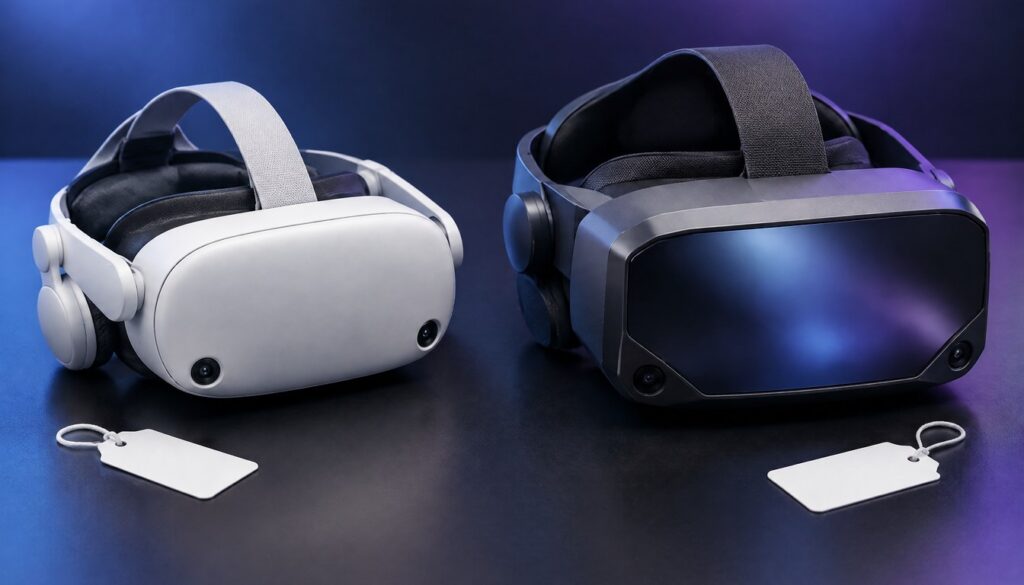
Valve picked a Monday to blow up the VR market. On September 14, 2026, the company quietly opened reservations and then, within weeks, started shipping the Steam Frame, its first standalone headset, at a price that stopped a lot of shoppers cold: $1,059 for the 256GB kit and $1,299 for the 1TB version. That is roughly 77% more than the $599 Meta is now charging for the 512GB Quest 3, after Meta raised that headset’s price from $499 back in April 2026. For anyone shopping for a VR headset this fall, the steam frame vs quest 3 question is no longer theoretical. It is a real purchase decision with a nearly $500 gap between the two devices.
We also cover the regional pricing differences, a step-by-step migration path if you are switching ecosystems, and five concrete buying scenarios so you can match the hardware to how you actually plan to use it.
Valve’s $1,059 Surprise Launch Changes the VR Calculus
Valve had been teasing a new headset for over a year, but the actual launch caught much of the VR press off guard. According to a report on the launch, Valve “officially released the Steam Frame VR headset” on a Monday, with the 256GB kit starting at $1,059 amid what the report described as rising component costs. That same week, Valve also launched the Steam Machine console and a new Steam Controller, positioning all three as pieces of a single gaming ecosystem built around SteamOS rather than three disconnected products.
The pricing immediately set Steam Frame apart from every mainstream consumer VR headset on the market. Meta’s Quest 3S starts at $349.99, and the standard Quest 3 now runs $599 for the 512GB configuration. Valve’s bet is that the Steam Frame’s deeper PC integration, its more powerful chipset, and the inclusion of a copy of Half-Life: Alyx justify a price point roughly double what Meta charges for the mid-tier Quest 3. Whether that bet pays off is the core question this comparison tries to answer.
Reservation demand also turned out to be a bottleneck. PC Guide reported that Valve has been emailing reservation holders in waves since mid-September, and as of early October some customers were told their order could ship as late as December 2026 or even push into 2027. Meanwhile, Valve kept iterating on the software: the outlet noted that SteamOS version 0.4 landed on the headset’s ARM64 branch with a battery-life improvement for all users, a sign the company is still actively tuning the device post-launch rather than treating it as finished.
Steam Frame Specs: What Valve Actually Shipped
Strip away the marketing and the Steam Frame is a standalone, Android-adjacent VR headset built to run SteamOS on ARM, with PC streaming baked in as a first-class feature rather than an afterthought. The headset ships with Steam Frame Controllers, a dedicated wireless adapter for PC streaming, and a code for Half-Life: Alyx included in the box at both storage tiers.
At the core of the device sits a Qualcomm Snapdragon 8 Gen 3 chipset paired with 16GB of LPDDR5X memory, a notably larger memory allowance than most standalone headsets carry. The display stack uses pancake lenses in front of a 2,160 x 2,160 LCD panel per eye, with a field of view rated at 110 degrees. Refresh rate options span 72Hz up to 144Hz, though the top rate is still flagged as experimental in the current software build rather than a fully supported mode.
Weight is where the design trade-offs show up. Reports put the front unit at roughly 185 grams with the battery and strap assembly bringing the total closer to 440 grams, a split-weight design meant to balance the mass against the back of the head rather than load it all onto the face. Battery capacity is rated at 21.6Wh, though one teardown reportedly found a 20.9Wh label inside the unit, and early reviews describe real-world runtime landing closer to one to two hours depending on workload.
On the connectivity side, the headset itself supports Wi-Fi 7, and PC streaming runs through a dedicated 6GHz wireless adapter included in the box, a setup Valve is pitching as a faster, lower-latency alternative to routing PCVR traffic over a shared home network.
Meta Quest 3 and Quest 3S Specs: The Incumbent Lineup
Meta’s side of the steam frame vs quest 3 matchup is really two products: the standard Quest 3 and the budget-focused Quest 3S. The Quest 3 runs on a Qualcomm Snapdragon XR2 Gen 2 chipset and uses a display rated at 2,064 x 2,208 pixels per eye, a resolution bump Meta’s own product pages describe as nearly 30% sharper than the original Quest 2. Field of view sits at 110 degrees horizontal, matching the Steam Frame’s rated FOV almost exactly. Refresh rate options run 72Hz, 90Hz, and 120Hz out of the box, with extended rates available behind developer settings.
Weight comes in at approximately 515 grams, and Meta’s official buying page currently lists 512GB as the primary configuration at $599, after the company raised pricing from the original $499 figure on April 19, 2026. A 128GB tier exists “while supplies last,” per Meta’s own storage listing, though current US pricing for that smaller tier was not consistently published at the time of writing. Mixed reality passthrough is a genuine strength here: Meta’s specs describe two RGB cameras delivering 18 pixels-per-degree, which the company states is 4.5 times sharper passthrough than Quest 2 offered, in full color rather than the grainy black-and-white passthrough on older headsets.
The Quest 3S trims cost by reusing older hardware. According to Road to VR’s spec comparison, the Quest 3S “co-opts Quest 2’s old Fresnel lenses and displays for a cheaper (and visually worse) experience than Quest 3.” Field of view drops to 96 degrees horizontal, and the unit weighs roughly 513 grams, just a couple of grams lighter than the standard Quest 3. Pricing lands at $349.99 for 128GB and $449.99 for 256GB in the US, with regional pricing in other markets running proportionally, such as roughly $370 and $480 in some non-US storefronts. Battery life is rated at up to 2.5 hours of average use, slightly better than the standard Quest 3’s roughly two-hour mixed-use figure.
Steam Frame vs Quest 3: Full Specs Comparison Table
Lining up every spec side by side makes the trade-offs clearer than any single paragraph can. Here is the steam frame vs quest 3 breakdown across the categories that matter most for a buying decision, with Quest 3S included where its numbers diverge from the standard Quest 3.
| Spec | Valve Steam Frame | Meta Quest 3 | Meta Quest 3S |
|---|---|---|---|
| Starting price (US) | $1,059 (256GB) | $599 (512GB) | $349.99 (128GB) |
| Top-tier price (US) | $1,299 (1TB) | $599 (512GB only) | $449.99 (256GB) |
| Chipset | Qualcomm Snapdragon 8 Gen 3 | Qualcomm Snapdragon XR2 Gen 2 | Not officially disclosed by Meta |
| RAM | 16GB LPDDR5X | Not published by Meta | Not published by Meta |
| Display resolution (per eye) | 2,160 x 2,160 LCD | 2,064 x 2,208 | Quest 2-generation Fresnel display |
| Refresh rate | 72-144Hz (144Hz experimental) | 72Hz / 90Hz / 120Hz | Lower than Quest 3, exact figure not published |
| Field of view | 110° | 110° horizontal | 96° horizontal |
| Weight | ~440g (185g front unit) | ~515g | ~513g |
| Battery (rated capacity) | 21.6Wh rated | Not published | Not published |
| Battery (real-world runtime) | ~1-2 hours in early reviews | ~2 hours mixed use | Up to 2.5 hours average |
| Storage tiers | 256GB, 1TB | 128GB (while supplies last), 512GB | 128GB, 256GB |
| Lens type | Pancake lenses | Pancake-style lenses | Older Fresnel lenses |
| Headset wireless | Wi-Fi 7 | Wi-Fi 6E | Wi-Fi 6E |
| PC streaming method | Included dedicated 6GHz adapter | Link cable or Air Link over home Wi-Fi | Link cable or Air Link over home Wi-Fi |
| Native OS | SteamOS (ARM64) with Proton + FEX | Horizon OS | Horizon OS |
| Release date | September 14, 2026 | 2023, price revised April 19, 2026 | 2024 |
Two things jump out immediately. First, the field of view is essentially tied between Steam Frame and the standard Quest 3, both at 110 degrees, which undercuts any assumption that the much higher price buys a dramatically wider view. Second, the weight numbers favor Steam Frame’s split-battery design on paper, but that lighter front unit comes paired with the shortest battery runtime of the three headsets, a trade-off worth weighing against how you actually plan to use the device.
Pricing Breakdown: Every Tier, Every Region
Price is the headline story in this comparison, and it is worth separating the US numbers from what buyers elsewhere are actually paying. Valve set Steam Frame pricing on September 14, 2026, the same post that opened reservation signups, and the regional figures show the premium is not just a US phenomenon.
| Region / Item | 256GB / Lower Tier | 1TB / Higher Tier |
|---|---|---|
| Steam Frame (US) | $1,059 | $1,299 |
| Steam Frame (Canada) | CA$1,529 | CA$1,859 |
| Steam Frame (Australia) | A$1,609 | A$1,969 |
| Steam Frame separate power supply | +$29 if not already owned | |
| Quest 3 (US, 512GB only tier currently listed) | $599 | |
| Quest 3S (US) | $349.99 (128GB) | $449.99 (256GB) |
| Quest 3S (select non-US storefront, local currency equiv.) | ~$370 | ~$480 |
The Steam Frame’s bundle does soften the gap slightly. Both storage tiers include the Steam Frame Controllers, the dedicated wireless PC-streaming adapter, and a code for Half-Life: Alyx, items that would otherwise add to a Quest 3 owner’s total cost if they wanted equivalent accessories or a flagship VR title. Even accounting for that bundle, a buyer choosing the entry Steam Frame kit over the Quest 3 is still paying $460 more for the hardware itself, before factoring in the optional $29 charge for a separate power supply if one is not already on hand.
Meta’s Quest 3 price history matters here too. The jump from $499 to $599 on April 19, 2026 means Meta’s own flagship headset got meaningfully more expensive this year, even as it still undercuts Steam Frame’s entry price by close to half. That repricing also effectively collapsed Meta’s old “budget vs flagship” spread, since Quest 3S now covers the lower end and Quest 3 occupies a higher mid-tier slot rather than a true budget option.
Display and Visual Quality: Pixels, Lenses, and Field of View
On paper, the Quest 3 edges out Steam Frame on raw pixel count, 2,064 x 2,208 versus 2,160 x 2,160, though the gap is small enough that it is unlikely to be the deciding factor for most buyers. Both headsets use pancake-style lens designs, which generally produce sharper center-of-view clarity and a more compact form factor than the older Fresnel lenses still found in the budget Quest 3S.
Field of view is where the numbers genuinely converge: both Steam Frame and Quest 3 are rated at 110 degrees, while Quest 3S trails at 96 degrees. That 14-degree gap on the budget model is noticeable in practice, narrowing the edges of your peripheral view inside VR scenes.
Road to VR’s hands-on review of Steam Frame, published September 16, 2026, put the visual comparison plainly: the two headsets are “roughly the same size, have similar visual performance, and a similar field-of-view.” That is a notable finding given the near-doubling in price, and it suggests Valve’s premium is buying something other than a dramatically better picture, whether that is the more powerful chipset, the native PC streaming hardware, or the SteamOS software stack underneath.
Where Quest 3 clearly pulls ahead is passthrough and mixed reality. Meta’s two RGB cameras at 18 pixels-per-degree deliver full-color passthrough that the company rates at 4.5 times sharper than Quest 2’s black-and-white cameras. Steam Frame’s research and marketing material has not emphasized color mixed-reality passthrough as a headline feature in the same way, suggesting Valve’s design priorities sit more squarely on VR gaming and PC streaming than on blended real-world overlays.
Performance: Snapdragon 8 Gen 3 vs Snapdragon XR2 Gen 2
Both headsets run on Qualcomm silicon, but they are not the same chip, and that gap shows up in what each device can actually do locally. Road to VR’s direct spec comparison notes that “both Quest 3 and Frame feature ARM-based Qualcomm Snapdragon processors (Frame’s is more powerful), only Frame can natively play x86 Windows and Linux content thanks to its built-in compatibility layer. Quest 3 can only natively play games compiled for ARM.”
That compatibility layer is a genuine architectural difference, not just a chip generation bump. Steam Frame runs SteamOS on ARM64 and relies on Proton together with FEX, an x86-to-ARM emulation layer, to run standard desktop Steam games that were never built for ARM hardware in the first place. Valve has also built in support for sideloaded Android APKs through a layer referred to as Lepton, giving the headset a secondary software path beyond native SteamVR titles. Quest 3 and Quest 3S, by contrast, are locked to Horizon OS and only run titles compiled for that ARM-based platform, whether sold through the Meta Quest Store or sideloaded through developer channels.
The 16GB of LPDDR5X memory in Steam Frame also outpaces what is typically found in standalone headsets at this price tier, giving it more headroom for the overhead that comes with running an emulation and translation layer on top of games that were never designed for a mobile chipset. None of the available reviews at publication time included independently measured frame-rate benchmarks pitting Steam Frame against Quest 3 on matched titles, so treat the chipset advantage as a hardware specification difference rather than a verified performance multiplier until more head-to-head testing data is published.
Battery Life and Comfort: The Weight-vs-Runtime Trade-off
This is arguably the most practical difference in the entire steam frame vs quest 3 comparison. Steam Frame’s rated 21.6Wh battery (with a teardown reportedly finding a 20.9Wh label on the actual cell) translates to roughly one to two hours of runtime in early hands-on testing, depending on what refresh rate and streaming mode is active. Quest 3 lands around two hours of mixed use, and Quest 3S edges it out slightly at up to 2.5 hours on average, according to Meta’s own published figures.
Valve’s split-weight design, pushing the battery back toward the rear strap rather than stacking everything on the front of the face, is a deliberate comfort trade-off. A 185-gram front unit is lighter than anything in the Quest lineup, which should reduce the forward tug on your face and neck during longer sessions. But that lighter front comes at the cost of the shortest rated runtime of the three headsets compared here, so comfort and battery life are pulling in opposite directions depending on how Valve tuned the trade-off.
The SteamOS 0.4 update that reached users around October 8, 2026 specifically targeted battery-life improvements, which signals Valve is actively aware that runtime is a weak point relative to the competition and is working through firmware rather than hardware revisions to close the gap. Anyone buying at launch should expect runtime to improve somewhat over the life of the product as Valve continues tuning power management, rather than assuming the October 2026 battery figures are final.
Game Libraries: SteamVR’s Depth vs Quest Store’s Breadth
Library access is where the two ecosystems diverge the most philosophically. VR.org’s direct buying guide frames it this way: the “$599 Quest 3 is a standalone-first device with the largest native VR library and color mixed reality, with PC VR as a well-supported extra,” while Steam Frame leans the opposite direction, treating PC streaming as the primary use case and standalone play as the secondary mode.
In practice, that means Quest 3 and Quest 3S owners get direct access to the Meta Quest Store’s full native catalog from the moment they turn the headset on, no gaming PC required. Steam Frame owners get a smaller standalone-certified catalog out of the gate, reported at over 100 titles carrying “Steam Frame Standalone Verified” status, but gain access to the entire SteamVR library and, through Proton and FEX emulation, a meaningful slice of flat-screen desktop Steam games as well, provided they either stream from a PC or run compatible titles locally.
For someone who already owns a capable gaming PC, that distinction barely matters, since Steam Frame’s PCVR streaming over its included 6GHz adapter opens up the full breadth of SteamVR regardless of what runs natively on the headset’s own chipset. For someone without a gaming PC, the calculation flips hard in Quest’s favor, since over 100 verified standalone titles is a much smaller on-device catalog than what Meta has built up on Horizon OS since Quest 2 launched years earlier. Readers researching their own GPU options for PC streaming can see current pricing and performance context in our RTX 5070 vs RX 9070 XT comparison, since the PC side of a PCVR streaming setup matters just as much as the headset itself.
Software Platforms: SteamOS and Proton vs Horizon OS
Underneath the hardware, these are genuinely different software philosophies. Steam Frame runs a build of SteamOS compiled for ARM64, the same general operating system family Valve uses on Steam Deck and the newly launched Steam Machine, giving Valve’s hardware lineup a shared software backbone across handhelds, consoles, and now headsets. Games that were never written for ARM chips run through Proton for compatibility translation and FEX for the underlying x86-to-ARM instruction emulation, the same general approach Valve has refined over several years on Steam Deck.
Meta’s Horizon OS, by contrast, is a closed, Android-derived platform purpose-built for the Quest lineup, with titles submitted through Meta’s own review and store process. There is no equivalent of Proton or FEX in that stack, since Horizon OS apps are compiled directly for the ARM chipsets Meta ships, which generally means more consistent performance within supported titles but zero flexibility to run software that was not specifically built or ported for the platform.
Valve’s continued SteamOS update cadence, with version 0.4 landing within a month of launch, suggests the company is treating Steam Frame’s software as a living platform rather than a fixed-at-launch product, consistent with how it has supported Steam Deck for years. Anyone concerned about account security across these platforms, especially once a headset is tied to a Steam or Meta account with purchase history attached, should also review basic account-hardening steps; our guide on recovering a hacked gaming account covers the same account-security fundamentals that apply to a Steam-linked VR headset.
What Reviewers Found: Steam Frame vs Quest 3 Hands-On
Independent, matched-title benchmark data pitting Steam Frame against Quest 3 was still thin as of mid-October 2026, just weeks after launch, but the hands-on impressions that have been published give a consistent early picture. Road to VR’s September 16, 2026 review, titled “Steam Frame Review – Power-user’s Playground,” is the most direct side-by-side account published so far, and its framing of the two headsets as similarly sized with similar visual performance and a similar field of view undercuts any assumption that Steam Frame is a visually superior product simply because it costs more.
The Economic Times’ coverage of the triple launch framed Steam Frame, Steam Machine, and the new Steam Controller as Valve “building a new gaming ecosystem” rather than shipping an isolated headset, which lines up with how reviewers have approached the device: less as a standalone Quest competitor and more as the VR half of a broader Steam hardware push that also includes a living-room console and a redesigned controller.
What is still missing from the public record, as of this writing, is a reviewer publishing matched frame-rate numbers on the same game running on both headsets, or a battery-drain test run under identical conditions on Steam Frame versus Quest 3. Until that data lands, buyers should treat the chipset and spec advantages Valve has on paper as directional rather than conclusively proven in day-to-day use, and weigh the qualitative reviewer impressions, which consistently describe the two headsets as closer in practical visual quality than the price gap would suggest, alongside the hard spec sheet.
5 Real-World Buying Scenarios
- The PC gaming enthusiast with a capable rig: Someone who already owns a strong gaming PC and wants wireless PCVR with minimal setup friction is the clearest Steam Frame buyer. The included 6GHz adapter and SteamVR’s full library access make the $1,059 premium easier to justify when the headset is essentially a wireless display extension for a machine that is already doing the heavy lifting.
- The VR-only household without a gaming PC: A buyer with no PC to stream from should lean toward Quest 3 or Quest 3S, since Horizon OS’s larger native standalone library outweighs anything Steam Frame’s roughly 100-plus verified standalone titles can currently offer on their own.
- The budget-conscious first-time buyer: At $349.99 for the 128GB model, Quest 3S is the only headset in this comparison under $400, making it the default pick for someone testing VR for the first time without committing serious money, even with the narrower 96-degree field of view and older Fresnel lenses.
- The mixed-reality and passthrough user: Anyone planning to use color passthrough for fitness apps, room-scale mixed reality games, or productivity overlays should favor Quest 3, given Meta’s 4.5x passthrough resolution claim versus Quest 2 and the lack of equivalent marketing emphasis on Steam Frame’s passthrough capability.
- The Valve ecosystem buyer already invested in Steam Deck and Steam Machine: Someone who has already bought into Valve’s SteamOS hardware lineup gets the most ecosystem continuity from Steam Frame, since all three devices share the same underlying software platform, account system, and compatibility layer, at the cost of the longest wait time given ongoing reservation delays pushing some orders into December 2026 or 2027.
Migration Guide: Moving Between Quest and Steam Frame
If you are switching from a Quest headset to Steam Frame, or adding Steam Frame alongside an existing Quest setup, the two ecosystems do not share purchases or accounts, so plan for a clean platform switch rather than a simple transfer. Here is the practical order of operations.
- Confirm your Steam account is current and has two-factor authentication (Steam Guard) enabled before pairing a new headset, since Steam Frame ties directly into your existing Steam library and wallet.
- Check which SteamVR titles you already own on Steam; those purchases carry over automatically to Steam Frame since it authenticates through the same Steam account, unlike Quest Store purchases, which do not transfer to any other platform.
- Set up the included 6GHz wireless adapter on a dedicated USB port on your PC rather than relying on your home router’s general Wi-Fi band, since the adapter is designed to create a direct, lower-latency link for PC streaming.
- Pair the Steam Frame Controllers through the headset’s setup flow, then confirm both controllers show correct battery levels before your first extended session.
- Leave the refresh rate at a supported default, such as 72Hz or 90Hz, before experimenting with the 144Hz experimental mode, since Valve itself has not certified that top rate as fully supported yet.
- For any flat Windows or Linux desktop titles you want to try through Proton and FEX, check community compatibility notes first, since not every PC title runs identically well through the translation layer.
- If you are retiring a Quest headset, factory-reset it through Horizon OS settings before selling or storing it, and separately secure or close out any linked Meta account you no longer plan to use.
- Budget for the $29 standalone power supply if you did not already have a compatible charger on hand, since Valve does not bundle one with every regional Steam Frame kit.
Steam Frame Pros and Cons
Pros: a more powerful Snapdragon 8 Gen 3 chipset with 16GB of RAM, a dedicated 6GHz adapter purpose-built for low-latency PC streaming, a lighter 185-gram front unit thanks to the split battery design, native x86 game compatibility through Proton and FEX that no Quest headset offers, full SteamVR library access, and a Half-Life: Alyx code bundled at both storage tiers.
Cons: a starting price of $1,059, roughly 77% higher than Quest 3’s $599 and nearly triple Quest 3S’s entry price; the shortest rated battery life of the three headsets compared here at roughly one to two hours; a smaller standalone-certified library of just over 100 titles compared to Quest’s years-deep native catalog; ongoing reservation delays pushing some orders into December 2026 or later; and a 144Hz refresh mode still labeled experimental rather than fully supported.
Meta Quest 3 and Quest 3S Pros and Cons
Pros: a mature, years-established native game library through the Meta Quest Store; genuinely strong color mixed-reality passthrough rated at 4.5x sharper than Quest 2; immediate availability with no reservation queue; a Quest 3S entry price of $349.99, the lowest of any headset in this comparison; and a simpler, closed software platform that avoids the complexity of running emulated desktop titles.
Cons: Quest 3’s price rose from $499 to $599 in April 2026, narrowing its value gap with pricier alternatives; Quest 3S’s 96-degree field of view and older Fresnel lenses are a visible step down from the standard Quest 3; neither Quest headset can natively run x86 desktop PC games the way Steam Frame can; and PC streaming on both Quest models still relies on a Link cable or standard home Wi-Fi via Air Link rather than a dedicated adapter built specifically for the task.
The Verdict: Which Headset Wins in 2026
There is no single winner in the steam frame vs quest 3 debate, because the two headsets are optimized for different buyers rather than competing head-on for the same dollar. If you already own a gaming PC and care most about SteamVR’s full library with a low-latency wireless connection, Steam Frame’s $1,059 starting price buys genuine hardware advantages: a stronger chipset, more RAM, a lighter front unit, and native x86 compatibility that nothing in Meta’s lineup matches. Reviewers who have tested it describe the visual experience as close to Quest 3’s, not dramatically better, so that premium is paying mostly for the PC-streaming architecture and the open SteamOS platform rather than a leap in picture quality.
If you do not own a gaming PC, want the widest native standalone library, need better mixed-reality passthrough, or simply want to spend less than $600, Quest 3 or Quest 3S remains the more sensible purchase. Quest 3S in particular, at $349.99, is the only headset here under $400, and for a first VR purchase that price gap is hard to ignore. Quest 3 at $599 lands in between, trading some of Quest 3S’s budget-friendliness for a sharper display and wider field of view that ties Steam Frame’s own 110-degree rating.
The honest summary: Steam Frame is the power-user’s PCVR streaming box with console-adjacent ambitions, while Quest 3 and Quest 3S remain the more accessible, self-contained standalone headsets. Buyers chasing the newest Valve hardware should also expect to wait, given reservation delays stretching into December 2026 or 2027 for some orders, a real-world factor that matters just as much as any spec sheet number.
For readers tracking the broader Valve hardware lineup, including rumors around a possible Steam Deck successor, our coverage of AMD’s driver leak tied to Steam Deck 2 codenames digs into what else Valve may have in the pipeline. And if you are weighing VR against other handheld and console options entirely, our Switch 2 games list tracker and our look at the current state of Xbox and PS5 hardware sales round out the picture of where gaming hardware spending is heading in late 2026. Our gaming coverage hub tracks all of this as it develops.
Frequently Asked Questions
Is Steam Frame worth $460 more than Quest 3?
It depends on what you already own. If you have a gaming PC and want the deepest PCVR streaming setup with full SteamVR access and a more powerful onboard chipset, the premium buys real hardware advantages. If you want a self-contained headset with the largest native library and no PC required, Quest 3 delivers more value per dollar.
Does Steam Frame have a better field of view than Quest 3?
No, they are essentially tied. Both are rated at 110 degrees. Quest 3S trails both at 96 degrees.
Can Steam Frame play Quest games, or vice versa?
No. Steam Frame runs SteamOS and accesses SteamVR titles plus, through Proton and FEX, a range of x86 desktop Steam games. Quest 3 and Quest 3S run Horizon OS and are limited to the Meta Quest Store’s native ARM-compiled catalog. The two platforms do not share purchases or libraries.
Which headset has better battery life?
Quest 3S currently rates the longest at up to 2.5 hours average use, Quest 3 follows at roughly 2 hours, and Steam Frame trails at roughly 1 to 2 hours in early reviews, though Valve’s SteamOS 0.4 update in October 2026 specifically targeted battery-life improvements.
Why is Steam Frame so expensive compared to Quest 3?
Reporting on the launch pointed to rising component costs as one factor, alongside Valve’s choice of a more powerful Snapdragon 8 Gen 3 chipset, 16GB of RAM, a dedicated wireless PC-streaming adapter, and a bundled Half-Life: Alyx code, all of which add cost relative to Quest 3’s more standard standalone-first design.
How long is the Steam Frame shipping wait as of October 2026?
Reservation holders have reported being told their order could arrive as late as December 2026 or push into 2027, depending on when they entered Valve’s reservation queue.
Is Quest 3 or Quest 3S the better buy for a first-time VR user?
Quest 3S, at $349.99 for 128GB, is the lower-risk entry point for a first headset given the lower price, even though its 96-degree field of view and older Fresnel lenses are a visible step down from Quest 3’s sharper display and wider 110-degree view.
Does Steam Frame need a gaming PC to work?
No, it can run standalone, with over 100 titles currently carrying “Steam Frame Standalone Verified” status. But its PC-streaming features, including the included 6GHz wireless adapter and full SteamVR library access, are the headset’s biggest differentiators, so pairing it with a gaming PC is where it delivers the most value relative to its price.