
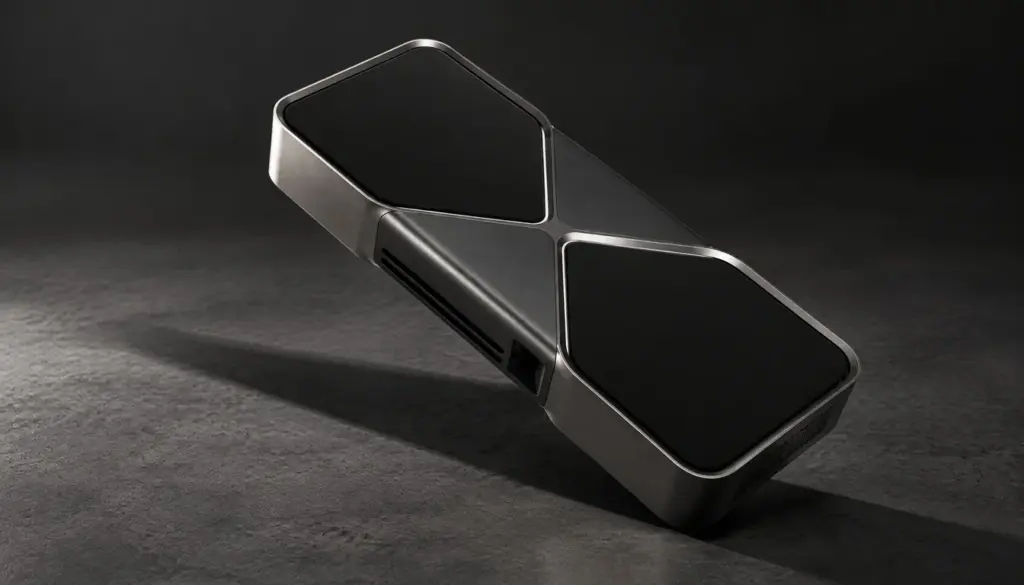
Nvidia has pushed back on a wave of reports claiming the GeForce RTX 5090 is being phased out, telling Taiwanese media this week that the flagship card is still in production even as component shortages squeeze how many units reach store shelves. The comments, delivered by Nvidia Senior Vice President Jeff Fisher during an interview in Taipei on October 16, 2026, land after weeks of speculation that the $1,999 GPU was quietly headed for end-of-life status.
Outlets including Dexerto, VideoCardz, and Hungary’s news.lavx.hu picked up Fisher’s remarks on October 17 and October 18, turning a long-simmering rumor into one of the week’s most-discussed hardware stories. The denial does not erase the underlying problem: finding an RTX 5090 at its official $1,999 suggested price remains, by most accounts, close to impossible.

Don't miss new tech stories on Google
Add Shattered once in the Google app and our stories show up in your news suggestions.
Nvidia Breaks Its Silence on RTX 5090 Discontinuation Rumors
The discontinuation chatter had been building for months, fed partly by Nvidia’s own supply decisions. Fisher’s comments were the company’s most direct response yet, and they followed a consistent pattern other Nvidia executives have used all year: acknowledge the shortage, deny the shutdown. According to the reports, Fisher did not dispute that RTX 5090 cards have become scarce and expensive on the secondary market. What he disputed was the idea that Nvidia had made a deliberate decision to stop making the chip altogether.
That distinction matters to buyers trying to decide whether to keep hunting for a card or pivot to something else. A true discontinuation would mean existing retail stock is the last stock, full stop. A supply constraint, by contrast, implies more units are coming, just slower and in smaller batches than demand calls for. Nvidia’s position, as relayed by Fisher, falls firmly into the second category: shipments continue, but production capacity cannot keep pace with orders.
Guru3D, one of the outlets tracking the story, noted that the RTX 5090 remained listed on Nvidia’s GeForce 50-series product page even as the card stayed unavailable for direct purchase through Nvidia’s own store, a detail that fed the discontinuation narrative in the first place. A product page that lists a card nobody can buy looks a lot like end-of-life staging, even when the company insists otherwise.
What Jeff Fisher Actually Said in Taipei
Fisher, who leads Nvidia’s personal computing business, gave two statements that outlets have treated as the clearest on-record pushback against the discontinuation claims. The first addressed the supply side directly: “The supply chain is indeed a bit constrained, but Nvidia is going all out to get products to market,” Fisher said, according to Dexerto’s report on the Taipei interview.
The second statement tackled the discontinuation question head-on. “Although the RTX 5090 has other variants, it has definitely not been discontinued. NVIDIA will continue shipping, and this is very important,” Fisher said, per the same wccftech report. Taken together, the two lines form Nvidia’s full position: yes, the chip is hard to make right now, but no, the company has not pulled the plug.
The reference to “other variants” is notable on its own. Nvidia has shipped a growing family of GB202-based products beyond the consumer RTX 5090, including workstation and data-center cards that draw on the same silicon. Fisher’s phrasing suggests Nvidia is managing allocation of a limited GB202 die supply across multiple product lines rather than winding any single one down, though Nvidia has not disclosed exact production splits between consumer and professional variants.
Shattered.io’s earlier coverage of Nvidia shifting GB202 chips toward the RTX Pro line traced this same tension weeks before Fisher’s Taipei comments, and a follow-up analysis of the economics behind that shift argued that professional-grade GB202 parts simply generate more revenue per wafer than gaming cards. If that reporting holds up, Fisher’s acknowledgment of constrained capacity may be less about manufacturing limits and more about where Nvidia chooses to point the chips it does make.
The $1,999 Price Tag Nobody Can Find
The gap between Nvidia’s suggested retail price and what shoppers actually pay is where the discontinuation story gets its teeth. Guru3D reported that the $1,999 figure remains listed on Nvidia’s own GeForce 50-series page, yet the card was not available for purchase through Nvidia’s direct store at the time of its report. That leaves buyers dependent on partner cards from board makers and retail channels, where availability has been inconsistent for much of the RTX 5090’s life on the market.
Shattered.io has tracked this gap before. An earlier report on the card vanishing from US retail shelves documented secondary-market listings climbing well past $9,500, a figure that underscores just how far street prices have drifted from the official MSRP. When a flagship GPU trades at roughly five times its launch price, rumors of discontinuation tend to spread regardless of what the manufacturer says in a press interview.
Nvidia has also layered additional friction onto RTX 5090 purchases this year. A prior report detailed a five-point export pledge Nvidia now asks RTX 5090 buyers to sign, a measure tied to concerns about cards being diverted to markets facing export restrictions. None of that directly explains the discontinuation rumors, but it adds to a picture of a product being treated as unusually sensitive, both for its AI-adjacent compute capability and for its scarcity.
Why the Discontinuation Rumors Started
Discontinuation rumors rarely come from nowhere. In the RTX 5090’s case, three threads appear to have converged. First, the card’s near-total absence from retail shelves for extended stretches created the visual impression of a product being wound down rather than merely rationed. Second, reports throughout the year pointed to Nvidia reallocating GB202 die output toward higher-margin RTX Pro and data-center parts, a shift shattered.io covered when it reported on the $1,999 chip reportedly shifting toward Pro GPUs. Third, earlier speculation specifically framed the RTX 5090 as heading toward replacement, a narrative shattered.io examined in a piece on the card being reportedly dead as the RTX 5080 gained a 24GB variant.
None of those three threads, on their own, proves discontinuation. But stacked together, they gave the rumor enough momentum that Nvidia apparently felt the need to respond directly through Fisher rather than let the story run unchallenged. That is itself informative: companies with genuinely dead products rarely bother with public denials. Companies managing a strained but still-active supply chain, on the other hand, have a clear incentive to correct the record before retailers and partners start making inventory decisions based on a false premise.
Supply Chain Constraints: What’s Really Happening
Fisher’s acknowledgment that “the supply chain is indeed a bit constrained” is the most concrete admission Nvidia has made about the RTX 5090’s availability problems. What he did not do, according to the available reporting, is specify shipment volumes, a restocking timeline, or how future wafer allocation between consumer and professional GB202 parts will be split. Those details remain undisclosed, and any number circulating online for RTX 5090 unit volumes should be treated as unverified until Nvidia or a credible financial disclosure confirms it.
What can be said with confidence is that the constraint sits somewhere in the chain between wafer production and finished-card assembly, not in demand. Nvidia has no shortage of buyers for a card that doubles as a capable entry point for local AI workloads alongside gaming. The scarcity is a manufacturing and allocation story, and Fisher’s comments confirm that Nvidia itself frames it that way rather than disputing that a shortage exists at all.
This is not a new pattern for Nvidia’s high end. The company’s memory supply has also tightened across its lineup this year, a trend shattered.io covered in a report on how a broader memory chip shortage has pushed PC prices up 17%. GDDR7, the memory type used on RTX 50-series cards including the 5090, sits inside that same squeezed supply chain, giving Nvidia two separate bottlenecks, logic die and memory, that can each independently throttle how many finished cards reach the market in a given month.
Market Impact: What This Means for Buyers Right Now
For anyone currently shopping for a flagship GPU, Nvidia’s statement changes the calculation only at the margins. The card has not been declared dead, so holding out for restocks remains a rational strategy rather than a wait for a ghost. But “going all out to get products to market,” in Fisher’s words, is a far cry from a promise of near-term normal availability. Buyers should expect the current pattern, limited drops, quick sellouts, inflated reseller prices, to persist rather than resolve on any specific date, since Nvidia disclosed no restocking schedule.
Retailers and board partners face a related calculation. If GB202 die allocation continues tilting toward RTX Pro and data-center SKUs, as earlier shattered.io reporting suggested, partners may receive smaller RTX 5090 shipments even while demand stays high, reinforcing exactly the scarcity that fueled the discontinuation rumor in the first place. Nvidia’s denial addresses the labeling of the problem without necessarily changing its shape.
The ripple effect extends to the rest of the RTX 50-series stack. Cards like the RTX 5080 and RTX 5070 Ti become more attractive by default when the 5090 is scarce, a dynamic that shapes how shattered.io’s own comparison of the RTX 5070 against AMD’s RX 9070 XT gets read by shoppers weighing a step down from the flagship. Anyone installing a new card from scratch can also follow shattered.io’s step-by-step RTX 5080 upgrade guide as a practical alternative while 5090 stock stays tight.
Historical Context: A Flagship’s Rocky First Year
The RTX 5090 launched as Nvidia’s Blackwell-generation flagship with a $1,999 suggested price, positioning it well above the prior-generation RTX 4090 and squarely as a halo product for gamers and AI hobbyists willing to pay a premium. Flagship GPU launches have followed a predictable arc for several Nvidia generations now: strong initial reviews, thin launch-day stock, months of inflated street pricing, and eventually a settling closer to MSRP as production ramps.
The RTX 5090 broke from that pattern by never settling. Instead of prices easing toward $1,999 over time, reports tracked by shattered.io showed the opposite trajectory, with secondary-market prices climbing rather than falling well into the card’s second year on the market. That inversion, scarcity worsening rather than improving with time, is unusual enough on its own to explain why discontinuation became the leading theory once availability failed to improve through 2026.
Industry watchers have pointed to a structural shift behind that inversion: GPU dies once reserved almost exclusively for consumer gaming cards are now competing internally for wafer capacity against AI and workstation products that carry far higher margins per chip. The RTX 5090, built on the same GB202 silicon as Nvidia’s professional RTX Pro cards, sits directly in the crossfire of that internal competition, making it a useful bellwether for how Nvidia balances gaming demand against the far more lucrative AI compute market.
Nvidia GeForce RTX 50-Series Desktop Lineup
| Model | Launch MSRP | Positioning | Current Status (per Nvidia, Oct. 2026) |
|---|---|---|---|
| GeForce RTX 5090 | $1,999 | Flagship, GB202 die | Shipping; supply constrained per Jeff Fisher |
| GeForce RTX 5080 | $999 | High-end | Shipping |
| GeForce RTX 5070 Ti | $749 | Upper mid-range | Shipping |
| GeForce RTX 5070 | $549 | Mid-range | Shipping |
| GeForce RTX 5060 Ti | $429 | Mainstream | Shipping |
The table reflects official launch suggested retail pricing for the RTX 50-series stack. Street pricing, particularly for the RTX 5090, has diverged sharply from these figures according to multiple outlets tracking secondary-market listings, though exact current street prices vary by region and retailer and were not independently re-verified for this report.
Timeline: How the Discontinuation Story Unfolded
| Date | Event | Source |
|---|---|---|
| October 16, 2026 | Jeff Fisher interviewed by Taiwanese media in Taipei, addresses RTX 5090 discontinuation claims | Dexerto, VideoCardz |
| October 17, 2026 | First English-language reports on Fisher’s comments published | VideoCardz, Dexerto, wccftech |
| October 17-18, 2026 | Story picked up by additional outlets confirming the denial and supply constraints | Guru3D, back2gaming, arynews.tv, gagadget |
| October 18, 2026 | Reports note RTX 5090 still listed on Nvidia’s GeForce 50-series page at $1,999 but unavailable via Nvidia’s direct store | Guru3D |
Competitive Landscape: AMD and Intel’s Opening
Every stretch of RTX 5090 scarcity is, by definition, an opening for AMD and Intel at the high end of the discrete GPU market, even though neither company fields a direct flagship competitor to the 5090 itself. AMD’s RX 9070 XT has instead positioned itself against Nvidia’s mid-range Blackwell cards, a matchup shattered.io broke down in its comparison of the RTX 5070 against the RX 9070 XT, where AMD’s card came out ahead on price-to-performance in several benchmarks.
The absence of a true AMD or Intel rival at the $2,000-plus flagship tier means RTX 5090 scarcity does not translate into lost sales for competitors the way shortages at lower price points might. Buyers priced out of, or unable to find, an RTX 5090 are more likely to step down to a 5080 or 5070 Ti within Nvidia’s own lineup than to jump to a different brand entirely, since no AMD or Intel card currently targets that exact performance bracket. That dynamic likely reduces the competitive pressure on Nvidia to resolve the shortage quickly.
Industry Reaction to Nvidia’s Denial
Coverage of Fisher’s comments has largely treated the denial as technically accurate but incomplete. VideoCardz’s framing of the story, titled around the idea that the card “is not discontinued, but good luck finding one for $1,999,” captures the skepticism running through most of the reporting: nobody disputes Nvidia’s literal claim that production continues, but few outlets are treating that claim as evidence that the shortage is close to ending.
Reaction site Back2Gaming framed the episode similarly, emphasizing that Nvidia’s denial confirms shipments continue without promising any specific fix to availability. That skepticism is reinforced by Fisher’s own word choice. “The supply chain is indeed a bit constrained, but Nvidia is going all out to get products to market,” he said, according to Dexerto’s report, language that commits Nvidia to continued effort without committing to any specific improvement in availability. Readers and outlets alike have noted that this kind of statement can remain true indefinitely regardless of whether the shortage improves, worsens, or simply stays flat for months.
Predictions: Where RTX 5090 Supply Goes From Here
- Nvidia is unlikely to formally discontinue the RTX 5090 in the near term, since Fisher’s statement sets a clear public record that would be awkward to reverse within weeks.
- Street prices will likely stay well above the $1,999 MSRP through at least the end of 2026, barring a disclosed increase in GB202 wafer allocation toward consumer cards.
- Nvidia will probably face similar discontinuation rumors again for other high-demand SKUs if GB202-based professional products continue absorbing a larger share of available die supply.
- Board partners may introduce more limited, higher-margin RTX 5090 variants rather than ramping standard-configuration volume, mirroring strategies already seen elsewhere in the RTX 50-series.
- Expect Nvidia to avoid disclosing specific shipment or allocation numbers for the RTX 5090 at least through its next earnings cycle, consistent with its pattern of acknowledging constraints without quantifying them.
What Buyers and Builders Should Do Now
Given Nvidia’s confirmation that shipments continue, the most practical move for anyone set on an RTX 5090 is to keep monitoring retailer restocks rather than assume the window has closed. Setting up stock alerts, checking board-partner sites directly, and avoiding resale-market purchases at multiples of MSRP remain the standard advice until availability measurably improves.
For builders who need a high-end GPU on a working timeline rather than an open-ended wait, dropping to the RTX 5080 or RTX 5070 Ti tier, both of which remain in regular supply, is the more realistic path. Shattered.io’s guide to installing an RTX 5080 upgrade walks through that process for anyone making the switch from an older card.
Frequently Asked Questions
Has Nvidia officially discontinued the RTX 5090?
No. Nvidia Senior Vice President Jeff Fisher told Taiwanese media on October 16, 2026, that the card has not been discontinued and that Nvidia will continue shipping it, according to reports from Dexerto and VideoCardz.
Why did people think the RTX 5090 was being discontinued?
Persistent retail scarcity, inflated secondary-market prices, and earlier reports about Nvidia shifting GB202 die production toward RTX Pro and data-center cards combined to fuel the rumor over several months.
What is the official price of the RTX 5090?
Nvidia lists the RTX 5090 at $1,999 on its GeForce 50-series product page, according to Guru3D. The card was reportedly not available for direct purchase through Nvidia’s own store at that price.
Did Nvidia explain why the RTX 5090 is hard to find?
Fisher acknowledged that supply chain production capacity is constrained but did not disclose specific shipment volumes, a restocking date, or future production allocation details, according to the available reporting.
Is the RTX 5090 shortage related to AI demand?
Reports have linked RTX 5090 scarcity to Nvidia reallocating shared GB202 die capacity toward higher-margin RTX Pro and AI-adjacent products, though Nvidia has not officially confirmed specific allocation figures.
Should I wait for an RTX 5090 or buy something else now?
Since Nvidia confirms shipments are ongoing, waiting remains a viable option, but with no disclosed restocking timeline. Buyers who need a GPU on a shorter timeline may find the RTX 5080 or RTX 5070 Ti more realistically available.
Are other RTX 50-series cards also affected by shortages?
Broader memory supply constraints have pushed PC component prices higher across the board in 2026, though the RTX 5090 has faced the most acute and prolonged scarcity within Nvidia’s current desktop GPU lineup.
Who confirmed Nvidia’s statement on the RTX 5090?
The statement was reported by multiple outlets, including Dexerto, VideoCardz, TechPowerUp, Guru3D, wccftech, and news.lavx.hu, all citing Jeff Fisher’s October 16, 2026 interview in Taipei.